Yes, contractors should use Google Ads. Start with Local Services Ads (LSAs) for urgent, same-day calls and a Search campaign for planned project work. Those two channels together cover the full range of how homeowners actually look for you.
Your first move:
- Claim and verify your LSA profile on Google if you haven’t already. It takes about 20 minutes and puts you at the very top of results with a Google Guaranteed badge.
- Build one Search campaign with 5–10 high-intent keywords like “licensed electrician Denver” or “roof replacement quote near me.”
- Set a modest test budget for a single-service business and run it for a couple of months before drawing conclusions.
That’s the short version. The rest of this guide shows you exactly how to do each step, what to expect, and when to call in help.
Table of Contents
- How do Google Ads actually work for contractors?
- Why Google Ads works especially well for contractors
- How do you set up a contractor Search campaign step by step?
- How do you optimize campaigns and measure real ROI?
- What does Google Ads actually cost for contractors?
- What mistakes do contractors make with Google Ads?
- When should you hire a Google Ads agency?
- Key Takeaways
- The part most contractors overlook
- Denvercountywebdesign helps contractors run ads that actually book jobs
- Useful sources
- FAQ
How do Google Ads actually work for contractors?
Google offers four ad types that matter for home service businesses. Each one appears in a different spot on the page and charges you differently.

Local Services Ads (LSAs)
LSAs appear at the very top of search results, above everything else, including regular Search Ads. They show your business name, rating, phone number, and a Google Guaranteed or Google Verified badge. You pay per lead, not per click, and Google handles most of the targeting automatically. LSAs work best for urgent, high-intent searches: “plumber near me,” “emergency HVAC repair,” “electrician open now.”

Pay-per-lead pricing typically runs a moderate amount for standard services and can be higher for emergency calls or high-value trades in competitive markets.
Search Ads
Search Ads appear just below LSAs. You control the keywords, ad copy, bids, and the landing page people reach after clicking. You pay per click, not per lead. This format is better for planned work: “kitchen remodel contractor Denver,” “new roof estimate,” “deck builder near me.” Because you control the landing page, you can qualify leads more precisely and capture job details upfront.
Performance Max, Display, and Remarketing
Start with LSAs and Search, then add Performance Max once Search is consistently profitable and you have budget to scale. Performance Max runs across all Google channels (Search, Maps, YouTube, Gmail, Display) using automated targeting. Display and remarketing campaigns keep your brand visible to people who visited your site but didn’t call, which is useful for higher-ticket projects where homeowners shop around for weeks.

Call-only campaigns are worth running alongside Search for mobile users. They skip the landing page entirely and dial your number directly from the ad.
LSA vs. Search Ads at a glance
| Feature | Local Services Ads | Search Ads |
|---|---|---|
| Page position | Top of results (above Search Ads) | Below LSAs |
| Pricing model | Pay per lead | Pay per click |
| Keyword control | Automatic (Google-managed) | Full control |
| Landing page | Google-hosted profile | Your own page |
| Best for | Urgent/emergency intent | Planned projects |
| Trust signal | Google Guaranteed badge | Ad extensions |
Pro Tip: Build separate campaigns for emergency intent and planned-project intent from day one. Emergency keywords like “burst pipe repair” need 24/7 scheduling and higher bids. Planned-project keywords like “bathroom remodel estimate” can run during business hours with a softer bid strategy. Mixing them in one campaign muddies your data and wastes budget.
Why Google Ads works especially well for contractors
The timing advantage is real. When someone searches “water heater replacement near me,” they’re not browsing. They need help today, and they’re ready to call whoever shows up first. Google Ads puts you in front of that person at exactly that moment.
A few specific advantages for contractors:
- Geographic precision. You can target by zip code, city, or a radius around your shop. Set location targeting to “presence only” so your ads only show to people physically in your service area, not people searching about it from across the country.
- Schedule-based bidding. Run ads only during the hours you answer the phone. Bid higher on weekday mornings when emergency calls spike. Pause ads on days you’re fully booked.
- Measurable cost per lead. If your average job is worth $2,500 and you close 1 in 4 leads, you can afford to pay up to $625 per lead and still profit. Many contractors pay less than that, which can make the investment worthwhile.
- Ad extensions build trust fast. Call extensions, location extensions, and structured snippets increase your ad’s size on the page and give searchers a direct way to call or see your service area before they even click.
For trust-sensitive customers comparing three contractors, seeing your Google rating, license badge, and a “Call now” button in the ad itself often tips the decision before they visit your site.
How do you set up a contractor Search campaign step by step?
Step 1: Set your campaign objective and account structure
Choose “Leads” as your campaign objective. Create separate campaigns for each intent type:
- Emergency/urgent (24/7 scheduling, higher bids, call-only or call-extension-heavy ads)
- Planned installs or replacements (business hours, landing page focused, longer keyword phrases)
- Maintenance or seasonal (targeted by season, lower bids, awareness-oriented copy)
This structure keeps your budgets and data clean. You’ll know exactly which campaign is generating calls and at what cost.
Step 2: Build your keyword list
Use Google Keyword Planner to find search volume and bid estimates for your trade and market. Focus on three keyword types:
- High-intent service + location: “licensed plumber Aurora CO,” “roof repair Denver”
- Emergency intent: “emergency electrician near me,” “AC not working same day”
- Project/install intent: “new HVAC system cost Denver,” “kitchen remodel contractor estimate”
Use phrase match and exact match for most keywords. Broad match burns budget fast on irrelevant searches. Add a negative keyword list from day one: “DIY,” “how to,” “tutorial,” “jobs,” “careers,” “free,” “cheap,” and competitor brand names you don’t want to pay for.
Step 3: Write your ad copy
Each ad needs three headlines and two descriptions. A simple template:
- Headline 1: Service + city (“Denver Plumber | Licensed & Insured”)
- Headline 2: Urgency or differentiator (for example, highlighting same-day service availability)
- Headline 3: Call to action (“Call for a Free Estimate”)
- Description 1: Specific service plus trust signal (e.g., emphasizing emergency repairs, accreditations, and customer reviews)
- Description 2: Qualifier plus call to action (for example, highlighting years of service and inviting calls or quote requests)
Add these extensions to every campaign: call extensions, location extensions, callout extensions (“Licensed & Insured,” “Free Estimates,” “24/7 Emergency Service”), and structured snippets listing your services.
Step 4: Build a landing page that converts
Contractor landing pages that actually generate calls follow a consistent pattern:
- Phone number large and clickable at the top of every page, especially on mobile
- One or two trust signals above the fold: Google rating, license number, years in business
- A short lead form (name, phone, service needed, timeline) that filters out tire-kickers
- A single, clear call to action (“Get Your Free Estimate”)
- No navigation menu pulling people away from the form
Pair each campaign with a dedicated landing page. Sending all your ad traffic to your homepage is one of the most common ways contractors waste their budget.
Step 5: Set up conversion tracking
This is non-negotiable. Without tracking, you’re flying blind.
Conversion tracking checklist:
- [ ] Install Google Ads conversion tag on your “thank you” page (post-form submission)
- [ ] Set up call tracking through Google Ads call extensions (tracks calls from the ad itself)
- [ ] Add a Google forwarding number to your landing page to track calls from the site
- [ ] Import offline conversions from your CRM to tell Google which leads became booked jobs
- [ ] Verify all conversions are firing in Google Ads before spending real budget
Step 6: Launch checklist
Before going live, confirm:
- [ ] Campaigns separated by intent type
- [ ] Negative keyword list applied to all campaigns
- [ ] Location targeting set to “presence only”
- [ ] Ad schedule matches your available hours
- [ ] At least 3 ad variations per ad group
- [ ] All extensions active
- [ ] Conversion tracking verified
- [ ] LSA profile claimed and verified in parallel
How do you optimize campaigns and measure real ROI?
Optimization isn’t a one-time task. It’s a weekly habit that compounds over time.
Weekly checklist:
- Review the Search Terms report and add irrelevant queries as negatives
- Check impression share; if it’s below 60% on your top keywords, consider a bid increase
- Pause ads with low CTR (under 3% for Search) after 100+ impressions
- Monitor cost per lead against your target CPL
Monthly checklist:
- Run A/B tests on headlines (test urgency vs. trust vs. price transparency)
- Compare landing page conversion rates across campaigns
- Adjust bids by hour-of-day and day-of-week based on conversion data
- Review Quality Scores; a score below 6 signals a mismatch between keyword, ad, and landing page
A/B testing priorities
Test one variable at a time. Start with headlines, since they drive the most CTR variance. Then test your CTA (“Call Now” vs. “Get a Free Estimate” vs. “Request a Quote”). After that, test landing page layouts: phone number at top vs. form at top, short form vs. long form.
Pro Tip: Import your CRM data as offline conversions. This tells Google which clicks turned into booked jobs, not just form fills. Once you have 30+ offline conversions imported, switch your bid strategy to Target CPA or Target ROAS and let Google optimize toward actual revenue rather than raw lead volume.
Reporting template
| Metric | What to track | Why it matters |
|---|---|---|
| Impressions | Weekly total by campaign | Visibility baseline |
| CTR | By ad group | Ad copy effectiveness |
| CPC | By keyword | Budget efficiency |
| Conversion rate | By landing page | Page quality signal |
| Cost per lead | Total spend ÷ conversions | Core ROI metric |
| Booked job rate | Leads → booked jobs | True lead quality |
| Revenue per lead | Job revenue ÷ leads | Ties spend to profit |
What does Google Ads actually cost for contractors?
Budget is the question every contractor asks first. The honest answer: it depends on your trade, your market, and how competitive your area is.
Typical CPC and CPL ranges by trade
| Trade | Emergency CPC range | Planned-project CPC range | LSA cost per lead |
|---|---|---|---|
| Plumbing | $35–$75 | — | $15–$100+ |
| HVAC | $25–$60 | — | $15–$100+ |
| Electrical | $30–$70 | — | $15–$100+ |
| Roofing | $20–$50 | — | $15–$100+ |
| General contracting | — | — | $15–$100+ |
CPC ranges reflect emergency keyword bid pressure in competitive U.S. metros. LSA cost per lead varies significantly by trade and urgency: $15–50 for standard services, $40–100+ for emergencies. Smaller markets run lower.
Sample monthly budget scenarios
- Single-service, smaller market: A modest monthly budget can generate enough data to optimize and produce a reasonable number of leads depending on trade and cost per lead.
- Multi-service or mid-size metro: A moderate monthly budget may cover multiple campaigns with room to test.
- Competitive metro, multiple trades: A higher budget is often realistic for businesses targeting several competitive urban markets and multiple services.
How to calculate your target CPL
Work backward from your job value:
- Average job revenue is calculated
- Close rate on leads can vary
- Revenue per lead is derived from job revenue and close rate
- Target cost per lead should consider gross margin and profitability benchmarks
If your actual CPL is well below that ceiling, you have room to scale. If it’s above it, something in your funnel needs fixing before you increase spend.
Timeline note: Run your test budget for at least 60–90 days before making major strategic changes. Google’s algorithm needs roughly 30–50 conversions per campaign to optimize effectively. Cutting a campaign after two weeks of data is one of the most common ways contractors give up too early.
What mistakes do contractors make with Google Ads?
Most wasted ad spend comes from a short list of fixable errors.
- No negative keywords. Without them, your plumbing ad shows for “plumbing jobs hiring” and “DIY pipe repair.” Add negatives before you spend a dollar.
- Broad match on everything. Broad match keywords cast too wide a net. Start with phrase and exact match, then expand carefully once you have data.
- Sending traffic to the homepage. Your homepage is for browsers. Your ad traffic needs a focused landing page with one job to do: generate a call or form fill.
- Not tracking phone calls. Most contractor leads come by phone. If you’re not tracking calls, you’re missing the majority of your conversions and your data is useless.
- Wrong location settings. Google defaults to “presence or interest,” which shows your ads to people searching about your area from anywhere. Switch to “presence only.”
- Running ads when you can’t answer the phone. Paying for clicks at 11 PM when no one picks up is pure waste. Set your ad schedule to match your actual availability.
Pro Tip: The fastest wins usually come from three low-cost fixes: adding 20–30 negatives from your Search Terms report, switching one broad-match keyword to phrase match, and adding a click-to-call button above the fold on your landing page. Run those changes for two weeks and compare your CPL before and after.
Quick troubleshooting checklist
- High CPL but good CTR? Your landing page isn’t converting. Check the form, the phone number placement, and your trust signals.
- Low CTR? Your ad copy isn’t compelling or your keywords don’t match what people are searching.
- Lots of clicks, zero conversions? Conversion tracking may be broken. Verify your tags.
- Leads coming in but not booking? The issue is in your follow-up process, not your ads.
When should you hire a Google Ads agency?
DIY Google Ads can work well for contractors who have time to learn the platform and check in weekly. But there are clear signals that it’s time to bring in help.
Hire a specialist when:
- You’ve run campaigns for 90 days with consistent negative ROI and can’t identify why
- You don’t have time to check the Search Terms report weekly or run A/B tests
- You need a landing page built alongside the campaign (most contractors do)
- You want CRM integration and offline conversion imports but lack the technical setup
- Your competitor is consistently outranking you and you can’t figure out their advantage
What a good agency actually delivers
A specialized agency doesn’t just manage bids. They should provide a full account audit, a structured campaign build with proper intent segmentation, LSA verification support, a dedicated landing page, CRM integration, and offline conversion imports. Monthly reporting should tie spend directly to booked jobs, not just leads.
Agency-managed campaigns that combine ad management with landing page builds and CRM integration optimize for job value rather than raw lead count, which is what actually grows a contracting business.
DIY vs. managed: what to expect
| Factor | DIY | Agency-managed |
|---|---|---|
| Time investment | 5–10 hours/week | Minimal (review calls only) |
| Setup quality | Varies with experience | Structured, audited build |
| Landing page | Usually existing site | Purpose-built for conversion |
| Conversion tracking | Often incomplete | Full tracking + CRM import |
| Optimization speed | Slow (learning curve) | Faster (experience + data) |
| Monthly cost | Ad spend only | Ad spend + management fee |
| Best for | Tech-savvy, time-rich owners | Busy owners focused on jobs |
Red flags when evaluating agencies: no mention of landing pages, no offline conversion tracking, vague reporting (“we increased impressions”), and no clear explanation of how they segment campaigns by intent.
Key Takeaways
Google Ads for contractors works best when LSAs capture urgent leads, Search Ads target planned projects, and every campaign is backed by conversion tracking tied to real job revenue.
| Point | Details |
|---|---|
| Start with LSAs + Search | LSAs capture emergency leads; Search Ads cover planned projects. Run both from day one. |
| Budget realistically | Single-service contractors need $1,500–$3,000/month; competitive metros or multi-service businesses often need $5,000–$15,000. |
| Track calls and forms | Conversion tracking is non-negotiable. Without it, you can’t optimize for actual job value. |
| Fix mistakes first | Negative keywords, location settings, and a dedicated landing page prevent most wasted spend. |
| Denvercountywebdesign | Offers bundled Google Ads setup, landing page builds, and local SEO for contractors in Colorado. |
The part most contractors overlook
There’s a gap between running Google Ads and running them well. Most contractors who “tried Google Ads and it didn’t work” made one of two mistakes: they sent traffic to a homepage that wasn’t built to convert, or they stopped after six weeks without enough data to draw any real conclusion.
The platform rewards patience and structure. A campaign with proper intent segmentation, a phone-first landing page, and 90 days of conversion data will almost always outperform a hastily built campaign that someone abandoned after a slow first month. The contractors who win with paid search treat it like a job site: they show up consistently, check the work, and fix what isn’t performing.
The other thing worth saying plainly: Google Ads and local SEO are not either/or. Ads give you immediate visibility while your organic rankings build. Once your Google Business Profile and site are pulling organic leads, your ad spend can drop or shift toward higher-value jobs. The two channels compound each other when they’re built on the same foundation.
Denvercountywebdesign helps contractors run ads that actually book jobs
Running Google Ads without a converting landing page is like sending a crew to a job site without tools. The budget goes out, but the work doesn’t get done.
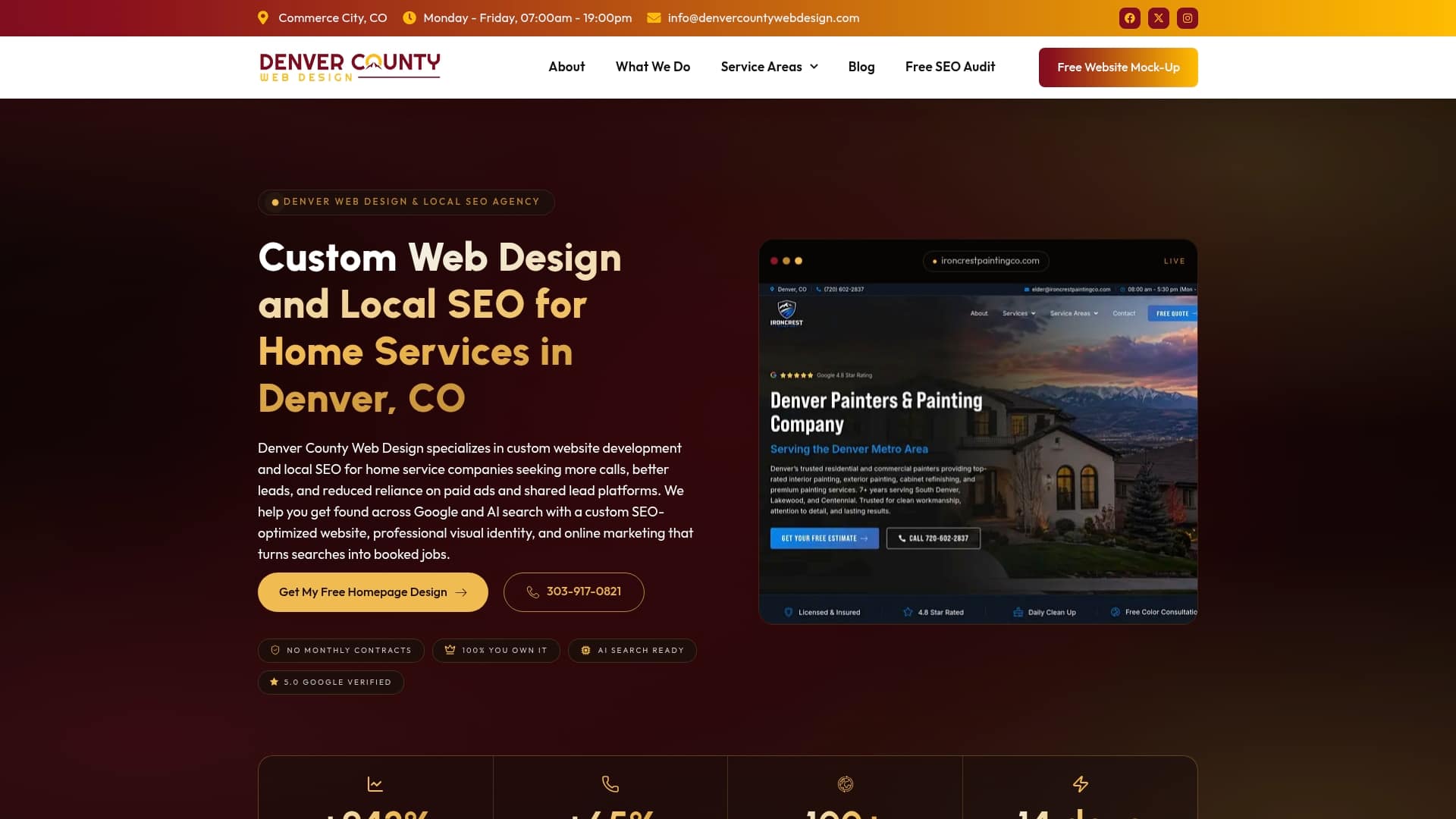
Denvercountywebdesign builds the full setup for contractors in Colorado: a purpose-built landing page, Google Ads campaign structure, conversion tracking, and local SEO cleanup, all in one package with no monthly retainer for the site itself. You own everything. The agency handles the technical build so you can focus on running your business.
Ready to see what’s holding your current visibility back? Start with a free map-pack audit to find out where you stand in local search, then talk through whether a full Ads + landing page setup makes sense for your trade and market. Visit Denvercountywebdesign or request your audit online to get started.
Useful sources
These are the primary references used throughout this guide. Each one is worth bookmarking for your own research.
- Google Local Services Ads — Official Google page for setting up and managing LSAs. Start here to claim your profile and understand the Google Guaranteed verification process.
- Google Ads for Home Services (Benly) — Covers LSA vs. Search Ad mechanics, pay-per-lead pricing ranges, and emergency keyword bid strategy. Referenced in the ad types and budgeting sections.
- HVAC, Plumbing and Roofing PPC Playbook (Groas) — Detailed guidance on campaign sequencing (LSA first, then Search, then Performance Max) and starter budget ranges. Used in the setup and budgeting sections.
- Google Ads for Contractors (ServiceTitan) — Landing page best practices for contractors: phone-first design, trust signals, and qualifying lead forms. Referenced in the campaign setup section.
- Home Services Google Ads (ServiceTitan) — Ad extensions and offline conversion tracking guidance. Used in the setup and optimization sections.
- PPC Advertising for Contractors (Buildertrend) — Keyword Planner usage, long-tail keyword strategy, and location targeting settings. Referenced in the keyword strategy section.
- Complete Guide to Google Ads for Contractors (BuildBook) — Broad overview of contractor-specific campaign structure and ad copy approaches.
FAQ
What is the difference between LSAs and Search Ads for contractors?
LSAs appear above Search Ads, charge per lead rather than per click, and carry a Google Guaranteed badge. Search Ads give you full control over keywords, copy, and landing pages, making them better for planned project work.
How much should a contractor spend on Google Ads per month?
A single-service contractor can start with a monthly budget of $1,500–$3,000, while competitive metro markets or multi-service businesses generally require $5,000–$15,000 to generate enough leads for meaningful optimization.
How long before Google Ads starts generating leads for a contractor?
LSAs can generate calls within days of verification. Search campaigns typically need 60–90 days and at least 30–50 conversions before the data is reliable enough to optimize bids and strategy.
What is the most common reason contractor Google Ads campaigns fail?
Sending ad traffic to a homepage instead of a dedicated landing page, skipping conversion tracking, and using no negative keywords are the three most frequent causes of wasted spend.
Can Denvercountywebdesign set up Google Ads for my contracting business?
Yes. Denvercountywebdesign builds bundled packages for Colorado contractors that include campaign setup, a purpose-built landing page, conversion tracking, and local SEO, with no ongoing monthly fee for the website itself.