TL;DR:
- Roofing SEO focuses on ranking your business where buyers search and generating verified, high-quality leads. It emphasizes optimizing Google Business Profile, local service pages, and call tracking, with results typically measurable within 30 to 90 days for initial improvements. The key to success lies in verifying leads, maintaining review velocity, and creating tailored, location-specific content to build a lasting online presence.
Roofer SEO is the local lead-generation system that makes your phone ring with verified, in-market customers. It combines Google Business Profile (GBP) visibility, intent-matched service pages, and reputation signals to put your business in front of homeowners who are ready to book, not just browse. If you want to act right now, here are three moves that matter most:
- Claim and optimize your Google Business Profile. Set your primary category to “Roofing Contractor,” add 10+ photos, and fill every service field. GBP is the single highest-leverage asset in local search, accounting for roughly 32% of local-pack ranking influence.
- Fix one high-intent service page. Pick your top service (“roof replacement” or “storm damage repair”), write a page with a city-specific title tag, clear H1, and a phone-number CTA above the fold.
- Enable call tracking. Install a dynamic number insertion tool before you spend another dollar on any marketing channel. You cannot measure cost per verified lead without it.
Local search behavior drives a disproportionate share of direct contacts for home services. Roofing is among the highest-intent categories in that group. Use Google Search Console to monitor which queries trigger impressions, and Google Analytics to confirm which pages convert those visitors into calls. If you want a done-for-you path, Denvercountywebdesign builds and manages exactly this system for contractors across Colorado.
Table of Contents
- What does roofer SEO actually do for your business?
- What your roofing website needs to rank and convert
- How to win the map pack with local SEO for roofers
- What keywords and content actually drive roofing leads
- How to get more reviews and use them to win more jobs
- Local link-building tactics that actually work for roofers
- How to measure SEO results, what it costs, and how long it takes
- How to choose the right SEO provider for your roofing business
- A real-world example of what roofing SEO delivers
- Key Takeaways
- What most roofers get wrong about SEO
- Denvercountywebdesign builds the local SEO system roofers need
- Useful sources and further reading
- FAQ
What does roofer SEO actually do for your business?
Roofing SEO performs two jobs at once: it ranks your business where buyers are looking, and it filters out tire-kickers so the leads you receive are worth answering. The map pack, the three local results that appear above organic listings, captures a large share of clicks on local queries. Organic listings below the map pack capture a second wave of searchers who scroll past the ads and want to compare options. A well-executed roofing SEO strategy covers both layers.
The business outcomes are concrete. Verified leads cost less than paid-search leads over a 12-month horizon because organic and map-pack traffic compounds. During storm surges, a roofer with strong local rankings captures emergency searches the moment hail hits, without paying per-click premiums. Replacement customers, who research for weeks before calling, find your content, read your reviews, and arrive pre-sold. Your close rate goes up because the lead quality is higher.
According to Elevarus, GBP signals account for roughly 32% of local-pack ranking influence, and the right way to measure roofing SEO is cost per verified lead, not raw rankings or sessions. That framing changes how you evaluate every tactic in this article.
KPIs worth tracking from day one:
- Verified calls by source (organic, GBP, paid)
- Cost per verified lead (total spend divided by confirmed booked calls)
- GBP views and click-to-call actions
- Organic impressions and clicks in Google Search Console
- Conversion rate from inspection to booked job
On timeline: expect early GBP movement and some inbound calls within 30–90 days of a focused campaign. Dominant local rankings typically require 6–12 months of consistent work. Paid ads deliver leads faster, but the moment you stop paying, the leads stop. SEO builds an asset that keeps working. Many roofing contractors run Google Ads alongside SEO during the first six months to bridge the gap while organic rankings develop.
What your roofing website needs to rank and convert
Your website is the foundation everything else rests on. A beautiful site that loads slowly or lacks service-specific pages will not rank, no matter how many citations you build. Here is what the technical and content structure needs to look like.
One page per service, one page per city
Every major service you offer needs its own dedicated page: roof replacement, roof repair, storm damage, commercial roofing, gutter installation. Each city or suburb you serve needs its own page too. A page titled “Roof Replacement in Aurora, CO” with unique content about Aurora neighborhoods, local weather patterns, and a project photo from that area will outrank a generic “Services” page every time.
Structure your URLs cleanly: /roof-replacement-aurora-co/ beats /services/?id=4. Your H1 should match the searcher’s query as closely as natural language allows. Put your phone number and a “Get a Free Estimate” button above the fold on every service page.
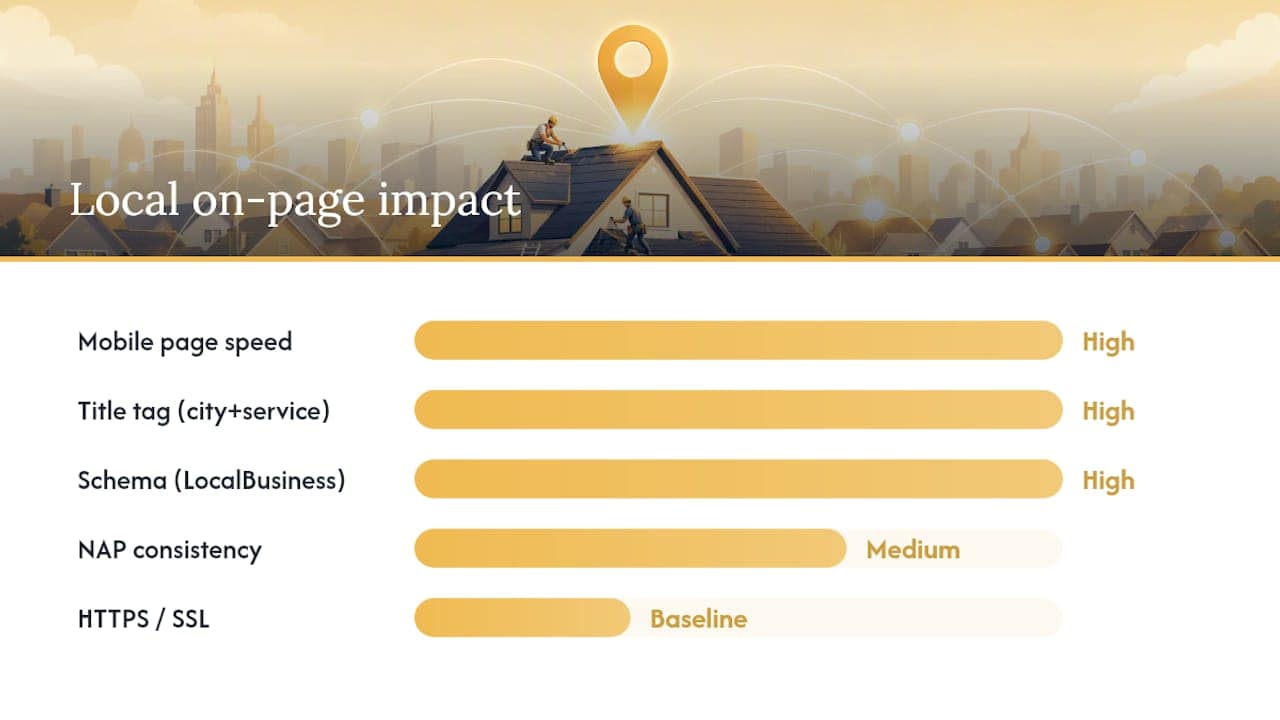
On-page elements and their local ranking impact
| On-Page Element | Local Ranking Impact | Notes |
|---|---|---|
| Title tag with city + service | High | Match the searcher’s exact query intent |
| GBP category alignment | High | Primary category must match page topic |
| Schema markup (LocalBusiness) | High | Required for rich results and AI extraction |
| Mobile page speed (Core Web Vitals) | High | Direct ranking factor |
| NAP consistency on page | Medium | Must match GBP exactly |
| Alt text on portfolio images | Medium | Include city and material type |
| Internal links to service pages | Medium | Distributes authority across the site |
| HTTPS / SSL | Baseline | Non-negotiable trust and ranking signal |
Pro Tip: Show a price range on your service pages rather than hiding costs entirely. A line like “Most Aurora roof replacements run $8,000–$18,000 depending on square footage and material” pre-qualifies callers and reduces wasted estimate appointments. Pair it with a financing callout to keep budget-sensitive visitors engaged.
For a practical look at what a Google-ready roofing website should include from a technical standpoint, that resource covers mobile optimization and on-site SEO readiness in detail.
How to win the map pack with local SEO for roofers
The map pack is where most roofing jobs start. When someone searches “roofer near me” or “roof repair Denver” on their phone, the three businesses in the map pack get the majority of clicks and calls. Getting there requires a coordinated approach across GBP, service-area pages, and citations.
Optimizing your Google Business Profile
Start with your primary category. Set it to “Roofing Contractor,” not “General Contractor” or “Home Improvement.” This single field carries more weight than most owners realize. From there, work through these priorities in order:
Photos: Upload at least 20 photos, including crew shots, completed jobs with recognizable local landmarks, and your truck with your logo visible. Add new photos every month. Google treats recent photo uploads as a freshness signal.
Services and attributes: Fill every service field Google offers. Add attributes like “Free estimates,” “Veteran-owned,” or “Family-owned” if they apply. These appear in your profile and filter searches.
Posts: Publish a GBP post at least twice a month. After a hailstorm, post immediately with something like “Serving [City] storm damage inspections this week, free assessment.” That timeliness captures emergency searches.
Q&A section: Seed your own Q&A with the questions customers actually ask: “Do you work with insurance adjusters?” “How long does a full replacement take?” Answer them yourself before a stranger does.
Review velocity: Review recency and volume materially affect local rankings. An active review program generating five or more new reviews per month typically outperforms a stale total of 200 reviews with nothing recent. Respond to every review, positive or negative, within 48 hours.
Service-area pages that actually rank
Each city page needs to feel written for that city, not copy-pasted with the name swapped. Include references to local neighborhoods, common roofing materials in that area, weather patterns (hail seasons, freeze-thaw cycles), and at least one project example from that location. Align the cities listed on your GBP service-area field with the pages on your site. Mismatches confuse Google and dilute your relevance signals.
One practical note: GBP service-area businesses (those without a public street address) rank well within their defined service area, but the physical address of your business still influences how far that radius extends. If you serve a 30-mile radius, your GBP address placement matters.
Citations and NAP consistency
Your business name, address, and phone number (NAP) must be identical across every directory listing. A single inconsistency, “St.” versus “Street,” or a missing suite number, can suppress your local rankings. Audit your citations on Google, Yelp, Angi, the Better Business Bureau, your local chamber of commerce, and any manufacturer dealer pages (GAF, Owens Corning, CertainTeed). Tools like DataPins automate citation management and surface recent project reviews on your location pages, which is a practical solution for contractors who do not have time to manage listings manually.
Pro Tip: Get listed on your roofing manufacturer’s dealer locator page. A GAF Master Elite or Owens Corning Preferred Contractor listing is both a citation and a trust signal. These pages rank well on their own and pass authority to your site.
Local SEO for roofing companies confirms that service-area pages with unique local content, GBP alignment, review velocity, and storm/insurance content are among the highest-ROI tactics for roofers.
What keywords and content actually drive roofing leads
Keyword research for roofers is not about chasing the highest search volume. It is about matching the right page to the right intent at the right moment in the buying cycle.
Keyword mapping by intent
| Intent Type | Example Keywords | Best Page Type |
|---|---|---|
| Emergency | “roof leak repair near me,” “emergency roofer [city]” | Service page with phone CTA above fold |
| Service + city | “roof replacement Denver CO,” “metal roofing Aurora” | Dedicated service-area page |
| Insurance / storm | “hail damage roof claim,” “does insurance cover roof replacement” | Insurance/storm content page |
| Material-specific | “asphalt shingle vs metal roof cost,” “TPO roofing commercial” | Comparison or product page |
| Informational / long-tail | “how long does a roof last,” “signs you need a new roof” | Blog post or FAQ page |
Prioritize local intent over national volume. “Roof replacement Denver CO” with 400 monthly searches is worth more to your business than “roofing materials” with 40,000, because the Denver searcher is ready to buy.
Content topics that convert roofing customers
These blog and FAQ topics funnel searchers directly to your service pages:
- “How to file a roof insurance claim in [State]” (links to your insurance page)
- “Average cost of roof replacement in [City] in 2026” (links to your replacement page)
- “What to do after a hailstorm: a homeowner’s checklist” (links to storm damage page)
- “How long does a roof replacement take?” (FAQ block on replacement page)
- “Asphalt shingles vs. metal roofing: which is right for [City] weather?” (comparison page)
- “Signs your roof needs repair vs. full replacement” (blog post with internal links)
Insurance and storm-related content funnels high-intent customers and is a strategic content priority for roofing sites. A homeowner who just had an adjuster visit is searching for exactly this content, and if your page answers their questions, you become the obvious contractor to call.
Structuring content for AI extraction
AI Overviews appear in roughly 44.4% of queries, so your content needs to be structured for extraction, not just ranking. Write answer-first paragraphs. Use clear H2 and H3 headings that mirror the question. Add FAQ schema blocks. Include tables and numbered lists where they clarify a process. The goal is to be the source an AI system cites, not just a link a human might click.
Converting a content page into a lead capture path
- Open with the direct answer to the searcher’s question (first 100 words).
- Expand with locally specific detail (city, weather, material, cost range).
- Add a trust block: star rating snippet, license number, manufacturer certification badge.
- Place a CTA button (“Get a Free Estimate”) mid-page and again at the bottom.
- Add FAQ schema with three to five questions the page already answers.
GAF’s best practices for roofing SEO reinforce that targeted keyword research, useful content, and location-based pages are the core of any effective roofing SEO strategy.
How to get more reviews and use them to win more jobs
Reviews are not just social proof. They are a ranking signal, a conversion tool, and a trust filter that works 24 hours a day. Review recency and volume materially affect local rankings, and an active review program generating five or more new reviews per month typically outperforms a stale high total.
Response templates that build trust
For a positive review: “Thank you, [Name]! We’re glad the [service] in [City] went smoothly. Our crew takes real pride in clean, quality work. We appreciate you trusting us with your home.”
For a negative review: “Hi [Name], I’m sorry to hear this wasn’t the experience we aim for. Please call me directly at [number] so we can make it right. [Owner name], [Company].”
Keep responses short, professional, and signed by the owner. Never argue, never get defensive, and never copy-paste the same response to every review. Google notices repeated response text.
Surfacing reviews on your site
Add review management tools to display your latest Google reviews on service pages and your homepage. Implement AggregateRating schema so star ratings appear in search results. A page with visible stars in the SERP gets a higher click-through rate than one without, even at the same ranking position.
Local link-building tactics that actually work for roofers
Backlinks tell Google that other credible sites vouch for yours. For local roofing businesses, the most valuable links come from sources that are both geographically relevant and topically related.
High-value link sources for roofers
- Roofing SEO 2026: Rank #1 on Google & AI Search | Complete Guide — Almcorp
- Roofing SEO: The 5 Pillars and the Verified-Lead Layer — Elevarus
- Local SEO for Roofing Companies (2026): 9 Steps to Rank | Astucia
- Roofing Contractor SEO — PipelineOn
- 6 best practices for roofing SEO — GAF
- Online local business search frequency — Statista
- DataPins
- SEO for Roofing Contractors: Storms, Replacements, and the Insurance Cycle | SEO Brothers
Linkable assets worth creating
- A neighborhood hail-damage summary after a major storm (with photos and repair data from your jobs)
- A storm-damage checklist homeowners can download
- A local roofing cost study with real project data from your service area
- A photo gallery tied to recognizable local landmarks or neighborhoods
These assets give journalists, local bloggers, and community sites something worth linking to. A generic “About Us” page earns nothing. A detailed “2026 Hail Season Impact in Aurora, CO” report earns local press coverage.
How to measure SEO results, what it costs, and how long it takes
Tracking the right numbers from the start saves you from making decisions based on vanity metrics. Traffic is not a business outcome. Verified leads are.
Expected timeline for roofing SEO results
| Milestone | Expected Timeframe |
|---|---|
| GBP improvements visible (more views, calls) | 30–90 days |
| Local map-pack movement for primary keywords | 30–90 days |
| Dominant organic rankings for service + city pages | 6–12 months |
| Compounding lead volume from content | 12+ months |
Elevarus confirms that early GBP movement and inbound calls typically appear within 30–90 days of a focused campaign, with dominant local rankings requiring 6–12 months of consistent work.
Red flags in pricing and proposals
- No call tracking or lead verification in the deliverables
- Promises of guaranteed #1 rankings (no one can guarantee this)
- No reporting cadence or dashboard access
- Vague timelines (“results in a few months”)
- You do not own your website or content at the end of the contract
Local search behavior drives frequent, high-intent contacts for home services. Any SEO provider who cannot tell you exactly how many verified calls came from organic search is not measuring what matters.
How to choose the right SEO provider for your roofing business
Not every agency that claims to do “roofing SEO” has actually ranked a roofer. The questions below separate experienced providers from generalists who will learn on your budget.
Interview questions to ask every candidate
- Can you show me a GBP case study for a roofing client, with before-and-after call data?
- How do you define and track a verified lead?
- Can I see a sample service-area page you built for a roofer?
- What is your review management process, and how do you handle negative reviews?
- How often do I receive reports, and what does the report include?
- Who owns the website and content if I cancel?
- Do you use call tracking, and which platform?
Red flags to watch for
- No roofing-specific case studies (general “SEO results” screenshots prove nothing)
- Reporting that shows only rankings or traffic, never verified leads
- Guaranteed ranking promises in writing
- Ownership of your website stays with the agency after cancellation
- No clear answer on how they handle storm-season content or insurance pages
Vendor checklist for comparing proposals
| Deliverable | What to Require |
|---|---|
| GBP setup and management | Monthly posts, photo uploads, Q&A management |
| Service-area pages | Unique content per city, not templated |
| Call tracking | Dynamic number insertion, source attribution |
| Review management | Request flow, response templates, monitoring |
| Reporting | Monthly report with verified leads by source |
| Content production | Blog posts or FAQ pages per month |
| Asset ownership | You own the site and content from day one |
Evaluate claims about results by requesting verified before-and-after call data with source attribution. A provider who cannot show you a tracked phone number report from a real roofing client is guessing, not measuring.
A real-world example of what roofing SEO delivers
Here is how a focused roofing SEO campaign typically unfolds when executed correctly.
Before: A roofing contractor in a competitive metro market had a five-page website with no service-area pages, an unclaimed GBP, and fewer than 10 Google reviews. Organic traffic was minimal, and the owner was spending heavily on paid ads with a high cost per lead.
After a focused campaign: The agency claimed and optimized the GBP, built 12 service-area pages with unique local content, launched a review request flow, and installed call tracking. Within 90 days, GBP call volume increased measurably. Within six months, the contractor ranked in the map pack for primary service-plus-city keywords. Denvercountywebdesign has delivered a 243% increase in organic traffic within 90 days for contractors using this approach.
Measuring cost per verified lead, rather than raw traffic or rankings, is what separates a roofing SEO campaign that pays for itself from one that looks good on a dashboard but does not grow the business. When you know exactly which organic searches turned into booked jobs, every dollar spent has a clear return.
The lesson for roofing owners is straightforward: verified-lead measurement beats traffic metrics for ROI decisions. If your current provider cannot show you a call-by-source report, you are flying blind.
Key Takeaways
Roofer SEO works when you treat it as a verified-leads engine, not a rankings exercise, combining GBP optimization, intent-matched service pages, review velocity, and call tracking into one measurable system.
| Point | Details |
|---|---|
| GBP is your highest-leverage asset | GBP signals account for roughly 32% of local-pack ranking influence; optimize it first. |
| Verified leads beat traffic metrics | Track cost per verified lead using call tracking, not sessions or raw rankings. |
| Timeline is 30 days to 12 months | Early GBP movement comes in 30–90 days; dominant organic rankings take 6–12 months. |
| Content must match buyer intent | Service-plus-city pages, storm/insurance content, and FAQ blocks convert better than generic copy. |
| Denvercountywebdesign delivers the system | The agency builds SEO-ready sites and manages local SEO for contractors, with clients retaining full site ownership. |
What most roofers get wrong about SEO
The conventional wisdom says “just rank higher and the leads will come.” That framing is wrong for roofing, and it costs contractors real money.
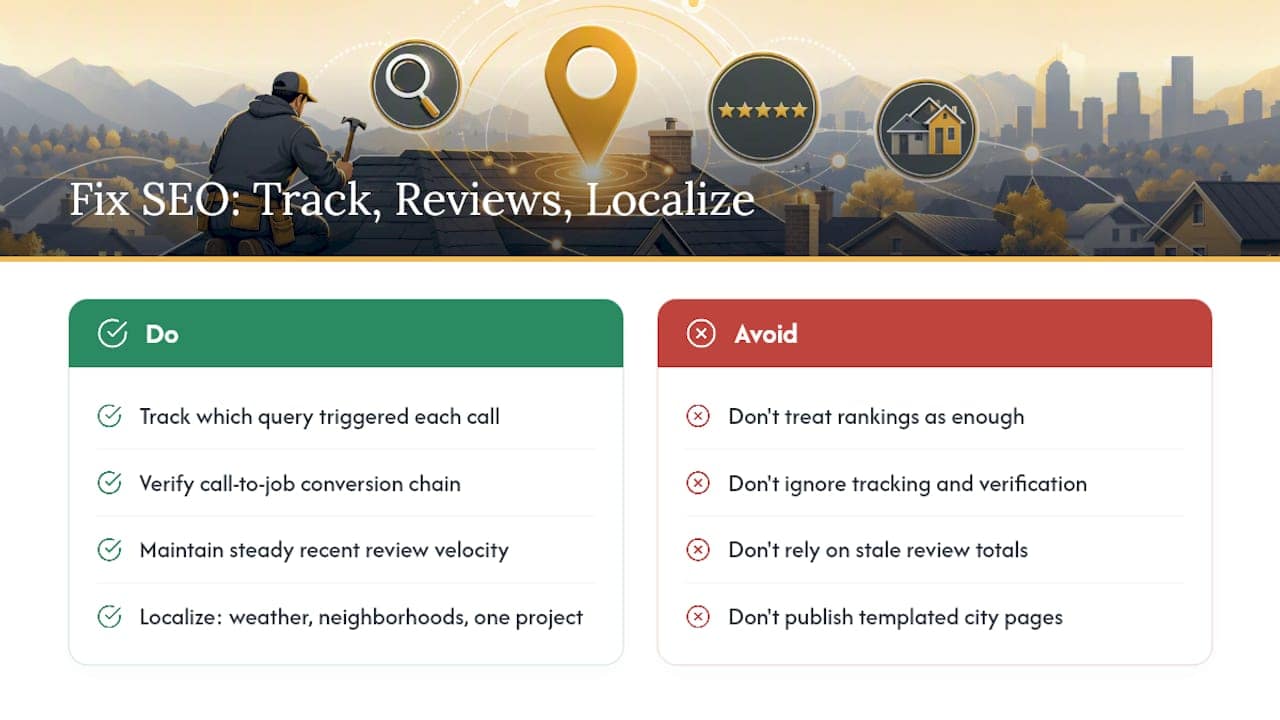
Rankings without verification are a vanity metric. A roofer can rank #1 for “roof replacement Denver” and still have a terrible cost per lead if the page does not convert, the phone number is not tracked, or the calls are from homeowners three states away who found the page through an unrelated query. The ranking is real. The business outcome is not.
What actually moves the needle is the combination of ranking and verification. You need to know which search query triggered which call, whether that caller booked an inspection, and whether the inspection converted to a job. Without that chain, you cannot make a rational decision about where to invest next.
The second thing roofers underestimate is review velocity. A competitor with 80 reviews, all from the last six months, will often outrank a business with 300 reviews and nothing recent. Google interprets recent reviews as a signal that the business is active and trustworthy. A static review total, no matter how impressive, decays in influence over time.
The third mistake is treating every city page as a copy-paste job. Google is sophisticated enough to recognize templated content where only the city name changes. A page about “Roof Replacement in Thornton, CO” needs to mention Thornton’s specific weather patterns, common neighborhoods, and at least one real project from that area. That specificity is what earns the ranking and builds trust with the homeowner reading it.
Denvercountywebdesign builds the local SEO system roofers need
If you have read this far, you know what a complete roofing SEO system looks like. Building it yourself takes time most roofing contractors do not have. Denvercountywebdesign handles the entire setup for home service businesses in Colorado: custom WordPress site builds, GBP optimization, service-area pages with unique local content, call tracking installation, and review management workflows.
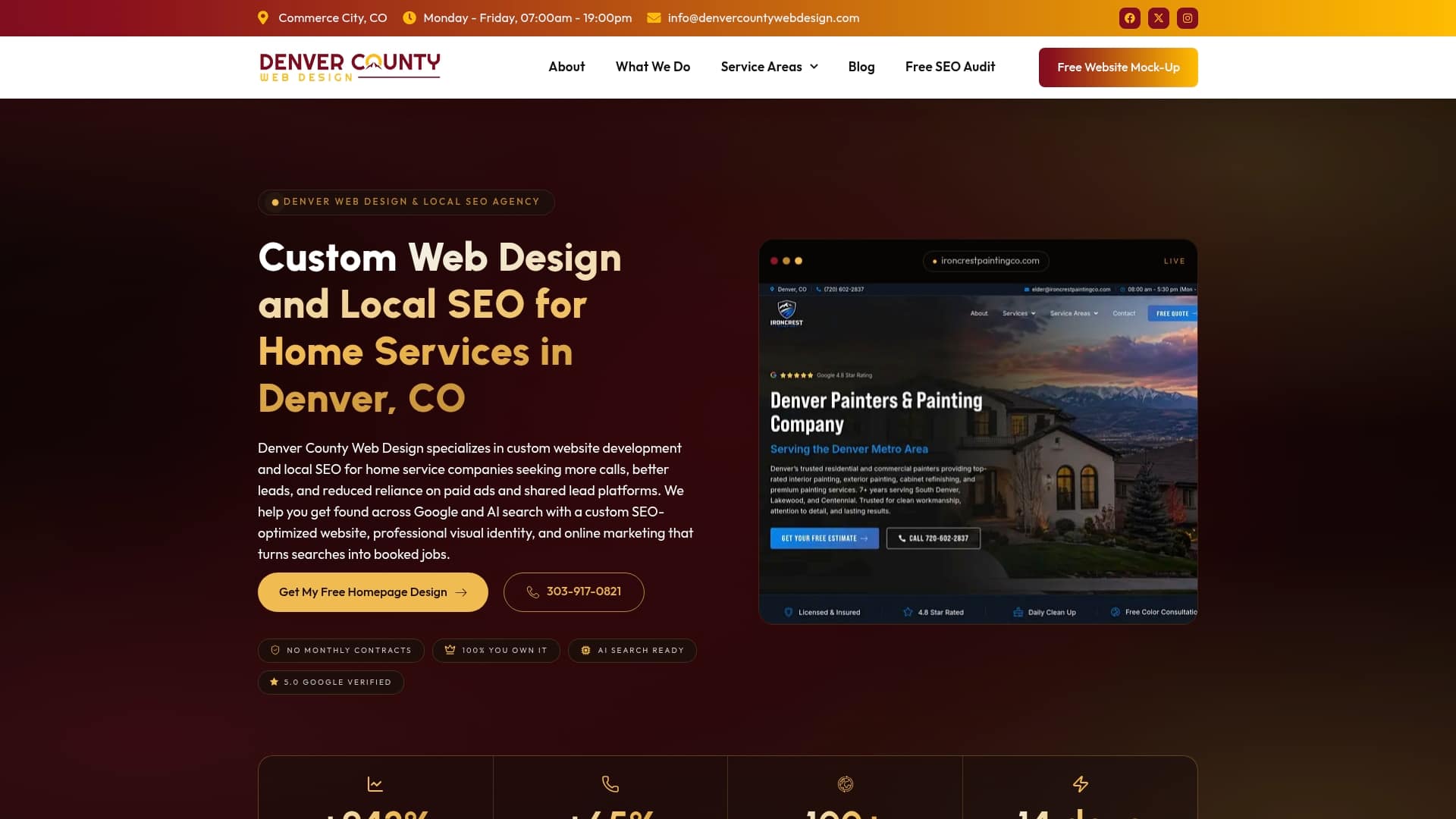
A typical local SEO starter package from Denvercountywebdesign includes GBP setup and monthly management, three to five intent-matched service pages, call tracking with source attribution, and a review request workflow. Clients keep full ownership of their website with no monthly ownership fees, which means the asset you build is yours permanently. The agency has delivered a 243% increase in organic traffic within 90 days for contractors using this approach.
Ready to see where your map-pack visibility stands right now? Request a free map-pack audit and get a clear picture of what is holding your GBP back. Or visit Denvercountywebdesign.com to see the full range of local SEO and web design services built specifically for contractors.
Useful sources and further reading
These resources support the strategies covered in this article and are worth bookmarking for ongoing reference.
- Roofing SEO: The 5 Pillars and the Verified-Lead Layer — Elevarus — Detailed breakdown of GBP influence, verified-lead measurement, and timeline expectations.
- Local SEO for Roofing Companies (2026): 9 Steps to Rank — Astucia — Step-by-step local SEO framework with service-area page strategy.
- Roofing SEO 2026: Rank #1 on Google & AI Search — Almcorp — Covers AI Overview optimization and schema for roofing sites.
- SEO for Roofing Contractors: Storms, Replacements, and the Insurance Cycle — SEO Brothers — Insurance and storm content strategy for roofing businesses.
- 6 Best Practices for Roofing SEO — GAF — Manufacturer-backed best practices covering keywords, content, and location pages.
- DataPins — Tool for automating citation management and surfacing project reviews on location pages.
- Online local business search frequency — Statista — Data on local search behavior and conversion intent.
FAQ
What does SEO mean for a roofing contractor?
SEO for a roofing contractor means optimizing your website and Google Business Profile so your business appears when local homeowners search for roofing services. The goal is verified calls and booked jobs, not just website traffic.
Is SEO still worth it for roofers in 2026?
Yes. Local search behavior drives a high share of direct contacts for home services, and roofing is one of the highest-intent categories. With AI Overviews now appearing in roughly 44.4% of queries, structured content and schema make SEO more valuable, not less.
How much should a roofer pay for SEO services?
Basic local packages typically run $300–$1,000 per month, while comprehensive campaigns in competitive markets run $1,000–$5,000 per month. One-time SEO-ready site builds generally start around $2,500. Any proposal without call tracking and verified-lead reporting is not worth the price.
How long does roofing SEO take to show results?
Early GBP improvements and inbound calls typically appear within 30–90 days. Dominant local rankings for service-plus-city keywords usually take 6–12 months of consistent work, as confirmed by industry data on roofing SEO timelines.
What is the most important ranking factor for a local roofer?
Google Business Profile optimization is the single highest-leverage factor, accounting for roughly 32% of local-pack ranking influence. Pair it with review velocity, service-area pages with unique local content, and consistent NAP citations for the strongest results.
Recommended
- Google Ads for Contractors: Get Local Leads Fast – Denver County Web Design
- Denver Web Design Company – SEO-Driven Websites for Local Businesses
- Google Ads for Electricians: Local Leads in 2026 – Denver County Web Design
- Best Review Management Software for Local Businesses – Denver County Web Design