Three actions produce the fastest lift in contractor local SEO: completing your Google Business Profile, building a repeatable review system, and creating one focused page per service and city. Do those three things in the right order and you will see map-pack movement within 3–6 months, with steady call growth compounding through month 12. A complete, active Google Business Profile plus consistent, location-specific reviews and job photos is the playbook that produces more qualified calls than any other single investment.
Your 30/60/90 Prioritized Checklist
Start here this week, then build from it:
| Timeframe | Action | Expected Outcome | Who Owns It |
|---|---|---|---|
| Week 1 (Days 1–7) | Claim/verify GBP, add click-to-call, set consistent NAP | Profile live and findable | Owner |
| Month 1 (Days 8–30) | Complete all GBP fields, launch review ask system, fix top citations | First review velocity, map-pack eligibility | Owner or office manager |
| Month 2–3 | Build 3–5 service/city pages, add LocalBusiness schema, start link outreach | Organic impressions rising | Owner + web person |
| Month 4–12 | Monthly content updates, review cadence, local link building | Steady call growth, compounding visibility | Office manager or agency |
Immediate checklist to run this week:
- Claim and verify your Google Business Profile at business.google.com
- Add your phone number as a click-to-call link on your website’s homepage
- Confirm your business name, address, and phone number match exactly across Google, Facebook, and Yelp
- Ask your last three customers for a Google review today
Key Takeaways
Completing your Google Business Profile, building a consistent review system, and creating focused service and city pages are the three actions that produce the fastest, most durable lift in contractor local SEO.
| Point | Details |
|---|---|
| GBP comes first | Complete every GBP field before investing in website SEO — it feeds the map pack directly. |
| Reviews drive prominence | Ask every customer at handover; target 2–3 new reviews per week for steady velocity. |
| Focused local pages rank | One unique page per service and city beats hundreds of templated pages every time. |
| Timeline is 3–12 months | Expect first map-pack movement in 3–6 months; full compounding gains by months 10–12. |
| Denvercountywebdesign | Builds contractor websites with local SEO, GBP management, and schema included — no monthly fees. |
Table of Contents
- 1. What contractor local SEO actually means and which signals you control
- 2. How to optimize your Google Business Profile for a service-area contractor
- 3. A practical review system that produces location-specific results
- 4. How to build service pages and city pages that actually rank
- 5. Site-level priorities that turn local clicks into booked jobs
- 6. Directory citations and NAP consistency: fix the top listings first
- 7. Technical local SEO and the schema types every contractor site needs
- 8. Realistic local link-building tactics that work for contractors
- 9. What to measure and what to expect in months 1–12
- 10. The weekly and monthly checklist every contractor can follow
- 11. Why this playbook works — evidence and implementation workflow
- 12. How social media supports your local SEO without becoming a second job
- 13. How to handle negative reviews and build reputation resilience
- 14. How voice search and mobile local searches find your business
- What most contractors get wrong about local SEO
- Denvercountywebdesign builds contractor websites that pull their weight locally
- Sources
- FAQ
1. What contractor local SEO actually means and which signals you control
Google ranks local results on three factors: relevance, distance, and prominence. Distance is fixed — you cannot move your service area. But relevance and prominence are both within your control, and they are where most contractors have the biggest gaps.
Relevance is how well your profile and pages match what a buyer is searching for. Choosing the right primary category (“Plumber” not “Contractor”), listing every service you offer, and writing a clear business description all push relevance up. Prominence is how well-known and trusted Google perceives your business to be. Reviews, citations, backlinks, and an active GBP all feed prominence.
For a plumber in Aurora, CO, the practical implication is this: a competitor with 80 recent reviews, a fully completed GBP, and a dedicated “drain cleaning Aurora CO” page will almost always outrank a competitor with a better-looking website but a thin profile and no reviews. Your GBP is the lever that moves fastest.
Pro Tip: When you set up your service-area settings in Google Business Profile, list every city you actually serve — not just your home base. Google uses this to determine relevance for searches in those towns.
2. How to optimize your Google Business Profile for a service-area contractor
Your GBP is the single highest-ROI local asset you have. Finish it completely before spending time or money on anything else. Optimizing GBP and reviews moves the needle faster than website-only SEO for most home-service contractors.
Fields to complete in order of impact:
- Primary category — pick the most specific match (e.g., “Electrician,” “Roofing Contractor,” “General Contractor”)
- Secondary categories — add up to 9 additional relevant categories
- Services list — add every service with a short description and price range where applicable
- Business description — 750 characters, include your top services and primary cities served
- Service-area settings — list all cities you serve; hide your home address if you work from home
- Photos — minimum 10 job photos at launch; add at least one new photo per week
- Business hours — keep these accurate and update for holidays
- Posts — publish one post per week (a completed job, a seasonal tip, a promotion)
- Q&A — seed 5–10 common questions and answer them yourself
- Messaging and booking links — enable messaging and link your booking form or phone
Verification: Google will mail a postcard to your business address or offer video verification. Complete this within 14 days or your profile will not show in the map pack.
Hiding your address: If you operate from a home address, you can hide it in GBP settings. Set your service area instead. Google will still show you in local results for the cities you list.
Weekly maintenance (15 minutes):
- Respond to any new reviews
- Upload one new job photo
- Check that your phone number and hours are correct
- Publish a short post if you have not done so in the past 7 days
Pro Tip: Name your photo files descriptively before uploading — “kitchen-remodel-denver-co.jpg” instead of “IMG_4821.jpg.” Google reads file names as a relevance signal, and it takes 10 seconds to rename a file.

3. A practical review system that produces location-specific results
Consistent, on-site asks at job handover combined with a fast follow-up link produce the best review velocity and the most useful review content. Reviews that include location and service wording give Google and future customers more context than generic praise.
The handover ask workflow:
- At job completion, say: “We’d really appreciate a Google review. It helps other homeowners in [city] find us. I’ll text you a direct link right now.”
- Send the link within 24 hours via text or email
- Follow up once more at 72 hours if no review has been posted
- Use a review management tool to automate the follow-up sequence
What to prompt for (without scripting the customer):
- The specific service performed (“they replaced my water heater”)
- The city or neighborhood (“in Thornton”)
- One detail about the experience (“showed up on time, cleaned up after”)
Replying to reviews: Respond to every review within 48 hours. For positive reviews, thank the customer by name, mention the service and city, and invite them to call again. For negative reviews, stay calm, acknowledge the issue, and offer to resolve it offline. Never argue publicly. Reputation management software can alert you the moment a new review posts so you never miss one.
Pro Tip: Set a goal of 2–3 new reviews per week. That pace is achievable for most contractors and produces the review velocity Google’s algorithm rewards.
4. How to build service pages and city pages that actually rank
One meaningful page per service and one per priority city. Not hundreds of templated pages with swapped city names — Google treats those as doorway pages and suppresses them. Dedicated city pages with unique content boost local relevance when they include real project photos, local testimonials, and specific copy about the area.
Page template for each service/city combination:
- Headline: “[Service] in [City], CO — [Short Benefit]”
- Short intro: 2–3 sentences mentioning the service and city naturally
- Scope of work: What the service includes, common problems you solve in that area
- Process: Your 3–5 step process so the reader knows what to expect
- Proof: 2–3 project photos from that city, one local testimonial
- FAQ: 3–5 questions specific to that service/city
- CTA: Phone number, form, and a clear next step (“Call for a free estimate”)
- Schema: LocalBusiness subtype + FAQ schema (see Section 8)
Rules to avoid thin pages:
- Each page needs at least 400 words of unique copy
- Photos must be from actual jobs in that city, not stock images
- Testimonials should name the city or neighborhood
- Never copy-paste the same page and swap the city name
| Page Type | Minimum Unique Elements | Schema to Add |
|---|---|---|
| Service page | Service scope, process, local photos, FAQ | LocalBusiness subtype, FAQPage |
| City page | City-specific intro, local project proof, area FAQ | LocalBusiness, serviceArea |
| Service + City combo | All of the above combined | LocalBusiness subtype, FAQPage, serviceArea |
Pro Tip: Start with your top 3 services and your top 3 cities. That gives you 9 pages that cover your highest-value work. Add more pages once those 9 are live and indexed.
5. Site-level priorities that turn local clicks into booked jobs
Your website’s job is to convert the click you earned in the map pack into a phone call or form submission. Most contractor sites lose that conversion because of slow load times, buried phone numbers, and forms that ask too many questions.
Conversion essentials — check every page:
- Click-to-call phone number in the header, visible on mobile without scrolling
- Business hours displayed on the homepage and contact page
- Short lead form — name, phone, service needed, zip code (4 fields maximum)
- Trust proof — license number, insurance badge, years in business, review count
- NAP (name, address, phone) in the footer of every page, matching your GBP exactly
Technical checklist:
- Mobile-first layout (test on a real phone, not just a browser resize)
- Images compressed to under 150KB each
- Page load time under 3 seconds (test with Google PageSpeed Insights)
- Clean URL structure:
/services/drain-cleaning/and/locations/aurora-co/ - XML sitemap submitted to Google Search Console
- HTTPS enabled on every page
Form and call-tracking setup:
- Use a local phone number (not a toll-free number) for trust
- Set up call tracking through a service like CallRail so you know which pages drive calls
- Test your form monthly — broken forms are the most common silent conversion killer
6. Directory citations and NAP consistency: fix the top listings first
NAP consistency is a core trust signal. When your business name, address, and phone number appear differently across directories, Google loses confidence in your data and your local ranking suffers. Fix the top listings first, then work down the list.
Priority directories for contractors:
- Google Business Profile (most important)
- Facebook Business Page
- Yelp for Business
- Better Business Bureau (BBB)
- Angi (formerly Angie’s List)
- HomeAdvisor
- Houzz (for remodelers and designers)
- Your local Chamber of Commerce directory
- Industry-specific associations (NECA, PHCC, NAHB depending on trade)
- Apple Maps / Bing Places
How to audit your citations:
- Search your business name in Google and note every listing that appears
- Check that the business name, address, and phone number match your GBP exactly — character for character
- Look for old addresses, old phone numbers, or misspelled business names
- Use a tool like BrightLocal or Whitespark to find listings you did not know existed
Fixing mismatches:
- Claim each listing and update it directly through the platform
- If a listing cannot be claimed, use the platform’s “suggest an edit” or contact their support
- Document every listing in a spreadsheet with the URL, current status, and date corrected
7. Technical local SEO and the schema types every contractor site needs
Schema markup and technical fixes make your content unambiguous to Google and reduce the friction between your site and a top-3 map-pack position. LocalBusiness schema and serviceArea markup are underused on contractor sites — adding them removes ambiguity and can improve per-city visibility when paired with unique local pages.
Schema types to add:
- LocalBusiness subtype — use the most specific type available:
Plumber,Electrician,RoofingContractor,GeneralContractor,HVACBusiness - serviceArea — list every city and zip code you serve
- openingHours — match your GBP hours exactly
- geo — latitude and longitude of your business address
- sameAs — links to your GBP, Facebook, Yelp, and BBB profiles
- FAQPage — add to every service and city page
A contractor with many recent, geographically tagged reviews and photos will often outrank a competitor with a stronger website but weak GBP — and schema is what ties those signals together for Google’s crawler.
Technical checklist:
- XML sitemap submitted and error-free in Google Search Console
- Robots.txt not blocking important pages
- Mobile viewport meta tag present on every page
- Structured data tested with Google’s Rich Results Test
- Core Web Vitals passing in Google Search Console
- HTTPS on every page with no mixed-content warnings
Pro Tip: Use Google’s free Rich Results Test (search.google.com/test/rich-results) to validate your schema before publishing. Fix any errors before the page goes live — a schema error on a city page can suppress the FAQ rich result you built the page around.
8. Realistic local link-building tactics that work for contractors
Local and trade links move the needle more for contractors than chasing national editorial placements. A link from your local Chamber of Commerce or a supplier’s “preferred contractor” page carries more local authority than most generic directory links.
Highest-value link sources for contractors:
- BBB membership — a BBB accreditation link is trusted, local, and easy to get
- Local Chamber of Commerce — join and get listed in their member directory
- Supplier and manufacturer directories — many suppliers list “certified installers” or “preferred contractors” on their websites
- Trade associations — NECA, PHCC, NAHB, NARI, and similar associations list members
- Local sponsorships — sponsor a youth sports team, school event, or community fundraiser and ask for a link on their website
- Partner case pages — if you work with a general contractor, architect, or designer, ask them to feature your work on their site with a link
- Local news and community blogs — offer to be a source for a home improvement story or write a guest post
Monthly outreach action plan (assign to an employee or VA):
- Identify 3 local organizations or suppliers to contact this month
- Send a short, personal email introducing your business and asking about listing or partnership opportunities
- Follow up once after 7 days
- Document every link earned in your citation spreadsheet
- Check new links with Google Search Console’s “Links” report monthly
For builders looking to expand their client acquisition beyond search, local outreach and partnership tactics follow a similar logic regardless of market — build relationships first, links follow.
9. What to measure and what to expect in months 1–12
Measure calls from maps, profile views, clicks-to-call, form submissions, and booked jobs — and track every source separately. Most contractors see measurable local-pack movement within 3–9 months after completing initial GBP cleanup, review systems, and targeted local pages, with full compounding effects by months 10–12.
KPIs to track monthly:
- GBP profile views (in GBP Insights)
- Calls from GBP (calls tracked in GBP Insights and call-tracking software)
- Website sessions from organic/local search (Google Analytics)
- Form submissions (Analytics goals)
- Booked jobs attributed to local search (ask every new customer “how did you find us?”)
Timeline and expectations:
| Month | What to Expect | Key Driver |
|---|---|---|
| 1–2 | GBP verified, first reviews posted, citations cleaned | GBP completion |
| 3–4 | Map-pack appearances increasing, first organic calls | Reviews + local pages live |
| 5–6 | Consistent map-pack visibility for primary keywords | Review velocity + schema |
| 7–9 | Organic traffic growing, city pages ranking | Local pages + link building |
| 10–12 | Compounding call growth, ranking for multiple cities | Full playbook in effect |
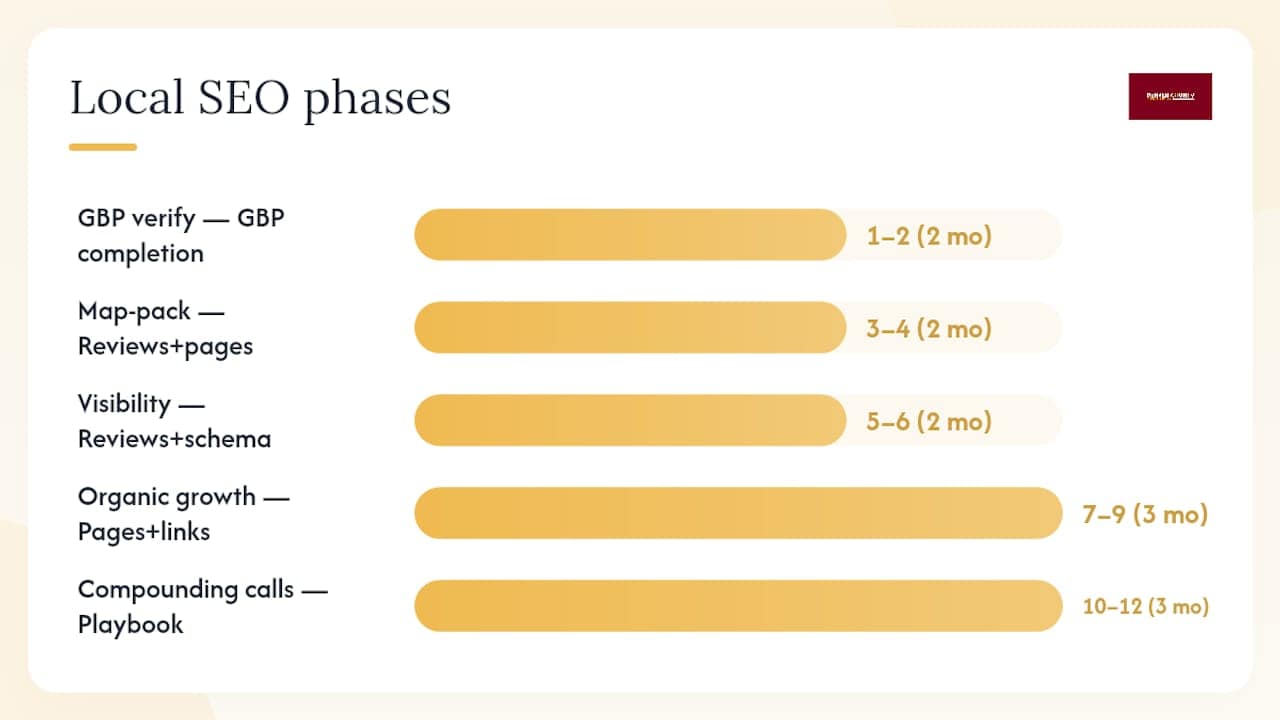
Cost ranges: DIY implementation takes 5–10 hours per month of consistent effort. Hiring a local SEO agency typically runs $500–$2,000 per month depending on scope. A one-time website build with local SEO setup can range from $1,500 to $5,000+. The Google Ads for contractors channel pairs well with local SEO once organic visibility is established, giving you a paid floor while organic rankings build.
10. The weekly and monthly checklist every contractor can follow
A 15–30 minute weekly routine and a 1–2 hour monthly routine will sustain your visibility without pulling you off the tools. Consistency beats intensity for local SEO.
Weekly tasks (15–30 minutes, assign to office manager):
- Respond to all new Google reviews
- Upload one new job photo to GBP with a descriptive file name
- Publish one GBP post (completed job, tip, or promotion)
- Spot-check that your phone number and hours are correct on GBP
- Verify that call-tracking numbers are working
Monthly tasks (1–2 hours):
- Update or expand one city or service page with new content or photos
- Send review request follow-ups to the past month’s completed jobs (target 10 asks)
- Run Google PageSpeed Insights on your homepage and fix any new issues
- Validate schema with Google’s Rich Results Test
- Check GBP Insights for profile views, calls, and direction requests
- Review your citation spreadsheet and fix any new mismatches found
11. Why this playbook works — evidence and implementation workflow
Tested across contractor clients, the combination of GBP optimization, a consistent review system, and focused local pages consistently produces measurable call growth. The local 3-pack often produces more immediate business for home-service contractors than organic blue links — and it is driven almost entirely by GBP data, not website authority.
Implementation workflow:
- Audit — assess current GBP completeness, review count, citation consistency, and site speed
- GBP fixes — complete all fields, verify, add photos and services
- Review system — launch handover ask + follow-up sequence
- Local pages — build service and city pages with schema
- Measurement — set up call tracking, GBP Insights monitoring, and Analytics goals
- Monthly cadence — follow the weekly/monthly checklist above
Request a free map-pack audit to see exactly where your profile stands against competitors in your area.
12. How social media supports your local SEO without becoming a second job
Social media does not directly move your Google rankings, but it supports local SEO in two ways: it builds the brand signals Google uses for prominence, and it creates a channel for sharing the job photos and reviews that also feed your GBP.
The practical approach for contractors is to post on Facebook and Instagram when you complete a notable job. A before-and-after photo with the city name in the caption takes two minutes and creates a local content signal. Tag the city or neighborhood. Use the business name consistently across every profile so it matches your GBP exactly.
Facebook Business Pages also appear in citation audits — your name, address, and phone number on Facebook must match your GBP. That consistency is the SEO value of social media for most contractors, not follower counts or engagement rates.
What to post and when:
- Completed job photos (before/after) with city and service in the caption
- Seasonal tips relevant to your trade (“time to flush your water heater before winter”)
- Customer reviews shared as graphics
- Team photos that humanize the business
Post 2–3 times per week on your primary platform. More than that is rarely worth the time for a contractor.
13. How to handle negative reviews and build reputation resilience
A negative review is not a crisis. It is an opportunity to show every future customer how you handle problems. Handled well, a thoughtful response to a 1-star review can be more persuasive than five 5-star reviews with no replies.
The response framework for negative reviews:
- Respond within 24 hours — speed signals that you care
- Thank the reviewer for the feedback, even if it stings
- Acknowledge the specific issue without admitting fault prematurely
- Offer to resolve it offline: “Please call us at [number] so we can make this right”
- Never argue, never get defensive, and never name the customer’s personal details publicly
Building resilience so one bad review does not define you:
- A business with 80 reviews and one 1-star is far more credible than a business with 8 reviews and one 1-star. Volume is your best defense.
- Respond to every positive review too — it shows you are active and engaged
- If a review is fake or violates Google’s policies, flag it for removal through GBP
- Reputation management software can monitor new reviews across platforms and alert you instantly, so you never miss a response window
The goal is a steady stream of new reviews so that any single negative review becomes a small fraction of your total. That is reputation resilience — not zero bad reviews, but enough good ones that the ratio stays strong.
14. How voice search and mobile local searches find your business
Voice search queries tend to be longer and more conversational than typed searches. Someone asking their phone “Who’s the best plumber near me open right now?” is looking for the same map-pack result as a typed search, but the phrasing is different. Optimizing for voice means answering natural-language questions on your site and keeping your GBP hours accurate.
Practical voice search optimizations:
- Add an FAQ section to every service page using natural question phrasing (“How much does drain cleaning cost in Denver?”)
- Keep your GBP hours updated — “open now” is one of the most common voice search filters
- Use FAQPage schema so Google can pull your answers directly into voice results
- Write your business description in plain, conversational language
Mobile local searches follow a similar pattern. Optimizing your website for local search means making sure the mobile experience is fast, the phone number is tappable, and the form works on a small screen. Over half of local searches happen on mobile, and a site that loads slowly or buries the phone number loses those calls before they start.
Test your site on a real phone every month. Tap every button, submit the form, and call the number. If anything is broken or frustrating, fix it that week.
What most contractors get wrong about local SEO
The three mistakes I see most often are a neglected GBP, no review system, and thin city pages. They persist for the same reason: contractors are busy doing the work, and these tasks feel like marketing, not the job. But they are the job now, because your next customer is searching before they call.
A neglected GBP is the most expensive mistake. A profile with no photos, no posts, and a handful of old reviews is invisible in the map pack. Competitors who post weekly and ask for reviews consistently will take those calls instead. The fix takes one afternoon and 15 minutes a week after that.
No review system means you are leaving your reputation to chance. The contractors who dominate local search in their market are not the ones with the best websites. They are the ones who ask every single customer for a review at handover. That habit, done consistently, compounds faster than any technical SEO tactic.
Thin city pages are the third gap. A page that says “We serve Aurora, CO” in one sentence does nothing. A page with a real project photo from Aurora, a local testimonial, and 400 words about the specific service in that city can rank within 3–4 months. The difference is 90 minutes of writing, not a technical skill.
The single habit that beats complicated tactics: ask for a review at every job handover, every time, without exception. Build it into your close-out process the same way you hand over a warranty card. That one habit, sustained for 12 months, will do more for your local visibility than most technical SEO work.
Denvercountywebdesign builds contractor websites that pull their weight locally
If you have read this far, you have the playbook. The question is whether you have the time to execute it. Most contractors do not — and that is exactly the gap Denvercountywebdesign fills.
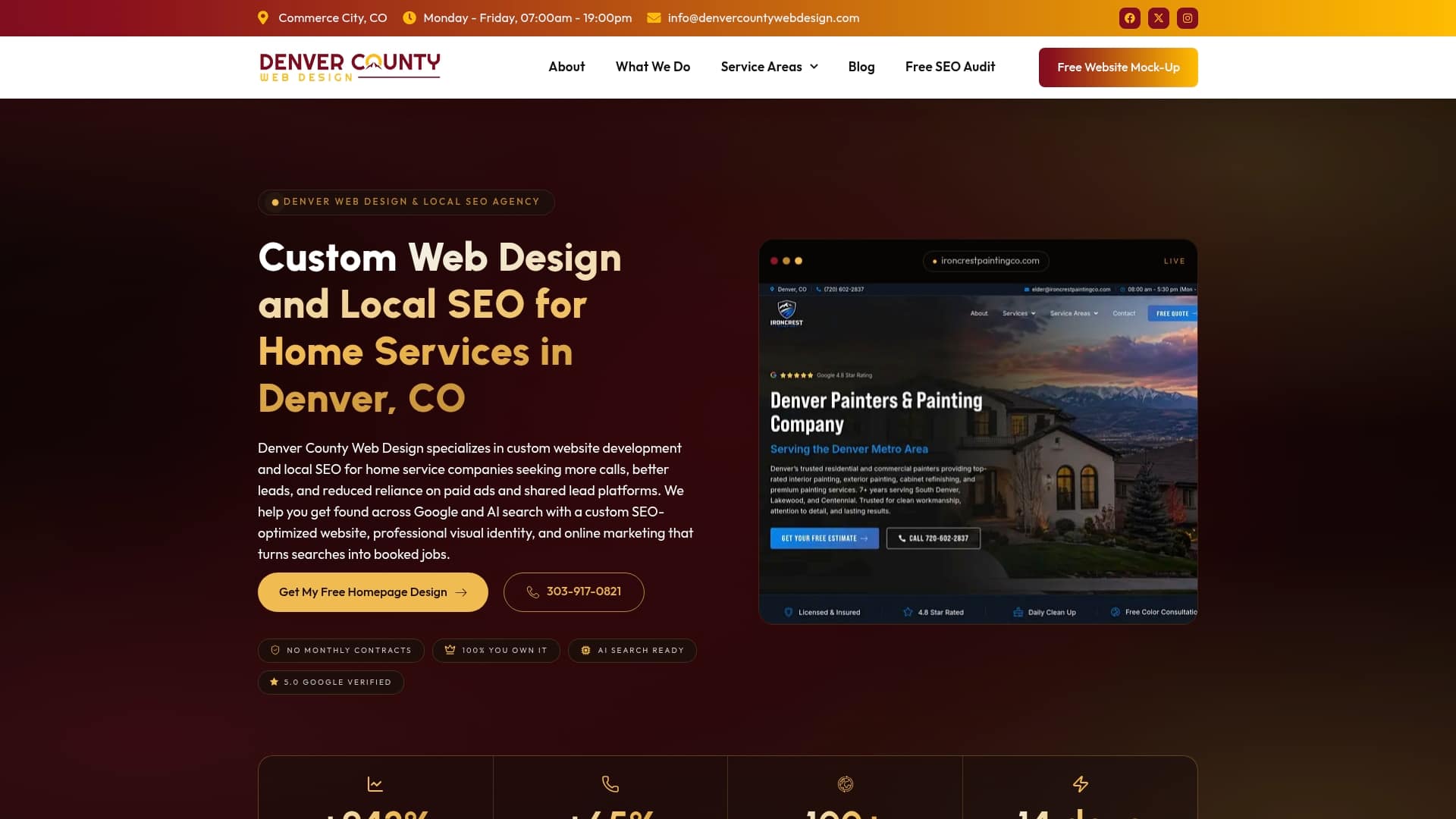
Denvercountywebdesign builds custom WordPress websites for home-service businesses in Colorado, with local SEO, Google Business Profile management, and citation cleanup built into every project. Every website is yours outright — no monthly platform fees, no lock-in, full ownership from day one. The agency handles the GBP setup, local pages, schema, and call-tracking configuration so you can stay on the tools while the site works for you.
Ready to see where your map-pack ranking stands right now? Request your free audit and get a clear picture of what to fix first. Or explore what a local SEO-ready website looks like for a contractor in your market.
Sources
The following official and industry sources back the core claims in this guide:
- Local SEO for Contractors: A 2026 Guide to More Leads — HearBack
- SEO for Contractors — Plain-English 2026 Guide
- SEO for Contractors | Guides | Bolster
- Reputation management software category — Capterra
FAQ
How much does local SEO cost for a contractor?
DIY local SEO costs 5–10 hours per month of consistent effort with minimal hard costs. Hiring an agency typically runs $500–$2,000 per month depending on scope; a one-time website build with local SEO setup ranges from $1,500 to $5,000 or more.
Is local SEO worth it for a home-service business?
Yes — the local 3-pack appears above organic results for most “near me” and city-based searches, and it is driven by GBP data and reviews that contractors can build without a large budget. Most contractors see their first map-pack calls within 3–6 months of consistent effort.
How long does it take to see results from contractor SEO?
Most contractors see measurable local-pack movement within 3–9 months after completing GBP cleanup, launching a review system, and publishing targeted local pages. Full compounding gains typically arrive by months 10–12.
How much does it cost to hire someone to do SEO?
Agency SEO for contractors runs roughly $500–$2,000 per month for ongoing local SEO management. Denvercountywebdesign offers bundled packages that include website design, local SEO setup, and GBP management with no ongoing monthly platform fees — the site is yours outright.
Is SEO still effective in 2026?
Local SEO for contractors remains one of the highest-ROI marketing channels available because buyers search before they call. The tactics have evolved — GBP, reviews, and schema carry more weight than they did five years ago — but the core principle holds: show up where your customer is looking.
Recommended
- Google Ads for Contractors: Get Local Leads Fast – Denver County Web Design
- Denver Web Design Company – SEO-Driven Websites for Local Businesses
- HVAC Google Ads for Contractors: Local Lead Playbook – Denver County Web Design
- Best Review Management Software for Local Businesses – Denver County Web Design