Local SEO for plumbers succeeds when you focus on five priority actions first: optimize your Google Business Profile (GBP), lock in consistent NAP citations, generate steady reviews, publish service-area landing pages, and add local schema markup. Do those five things in the right order and you will move the needle faster than any other investment.
Your week-by-week priority checklist:
Week 1 (Do these today):
- Claim and verify your GBP. Go to business.google.com, claim your listing, set your primary category to “Plumber,” and request verification.
- Audit your NAP. Search your business name on Google, Yelp, and Angi. Write down every variation in your name, address, or phone number and flag them for correction.
Weeks 2–4:
3. Build your review request workflow. Write one text template and one email template (samples in the reviews section below), then send them after every completed job.
4. Publish your first two city landing pages. Pick your two highest-revenue service areas and build a dedicated page for each with local proof, photos, and a tap-to-call button.
Months 2–3:
5. Add local schema markup. Implement LocalBusiness, PlumbingService, and FAQPage JSON-LD on your homepage and service pages to feed both Google and AI assistants.
Key Takeaways
Local SEO for plumbers delivers the fastest results when GBP optimization, citation consistency, and review velocity are treated as the foundation before any other tactic.
| Point | Details |
|---|---|
| GBP is your highest-impact asset | Complete every field, add services, upload photos, and verify ownership before anything else. |
| NAP consistency builds trust | Match your name, address, and phone number exactly across Google, Yelp, Angi, and every other directory. |
| Review velocity beats total count | Recent reviews outperform a large but stale total; aim for one review per five jobs completed. |
| City pages expand your territory | Differentiated landing pages with local proof rank for service-plus-city queries without a physical office. |
| Denvercountywebdesign offers a clear starting point | A free map-pack audit shows exactly where your GBP and site need work, with no commitment required. |
Table of Contents
- How does local SEO for plumbers actually work on Google?
- How to claim, verify, and fully optimize your Google Business Profile
- On-site local SEO essentials: page templates, meta tags, and schema
- Where to build local citations and how to keep your NAP consistent
- How to generate and respond to reviews that boost your rankings
- How to design service-area pages that actually rank and convert
- Local link building and community tactics that move the prominence signal
- What KPIs and tools should you track for local SEO?
- How much should you pay for local SEO for plumbers?
- A real local SEO result for a home-service client
- What we see working for plumbers right now
- Denvercountywebdesign builds local SEO-ready sites for plumbers
- Sources
- FAQ
How does local SEO for plumbers actually work on Google?
Local ranking depends on three factors: relevance, distance, and prominence. GBP completeness drives relevance. Your defined service area handles distance. Citations and reviews build prominence. Miss any one of those three and you leave map-pack positions on the table.
The good news: plumbing is a high-intent, emergency-driven category. When someone types “plumber near me” at 11 PM, they are not browsing. They are ready to call. That means ranking in the map pack converts at a rate that most other local categories cannot match. Getting your plumbing company SEO right is not a nice-to-have; it is the difference between a full dispatch board and a slow week.
How to claim, verify, and fully optimize your Google Business Profile
Claiming and fully optimizing your Google Business Profile is the single highest-impact action a plumber can take for local search visibility. Complete every field, add your services list, upload photos, and verify ownership before touching anything else on this list.
The verification flow
Go to business.google.com and search for your business. If it already exists, claim it. If not, create it. Google will offer verification by postcard, phone, video, or email depending on your account history. Video verification is now common for new listings; you will record yourself showing your business location or vehicle and license. Keep your contractor’s license handy because Google may request it during the process.
Every field you need to complete
| GBP Field | What to Enter | Why It Matters |
|---|---|---|
| Primary category | Plumber | Drives the core relevance signal |
| Secondary categories | Drainage service, Water heater installation service | Captures additional service queries |
| Business description | 750-char summary: services, cities, license, years in business | Feeds keyword relevance |
| Services list | Drain cleaning, water heater repair, sewer line, leak detection | Matches specific search queries |
| Hours (including emergency) | Standard + “Open 24 hours” if applicable | Surfaces for emergency searches |
| Attributes | Licensed, insured, veteran-owned (if applicable) | Builds trust and filters |
| Photos | Exterior, team, job site before/after, truck | Drives direction requests and clicks |
| Products/services with prices | Water heater replacement: $800–$1,500 | Reduces friction, qualifies leads |
Profiles with photos receive materially more direction requests and website clicks than those without. Upload at least 10 photos when you first set up the profile, then add two or three new ones each month. Job-site before-and-after shots perform especially well.
Adding emergency hours and the “Open 24 hours” attribute is a quick win for emergency searches and increases call-through rates for businesses that genuinely offer after-hours service. Only add it if you actually answer those calls.
Policy pitfalls to avoid
- Never create a second GBP listing for the same location.
- Do not use a virtual office or UPS Store address unless you staff it during business hours.
- Never buy, trade, or incentivize reviews in exchange for discounts.
- Do not keyword-stuff your business name field (e.g., “Mike’s Plumbing — Denver Emergency Plumber 24/7”).
Pro Tip: Set a recurring calendar reminder every two weeks to post a Google Post (a completed job photo, a seasonal tip, or a limited-time offer) and to review the Q&A section. Answer every question yourself before a stranger does. Google’s small-business bulletins publish feature updates and seasonal tips worth checking each month.
On-site local SEO essentials: page templates, meta tags, and schema
Your website must speak in service-plus-location language on every page. Google reads your title tags, H1s, and first paragraphs to understand what you do and where you do it. If those signals are vague, your rankings will be too.
Page types to build
- Homepage: Your city name, primary service (“Denver Plumber”), license number, and a tap-to-call button above the fold.
- Service pages: One page per core service (drain cleaning, water heater repair, sewer line replacement, leak detection). Each page targets one service keyword.
- City/service-area landing pages: One page per priority city you serve (covered in depth in the next section).
- FAQ page: Answers to the questions your customers actually ask (“How much does a water heater replacement cost in Denver?”).
- Blog/how-to posts: Seasonal content (“How to prevent frozen pipes in Colorado”) that earns links and feeds AI citation signals.
Meta title and description patterns
| Page Type | Meta Title Pattern | Meta Description Pattern |
|---|---|---|
| Homepage | Plumber in [City], [State] | Licensed [City] plumber. 24/7 emergency service. Call [number]. |
| Service page | [Service] in [City] | [Service] by licensed [City] plumber. Fast response. Free estimates. |
| City landing page | [City] Plumber | Emergency and residential plumbing in [City]. Call now. |
| FAQ page | Plumbing FAQ | Answers to common plumbing questions for [City] homeowners. |
Your H1 and first 100 words should name the service and the city together. A water heater repair page for Aurora, CO should open with something like: “Need water heater repair in Aurora? Our licensed plumbers respond within two hours.” That sentence alone covers the primary keyword, the location, and the value proposition.
Schema markup beyond LocalBusiness
Structured data, FAQ schema, and hyper-local content increase the chance that AI assistants will name your business in local recommendations.(https://www.flento.io/blog/local-seo-for-plumbers) The schema types worth implementing:
- LocalBusiness / PlumbingService: Name, address, phone, geo coordinates, service area, opening hours, price range.
- Service: One block per core service with name, description, and area served.
- AggregateRating: Pull your average star rating and review count from GBP or Yelp.
- FAQPage: Mark up your FAQ page answers so Google can pull them into rich results.
Place the JSON-LD block in the <head> of each page. You do not need to dump every property; focus on name, telephone, address, areaServed, openingHours, priceRange, and aggregateRating.
Pro Tip: If you add FAQ schema with neighborhood-specific pricing or response-time data, AI assistants are more likely to cite your business in local recommendations. A question like “How fast does a plumber respond in Highlands Ranch?” answered with a specific time on your FAQ page is exactly the kind of proprietary local data that feeds AI citations.
Mobile speed matters here too. A page that loads in under 2.5 seconds on a phone (the Core Web Vitals LCP threshold) keeps callers on the page long enough to tap your number. For practical mobile speed and conversion design tips, the fundamentals are image compression, a fast host, and no render-blocking scripts.
Where to build local citations and how to keep your NAP consistent
Consistent NAP (name, address, phone number) on core aggregators moves the prominence signal that Google uses to rank local businesses. When your name appears as “Mike’s Plumbing LLC” on Google and “Mikes Plumbing” on Yelp, Google’s confidence in your business drops.
Top citation targets for plumbers
| Directory | Priority | What to Check |
|---|---|---|
| Google Business Profile | Critical | Name, address, phone, website, categories |
| Bing Places for Business | High | Mirror your GBP data exactly |
| Yelp | High | Business name, phone, service categories, photos |
| Angi | High | License info, service area, reviews |
| HomeAdvisor | High | Background check badge, service area, pricing |
| YellowPages | Medium | NAP, website URL, business description |
| Better Business Bureau | Medium | Accreditation status, NAP, complaint history |
| Chamber of Commerce | Medium | Local membership link (also a local backlink) |
| Nextdoor | Medium | Business page, neighborhood recommendations |
Citation audit checklist
- Search “[your business name] + [city]” and record every listing you find.
- Check that your phone number format is identical everywhere (use one format: (303) 555-0100).
- Verify your address uses the same abbreviations (St. vs. Street, Suite vs. Ste.).
- Look for duplicate listings and submit removal requests through each platform’s support.
- Update your website URL if you have changed domains.
Tools like BrightLocal and Whitespark can automate the audit and flag inconsistencies across hundreds of directories. They also track new citations over time so you catch drift before it compounds.
Pro Tip: If you run a service-area business from a home address, hide your address on GBP (there is a toggle in your profile settings) and define your service radius instead. Never list a home address publicly if you do not want customers showing up at your door. Use a licensed business address on your state contractor registration and mirror that on every citation.
How to generate and respond to reviews that boost your rankings
Steady, recent reviews at a strong average rating move both map-pack rankings and click-through rates. Volume signals activity. Recency signals that you are still operating. Review text that mentions a specific service and neighborhood helps you surface for those exact queries.
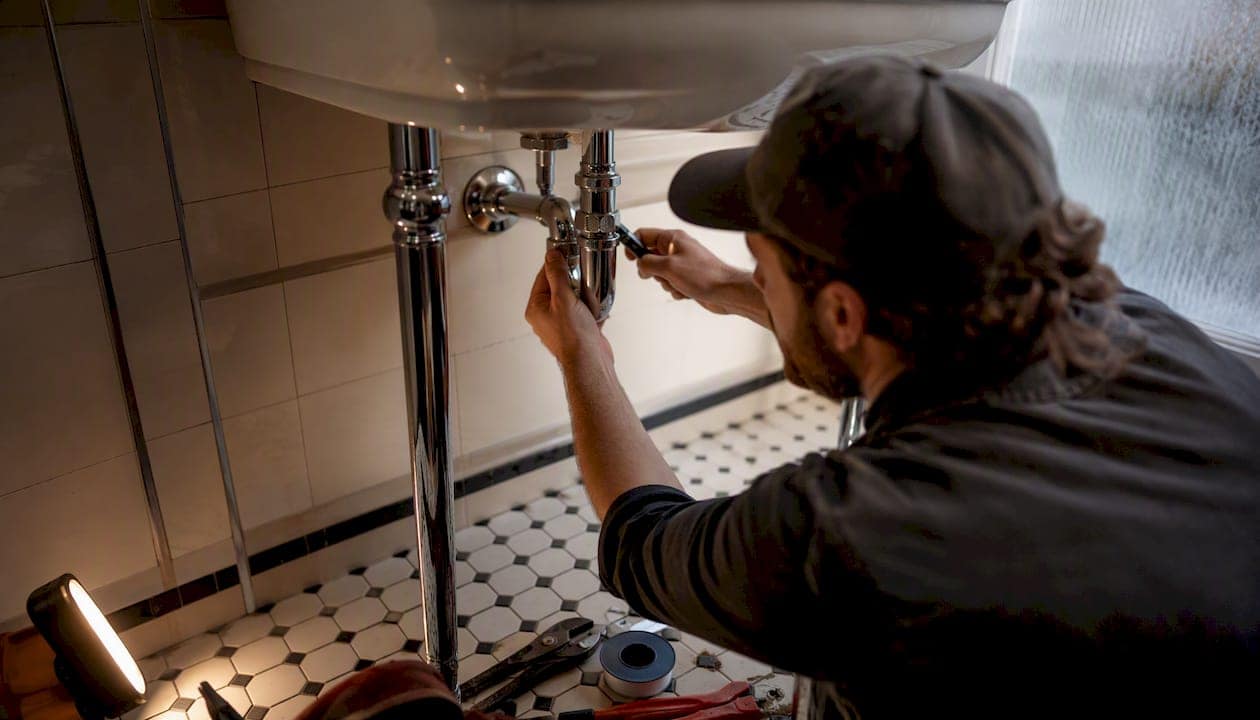
Review text that mentions service type and neighborhood (for example, “fixed my water heater in Stapleton”) helps a business rank for those locality-plus-service searches. That means your review request should prompt customers to include those details.
Review request templates
Text message (send within 2 hours of job completion):
Email (send same evening):
Subject: How did we do today, [Name]?
“We hope your [service] is working perfectly. If you have a moment, leaving us a Google review helps other [City] homeowners find us. Just click here: [link]. Mention the service and your neighborhood if you can — it helps a lot.”
Invoice insert (printed or PDF):
Response templates
Positive review response:
Negative review response:
Dos and don’ts
- Ask every customer, every time. Make it part of your closing conversation.
- Never offer a discount, gift card, or free service in exchange for a review.
- Never post fake reviews or use a review-generation service that does.
- Respond to every review, positive or negative, within 48 hours.
For managing review volume across Yelp, Angi, and Google simultaneously, a review management platform can centralize requests and alerts so nothing slips through.
Pro Tip: Target one review per five completed jobs as a baseline velocity. If you run 20 jobs a week, you should be generating three to four new reviews weekly. Track your count each Monday and adjust your ask rate if you fall behind.
How to design service-area pages that actually rank and convert
Individual, differentiated pages for the priority cities you serve will expand local visibility into nearby markets without requiring a physical office in each one. The key word is “differentiated.” A page that just swaps the city name into a boilerplate template will not rank.
City page template
Each city page should include:
- H1: “[City] Plumber — [Your Business Name]” or “[Service] in [City], CO”
- Opening paragraph: Name the city, the service, your response time, and your license number in the first 100 words.
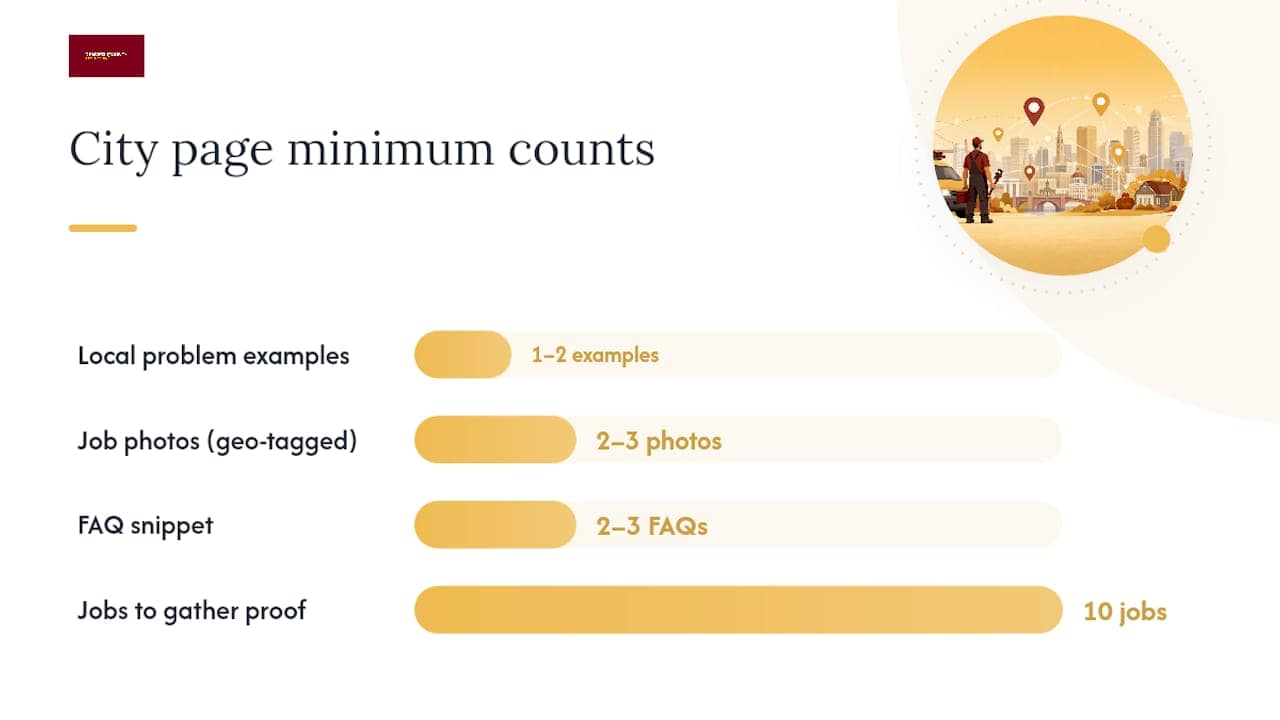
- Local problem examples: Mention neighborhood-specific issues (older homes in [neighborhood] often have galvanized pipes; hard water in [city] accelerates water heater corrosion).
- Project photos: Tag photos with the city name in the file name and alt text.
- Estimated pricing ranges: “Water heater replacement in [City]: $800–$1,500 depending on unit size.”
- Local FAQ snippet: Two or three questions specific to that city’s common plumbing issues.
- Tap-to-call CTA: A phone number button visible on mobile without scrolling.
- PlumbingService schema: With
areaServedset to that city.
| City Page Element | Purpose | Minimum Requirement |
|---|---|---|
| City name in H1 | Relevance signal | Required |
| Local problem examples | Unique content, avoids thin-page penalty | 1–2 specific examples |
| Job photos with geo tags | Visual proof, engagement | 2–3 photos |
| Pricing ranges | Conversion, reduces bounce | At least one range |
| FAQ snippet | Rich result eligibility, AI citation | 2–3 questions |
| Tap-to-call button | Mobile conversion | Above the fold |
Pro Tip: The fastest way to gather city-specific proof is to tag every job in your dispatch software with the city and service type. After 10 jobs in a city, you have real photos, real pricing data, and real customer names (with permission) to build a page that no competitor can copy.
Local link building and community tactics that move the prominence signal
Targeted local links improve the prominence factor that Google weighs in map-pack rankings. For plumbers, the highest-value links come from sources that already have local authority: news sites, community organizations, and trade associations.
Where to find local links
- Local news coverage: Pitch a story when you complete a notable job (a major flood restoration, a historic building re-pipe). Local reporters cover community stories, and a single link from a local news site carries real weight.
- Chamber of Commerce membership: Most chambers list members with a backlink. The link is modest in authority but adds a local citation signal and a trust marker.
- Sponsorships: Little League teams, school fundraisers, and community events often list sponsors on their websites. A $200 sponsorship can yield a local link that lasts for years.
- Vendor and supplier pages: Ask your pipe supplier or HVAC parts distributor if they maintain a contractor directory. Many do.
- Trade association listings: PHCC (Plumbing-Heating-Cooling Contractors Association) and state-level equivalents list members with links.
- Neighborhood forums: Nextdoor business pages and local Facebook groups are not traditional backlinks, but they generate referral traffic and review prompts.
Outreach templates
Sponsorship ask:
Local news pitch:
Cross-promotion with HVAC contractors, roofers, and property managers is one of the most underused local link plays. Agree to list each other on your “trusted partners” pages. You get a local link; they get one back. Both of you get referrals.
Pro Tip: Autocomplete optimization is an underused tactic. When people search “plumber in [city],” autocomplete suggestions shape which businesses they click. Publishing consistent, city-specific content and earning local mentions trains autocomplete to surface your business name earlier in the search journey.
Avoid paid link schemes and mass directory submissions from low-quality networks. Google’s spam filters catch these patterns, and a manual penalty sets your local SEO back by months.
What KPIs and tools should you track for local SEO?
Measure calls and booked jobs by source first. Everything else is context. If you cannot trace a lead back to Google organic, GBP, or a specific city page, you cannot make smart decisions about where to invest next.
KPIs that matter for plumbers
- GBP calls: Tracked in GBP Insights under “Calls.” Watch weekly.
- Direction requests: A proxy for how many people are close to calling. Rising direction requests usually precede a call volume increase.
- Website phone clicks: Set up a GA4 event for clicks on your
tel:link. This is your clearest mobile conversion signal. - Form submissions: Track as a GA4 conversion event. Separate emergency forms from estimate request forms.
- Organic sessions by city page: In Google Search Console, filter by page to see which city pages are gaining impressions and clicks.
- Ranking positions: Track your priority “service + city” queries weekly (e.g., “drain cleaning Denver,” “water heater repair Aurora”).
- Review velocity: New reviews per week across Google, Yelp, and Angi.
Recommended tools and setup
| Tool | What It Tracks | Setup Time |
|---|---|---|
| GBP Insights | Calls, direction requests, photo views | Zero — built in |
| Google Search Console | Impressions, clicks, ranking positions | 30 minutes |
| GA4 | Phone clicks, form submissions, sessions by page | 1–2 hours |
| BrightLocal or Whitespark | Citation consistency, ranking positions | 1 hour |
| CallRail or similar | Call source attribution, recording | 1–2 hours |
What to expect on your timeline
- Weeks 1–8: GBP verification completes, citation cleanup begins, first reviews come in. You may see GBP call volume tick up within 30 days of completing your profile.
- Months 3–6: City pages start ranking for lower-competition queries. Organic traffic from service pages grows as Google indexes and trusts the new content. Review count compounds.
Check GBP Insights every week. Run a full ranking and traffic report monthly. Do a strategy review quarterly to decide which city pages to add next and which services need more content.
How much should you pay for local SEO for plumbers?
Local SEO pricing for plumbers ranges from a one-time project setup to ongoing monthly management, and what you pay should match what you get. Here is a realistic breakdown.
Pricing tiers by service shape
One-time GBP + site setup ($500–$1,500):
Covers GBP claim and optimization, NAP audit, basic schema implementation, and meta tag corrections. Good starting point if your site is already solid.
Ongoing citation and review management ($200–$500/month):
Covers citation monitoring, review request workflow management, and GBP post publishing. Suitable after the one-time setup is complete.
Full local SEO retainer ($750–$2,000+/month):
Covers everything above plus city page creation, link building, monthly reporting, and content. Appropriate for plumbers targeting multiple cities or competing in dense markets.
Questions to ask any vendor
- Do you have experience with home-service or plumbing clients specifically?
- Can you show me a GBP before-and-after from a similar client?
- What does your reporting look like, and how often do I receive it?
- Who owns the website and content if I stop working with you?
- Do you build citations manually or through an automated network?
Red flags to walk away from
- Any guarantee of a “#1 ranking on Google” within a fixed time frame.
- Mass citation submissions to hundreds of low-quality directories.
- Review generation services that post reviews from fake accounts.
- Agencies that cannot show you a real client result with real numbers.
Pro Tip: Start with a 90-day project: GBP optimization, site fixes, and a review request process. After 90 days, you will have real data on call volume and ranking movement. Use that data to decide whether ongoing monthly management is worth the investment for your market.
A real local SEO result for a home-service client
Here is what the work looked like.
Before and after
- GBP calls: Up significantly within the first 30 days after completing the profile, adding photos, and enabling emergency hours.
- Organic sessions: Grew steadily as four new city landing pages were indexed and began ranking for service-plus-city queries.
- Review count: Went from fewer than five to over 30 within 60 days using a text-based review request sent after every job.
- Map-pack visibility: The business appeared in the local 3-pack for its primary city within 45 days of citation cleanup.
Methodology
- Claimed and fully completed GBP (all fields, services list, 15 photos uploaded on day one).
- Audited NAP across 12 directories and corrected inconsistencies on Yelp, Angi, and YellowPages.
- Built four city landing pages with local problem examples, job photos, and pricing ranges.
- Implemented
LocalBusiness,PlumbingService, andFAQPageschema on the homepage and service pages. - Set up a text-based review request workflow triggered after job completion.
- Earned two local links through a Chamber of Commerce membership and a supplier directory listing.
The elements that moved the needle fastest were GBP completion and the review workflow. City pages took longer to rank but drove the most sustained organic growth.
Pro Tip: The review workflow is the most repeatable piece. Once it is set up, it runs with almost no effort. Every plumbing business, regardless of market size, can implement it in a single afternoon.
What we see working for plumbers right now
The three highest-return actions for plumbers in 2026 are GBP completeness, review velocity, and AI citation signals through structured data. Everything else amplifies those three. Here is why they outperform other tactics right now.
GBP completeness has always mattered, but the weight of the “services” field has grown as Google uses it to match specific queries. A plumber who lists “sewer line inspection” as a service will surface for that query even without a dedicated page. That is a fast win most plumbing businesses leave unclaimed.
Review velocity matters more than total count. A business with 15 reviews in the last 30 days outperforms one with 200 reviews and nothing recent. Google treats recency as a freshness signal for local intent queries. Set your review request to fire within two hours of job completion, when the customer’s satisfaction is highest.
AI citation signals are the newest lever. When a homeowner asks ChatGPT or Perplexity “who is the best plumber in [city],” the AI pulls from structured data, FAQ content, and hyper-local specifics. Structured data, FAQ schema, and hyper-local content increase the chance that AI assistants will name your business in local recommendations.(https://www.flento.io/blog/local-seo-for-plumbers) Most plumbers have not touched this yet. That gap is your opportunity.
30/60/90 day plan
Days 1–30 (owner tasks):
- Claim and complete GBP.
- Audit NAP on the top five directories.
- Set up review request text template.
- Install GA4 and Search Console.
Days 31–60 (agency or owner):
- Build two city landing pages.
- Implement LocalBusiness and PlumbingService schema.
- Submit to Bing Places, Yelp, Angi, and YellowPages.
- Publish two Google Posts.
Days 61–90 (agency or owner):
- Add FAQPage schema to the FAQ page.
- Build two local links (Chamber, supplier directory).
- Review first month’s GBP Insights data and adjust service area if needed.
- Start a monthly blog post cadence (one seasonal or how-to post per month).
Handing this work to an agency speeds up execution but requires you to stay involved on review requests and photo uploads. Those two tasks stay with you regardless of who manages the rest.
Denvercountywebdesign builds local SEO-ready sites for plumbers
Plumbing contractors in Colorado get a specific kind of problem: a crowded map pack, emergency-driven search behavior, and customers who decide in seconds. Denvercountywebdesign is built for exactly that situation.
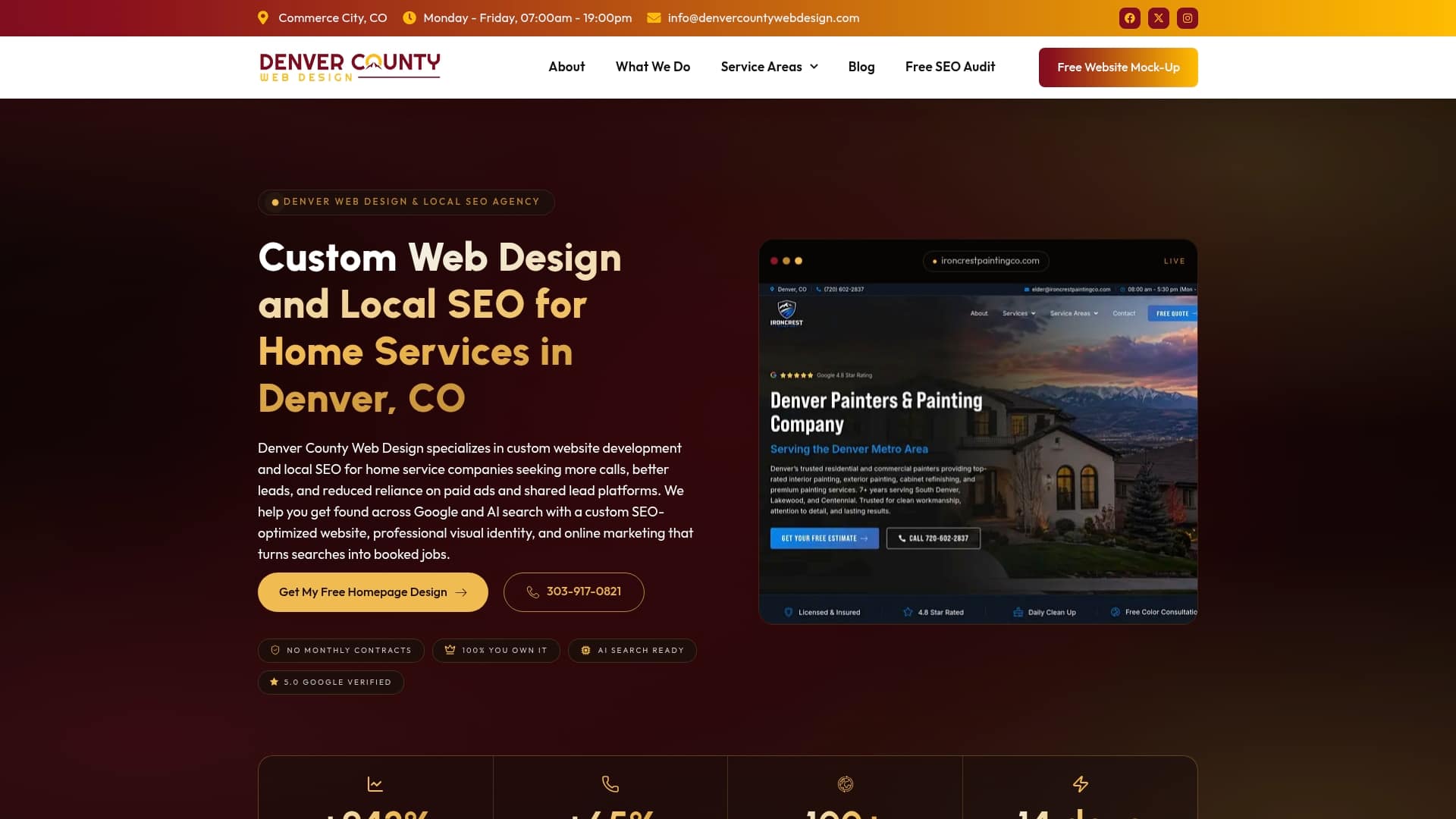
The agency offers one-time WordPress website builds with local SEO baked in from day one: GBP setup and optimization, citation cleanup, city landing pages, schema implementation, review request workflows, and call tracking. No monthly platform fees. You own the site outright. For plumbers who want a fast, professional web presence without a long-term agency contract, that model removes a lot of friction.
Services relevant to plumbing businesses include GBP management, NAP audit and correction, service-area page builds, PlumbingService schema, and Google Ads campaign setup. You can also pair social content automation through tools like PostPixel’s plumbing social media templates to keep your local presence active across platforms.
Start with a free map-pack audit to see exactly where your GBP and site stand today. It takes five minutes and gives you a clear picture of what to fix first.
Sources
The resources below back the tactical steps in this guide and are worth bookmarking for ongoing reference.
- How to Improve Local SEO for Plumbers (2026 Guide)
- Local SEO for Plumbers: How to Rank on Google Maps and Get Found in AI Answers | Fokal Guides
- AI SEO for Plumbers 2026: Local SEO, Maps and GEO Guide | Flento
- Google Small Business Bulletin (GBP operational tips)
FAQ
How much should I pay for local SEO as a plumber?
A one-time GBP and site setup typically runs $500–$1,500. Ongoing monthly management ranges from $200 for basic citation and review work up to $2,000 or more for full local SEO retainers covering city pages, link building, and reporting.
What is the best way to advertise as a plumber?
Google Business Profile optimization combined with Google Local Services Ads (LSAs) gives plumbers the fastest path to booked calls because both appear at the very top of local search results. Organic local SEO builds sustainable visibility over months 3–6.
What is the 80/20 rule in SEO?
Those three actions drive the majority of map-pack visibility before any advanced tactic is needed.
Who handles plumbing SEO in the United States?
Local digital marketing agencies that specialize in home-service businesses handle plumbing SEO most effectively, because they understand the emergency-driven search behavior and the GBP verification requirements specific to licensed contractors. Denvercountywebdesign focuses specifically on home-service and contractor businesses in Colorado.
Recommended
- Google Ads for Electricians: Local Leads in 2026 – Denver County Web Design
- HVAC Google Ads for Contractors: Local Lead Playbook – Denver County Web Design
- Google Ads for Contractors: Get Local Leads Fast – Denver County Web Design
- Best Review Management Software for Local Businesses – Denver County Web Design