A custom, conversion-first website built for mobile lead capture, service-area SEO, and dispatch integration is the fastest way to turn web traffic into booked jobs. Generic templates and DIY builders leave money on the table because they are not built around how homeowners actually find and hire contractors: a quick Google search, a tap on a phone, and a call or form submission within 60 seconds. If your site does not make that path frictionless, you are handing leads to a competitor who does.
Here is what the right approach delivers:
- Faster bookings: click-to-call and multi-step forms reduce friction at the moment of intent
- Better local visibility: service-area pages and proper schema push you into the map pack
- Full ownership: no monthly platform fees, no vendor lock-in, and no hostage code
Pro Tip: Before you contact any web designer, pull up your current site on a phone and try to call yourself. If the number is not tappable within three seconds of landing, you already know the first fix.
Key Takeaways
A custom, conversion-first home service website built with full ownership, local SEO, and dispatch integration consistently outperforms template-based alternatives on lead volume and local search visibility.
| Point | Details | ||||||
|---|---|---|---|---|---|---|---|
| Choose your pricing model first | Decide between a one-time build (ownership, lower long-term cost) and a subscription before comparing vendors. | ||||||
| Require full ownership at launch | Confirm code and domain transfer in writing so you are never locked into a vendor’s platform. | ||||||
Table of Contents
- What does a home service website need to do?
- Services and features a professional builder should deliver
- Pricing models and what you should expect to pay
- What does the process look like from brief to launch?
- How do you choose the right home service web design provider?
- What should a strong portfolio actually show you?
- Why Denvercountywebdesign meets the criteria
- An honest perspective on what actually matters when building these sites
- Denvercountywebdesign: get a free map-pack audit
- Sources
- FAQ
What does a home service website need to do?
The job of a home service website is not to look good. It is to generate calls, form fills, and booked appointments, and every design decision should serve that goal. ServiceTitan’s curated examples of top-performing contractor sites consistently show that category-specific features, including scheduling widgets and clearly structured service pages, have a measurable effect on lead volume.
Lead generation comes first. Your site needs a sticky click-to-call button visible on every page, a mobile-first contact form that loads fast, and an after-hours capture option so you are not losing leads at 9 PM when a pipe bursts. According to TMN Creative, after-hours capture can account for a substantial portion of leads for home service businesses.
Local visibility is non-negotiable. Service-area pages, Service and LocalBusiness schema markup, and a Google Business Profile that matches your site’s NAP data are the three pillars of map-pack ranking. A 2026 local SEO checklist from MySearchHero identifies structured data, service-area pages, and AI-readable content as the highest-priority signals for local service visibility right now.
Trust signals close the deal. License and insurance badges, technician bios with real photos, live review pulls from Google, and financing or free-estimate options for larger jobs all reduce hesitation at the moment a visitor is deciding whether to call you or the next result.
Operational integration matters more than most owners realize. When a form lead or booking request flows directly into ServiceTitan, Housecall Pro, or Jobber, your dispatcher sees it in seconds. Manual re-entry is eliminated, and response time drops. That speed difference often determines who gets the job.
Statistic: Sites that combine mobile-first design with integrated booking flows and clear trust signals consistently outperform template-based alternatives on both call volume and local search rankings, according to WebsiteForces.
Services and features a professional builder should deliver
When you review a proposal, you are not just buying a design. You are buying a set of deliverables that either include the conversion infrastructure or leave it out. Here is what a complete scope looks like.
Design and content:
- Homepage with a clear value proposition and above-the-fold CTA
- Individual service pages (plumbing, HVAC, electrical, landscaping, etc.) with keyword-targeted copy
- Service-area pages for every city or neighborhood you want to rank in
- Technician bio pages and a licensing/insurance trust section
- Financing or free-estimate landing pages for high-ticket services
Lead capture and UX:
- Sticky click-to-call button on mobile
- Multi-step contact forms (shorter forms convert better than long ones)
- After-hours form with auto-response email or SMS
- Click-to-text option for text-first customers
- Optional chatbot or live-chat widget
Technical deliverables:
- Mobile-first build with fast load times (Google’s Core Web Vitals benchmarks apply)
- Structured data: Service schema, LocalBusiness schema, and FAQ schema
- CMS access so you can edit content without calling a developer
- Hosting setup, SSL, and automated backups
- SEO-first site architecture baked into the build, not retrofitted later
Integrations:
- ServiceTitan, Housecall Pro, or Jobber form-to-dispatch connections
- Google Local Services Ads (LSA) landing page alignment
- Call-tracking numbers (CallRail or similar) for attribution
- Payment or financing prequalification flows for larger jobs
For trade-specific nuances, like seasonal CTAs for lawn care or quote-request flows for irrigation, ForgeWeb Studio’s feature guide shows how buyer behavior varies by trade and why a one-size-fits-all template misses those details.
Ownership and maintenance:
- Confirm who owns the domain and code after launch
- Clarify where the site is hosted and whether you can move it
- Ask how content updates are handled (self-serve CMS vs. care plan)
- Understand what a care plan covers: updates, backups, security patches, and uptime monitoring
Pro Tip: Ask every vendor to send you a sample hosting and ownership agreement before you sign anything. A reputable builder will not hesitate. One who stalls is telling you something.
Pricing models and what you should expect to pay
Two models dominate the home service web design market, and they suit different business situations.
| Factor | Subscription / Monthly Retainer | One-Time Flat-Fee Build |
|---|---|---|
| Best for | Businesses wanting ongoing managed marketing and frequent iterative changes | Owners who want full ownership and lower long-term cost |
| Pricing model | Monthly fee (often $150–$500+/month) | One-time project fee; typical range $2,250–$5,000+ |
| What’s included | Design, hosting, updates, and sometimes SEO bundled | Design, development, SEO setup; hosting and care plans optional |
| Ownership | Site often stays with vendor; leaving means losing the asset | You own the code and domain outright from day one |
| Ongoing fees | Required; stopping payments may mean losing the site | Optional care plan only; no mandatory recurring cost |
| Turnaround | Varies; ongoing relationship model | Typically 1–3 weeks for a standard multi-page build |
What drives price up:
- Number of service-area pages (each requires unique copy and schema)
- Custom integrations (ServiceTitan, Housecall Pro, Jobber)
- Professional photography or video production
- Multi-location builds with separate local pages per city
- Google Ads landing pages or LSA-specific pages
What keeps price reasonable:
- Arriving with content ready (service descriptions, photos, bios)
- Limiting the initial scope to core pages, then expanding
- Choosing a vendor with a proven home-service template as a starting point
The subscription model can make sense when you want a single vendor handling design, SEO, and paid ads under one monthly bill. The one-time model wins when you want to own your asset, avoid long-term contracts, and pay a care plan only for what you actually use.
What does the process look like from brief to launch?
A well-run home service web project follows a predictable sequence. Knowing the milestones lets you hold vendors accountable and spot delays before they compound.
- Discovery: You share your services, service areas, competitors, and goals. The vendor audits your current site and Google Business Profile.
- Sitemap and wireframes: The page structure is mapped out before any visual design begins.
- Visual design: Homepage mockup first, then interior pages. You review and approve before development starts.
- Development: Pages are built in WordPress (or the agreed platform), forms are connected, and integrations are configured.
- Content population: Copy, photos, and schema markup are added to every page.
- Testing: Mobile performance, form submissions, call-tracking, and cross-browser checks.
- SEO switch and redirects: Old URLs are redirected, meta data is finalized, and Google Search Console is configured.
- Launch and post-launch monitoring: The site goes live, and the first 30 days of traffic and ranking data are watched closely.
Realistic timelines:
- Single-page refresh or landing page: 3–5 business days
- Full multi-page rebuild (5–15 pages): 1–3 weeks
- Multi-location build with 10+ service-area pages: 3–6 weeks or more
What speeds a project up: You arrive with approved copy, photos, and a clear list of services and cities. Decisions get made in 24 hours, not a week.
What slows it down: Complex CRM integrations, multiple stakeholders reviewing designs, missing content, or a large number of service-area pages that each need unique copy.
Pro Tip: At the wireframe stage, ask your vendor to show you the mobile version first. If they show you desktop wireframes only, that is a signal about where their priorities are.
How do you choose the right home service web design provider?
The difference between a vendor who delivers and one who disappoints usually shows up before you sign, if you know what to look for.
Evaluation checklist:
- Portfolio includes real home service clients (not just restaurants or retail)
- Documented results: lead increases, traffic gains, or map-pack ranking improvements
- Demonstrated integration experience with ServiceTitan, Housecall Pro, or Jobber
- Fast turnaround with clear milestone commitments in writing
- Full code and domain ownership transferred at launch
- SEO process is part of the build, not an upsell
Questions to ask every vendor:
- Who owns the code and domain after launch, and can I move my site to any host?
- How do you handle 301 redirects and Search Console during a relaunch?
- Do you build Service schema and LocalBusiness schema into every page?
- Can you show me an example of a service-area page you built that ranks?
- How do you connect forms to ServiceTitan, Housecall Pro, or Jobber?
- What does your reporting look like in the first 90 days after launch?
Red flag worth remembering: “If a vendor cannot show you a live example of a home service site they built that ranks in a local map pack, they are selling you a promise, not a proven process.”
Red flags to walk away from:
- Pricing is vague or changes after the proposal
- The site lives on a proprietary platform you cannot export
- Every client site looks identical (same template, different logo)
- No examples of CRM or dispatch integrations
- Mobile performance scores are poor on their own portfolio sites
Match the vendor to your scale: A solo operator (one trade, one city) needs a tight five-to-eight page site with strong local SEO. A small multi-tech crew needs service-area pages for every city they cover. A multi-location operator needs a scalable architecture with location-specific landing pages and consistent NAP data across all of them.

What should a strong portfolio actually show you?
A portfolio is only useful if it shows outcomes, not just aesthetics. Any vendor can show you a site that looks clean. Fewer can show you one that ranks and converts.
Portfolio signals that matter:
- Before-and-after conversion metrics (call volume, form submissions, lead count)
- Service-area SEO results: specific pages ranking in the map pack or top organic positions
- Real client testimonials tied to measurable outcomes, not just “great to work with”
- Integrated booking flows you can interact with on a phone
Key metrics to look for in a case study:
| Metric | What it tells you |
|---|---|
| Organic traffic increase | Whether the build improved search visibility |
| Lead volume change | Whether the design actually converts visitors |
| Map-pack ranking improvement | Whether local SEO was executed correctly |
| Page load speed (Core Web Vitals) | Whether mobile performance was prioritized |
How to verify claims: Ask for Google Search Console screenshots showing traffic before and after launch. Ask for call-tracking reports showing lead volume by month. Ask for the redirect plan they used during migration, because a botched redirect strategy can wipe out years of SEO equity overnight.
The proof types that matter most for home service businesses are lead volume, booking conversion rate, and local map visibility. Traffic numbers without conversion data are incomplete.
Why Denvercountywebdesign meets the criteria
Denvercountywebdesign builds custom WordPress websites specifically for home service businesses and contractors, with full code and domain ownership transferred at launch and no mandatory monthly ownership fees.
The service model maps directly to the decision framework outlined earlier. For a solo operator or small crew that wants ownership, fast delivery, and local SEO built into the site from day one, Denvercountywebdesign’s one-time project model removes the long-term contract risk that subscription platforms carry. Google Business Profile management and AI search optimization are included in bundled packages, which means the site is positioned for both traditional local search and the generative AI results that are increasingly shaping how homeowners find contractors.
An honest perspective on what actually matters when building these sites
The conventional wisdom in home service web design is to lead with design. A clean look, a professional color palette, and a modern layout. Those things matter, but they are not what fills a dispatch board.
What builders prioritize on day one is clarity: a service page that says exactly what you do, where you do it, and what to do next. The click-to-call button needs to be the most visible element on a phone screen, not buried below a hero image. After-hours form capture needs to be live before the site launches, not added later, because that first week of traffic is data you cannot get back.

The most common client mistake is a buried CTA. Owners spend weeks approving color choices and then approve a homepage where the phone number is in the footer. The second most common mistake is uploading uncompressed photos that push load times past three seconds on mobile, which is where most of your traffic is coming from.
Quick wins to ask your vendor for in the first week after launch: install a heatmap tool like Hotjar or Microsoft Clarity, set up call-tracking with a forwarding number, and A/B test your primary form headline. Those three things will tell you more about what your visitors actually do than any design opinion.
Get a Free homepage mock up concept for you home service business
Denver County Web Design builds lead-generating WordPress sites for home service businesses with full ownership, no monthly lock-in, and local SEO included from the start.
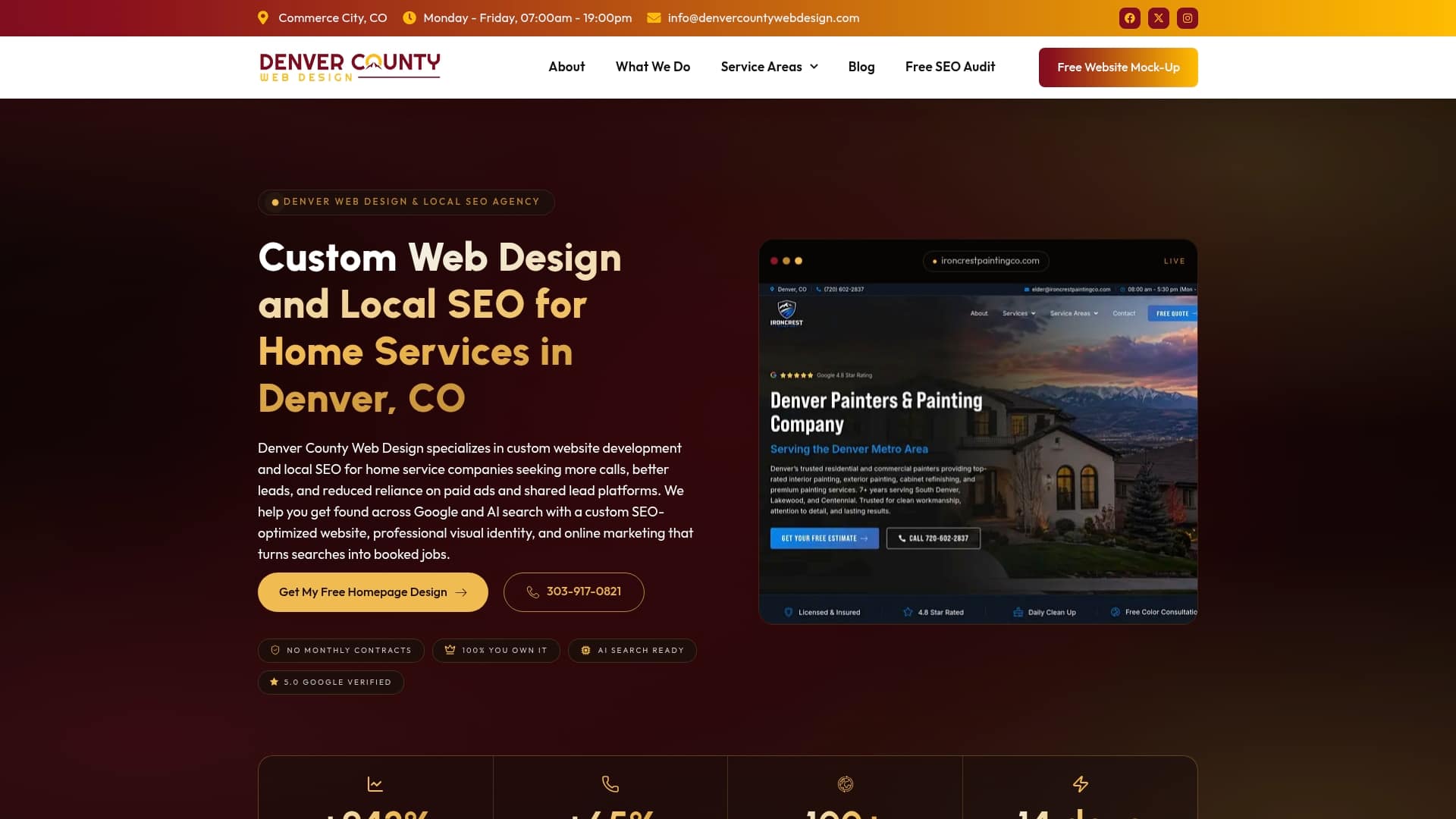
The agency handles custom design, service-area pages, Google Business Profile optimization, and Google Ads setup as a bundled package. Clients in Colorado have seen fast builds with no monthly fees and measurable gains in local search visibility. Whether you need a full rebuild or a targeted redesign, the process starts with a free map-pack audit that shows exactly where your current site is losing ground to competitors.
Request your free web design mock up and get a timeline estimate, a scope recommendation, and a clear picture of what a custom build would deliver for your business.
Sources
- 10 Best Home Service Websites: Examples & Improvement …
FAQ
How much does a home service website design cost?
A professional home service website typically runs $2,250–$5,000+ for a one-time custom build, depending on the number of service-area pages, integrations, and custom features. Subscription models charge $150–$500+ per month but often retain ownership of the site.
What is the three-second rule in website design?
If a page does not load and display its primary content within three seconds on a mobile connection, most visitors leave before they ever see your CTA. For home service sites where most traffic arrives on phones, this makes mobile load speed a direct factor in lead volume.
Is web design still in demand in 2026?
Yes, and specifically for local service businesses the demand is growing. AI-driven search results and Google’s map pack now require structured data, service-area pages, and AI-readable content that most older or template-built sites do not have.
Can an AI tool like ChatGPT design a home service website?
AI tools can generate copy and basic layouts, but they cannot configure ServiceTitan integrations, build proper LocalBusiness schema, set up call-tracking, or execute a redirect strategy during a relaunch. For a site that needs to rank and convert, a specialist builder handles what AI cannot.