The fastest path to booking more landscaping jobs from Google is a local-SEO-first program built around your Google Business Profile, a small set of deep service and location pages, and a steady stream of fresh reviews. That combination consistently drives the map-pack calls and quote requests that turn into signed contracts, more than blog volume or generic “SEO packages” ever will.
If you’re vetting who should build that program, here’s a working shortlist to start from:
- Denvercountywebdesign — SEO-ready website builds for Colorado home-service businesses, with GBP setup and full site ownership included, no monthly fees to keep it running.
- Lawnline Marketing — Lawn care and landscaping specialists with packages built around the seasonal rhythm of the industry.
- Built-Right Digital — Works almost exclusively with contractors and trades, so the content and link strategy already speaks your customers’ language.
- Blue Corona — Strong pick if closed-loop call tracking and lead attribution matter as much as rankings to you.
- WebFX — A large-scale option for companies ready to run SEO, paid ads, and content simultaneously with a big team behind it.
- Thrive Internet Marketing Agency — A full-service national agency if you want one vendor handling everything from technical SEO to social.
Before you sign anything, run a three-point gut check on your own presence: is your Google Business Profile fully filled out with photos and the right primary category, do you have a dedicated page for each core service and each city or neighborhood you actually serve, and are you collecting reviews on a schedule instead of in occasional bursts? If any of those come back weak, that’s your starting point. A free map-pack audit can tell you exactly where you stand before you spend a dollar on an agency.
Key Takeaways
Booking more landscaping jobs from search depends on a fully optimized Google Business Profile, a small set of deep local service pages, and a consistent review-request workflow working together, not any single tactic alone.
| Point | Details |
|---|---|
| GBP comes first | A complete, photo-rich Google Business Profile drives more map-pack calls than any other single asset. |
| Depth beats volume | Build 5 to 20 unique service and location pages rather than one generic services page. |
| Review velocity matters | Aim for a steady stream of new verified reviews in competitive markets. |
| Set realistic timelines | Expect early lifts by month 4 to 6 and compounding results by month 6 to 12. |
| Consider Denvercountywebdesign | For Colorado landscapers, Denvercountywebdesign bundles an SEO-ready site build with local SEO and GBP setup, with full ownership and no monthly fee. |
Table of Contents
- What Is Landscaper SEO and Why Does It Work Differently?
- How Do Top Landscaping SEO Agencies Compare?
- What Should You Ask an SEO Agency Before You Hire Them?
- What Services Actually Move the Needle for Landscapers?
- How Much Does Landscaper SEO Cost and How Long Until Results?
- How Were These Landscaping SEO Agencies Evaluated?
- What Does a Real Landscaper SEO Result Look Like?
- When Should You Hire an Agency Versus Handle SEO Yourself?
- Get an SEO-Ready Website Built for Colorado Landscapers
- Sources
- FAQ
What Is Landscaper SEO and Why Does It Work Differently?
Landscaper SEO is the practice of optimizing a landscaping company’s online presence, primarily its Google Business Profile, website, and local content, so it shows up when nearby homeowners or property managers search for lawn care, landscape design, or seasonal cleanup services. It behaves differently than SEO for e-commerce or national brands because almost every valuable search has a location baked into it, whether the searcher types it or not.
That distinction matters for budgeting. A generic “SEO agency” that built its playbook on ranking blog content for a software company will often default to publishing articles, when what actually moves a landscaper’s phone is a fully built-out Google Business Profile combined with review velocity and dense local service pages. A fully fleshed-out profile with accurate categories, complete service listings, and fresh photos is the single highest-impact local-SEO asset most landscaping businesses have available to them.
The keyword research also splits into three buckets that a good landscaper SEO strategy has to serve at once: transactional searches (“landscaping company near me”), informational searches (“when to aerate lawn”), and seasonal searches (“spring cleanup services”), each requiring different page types and different timing. Miss the seasonal bucket and you’re publishing spring cleanup content in April, when the demand spiked in February.
How Do Top Landscaping SEO Agencies Compare?
Once you know what good landscaper SEO looks like, the harder question is who should build it. Here’s how the major players stack up on the dimensions that actually matter to a landscaping business owner: what they’re best suited for, what they typically charge, and what they’ll actually deliver.
If your budget is tight and your biggest problem is showing up in the map pack at all, start the conversation with a provider like Denvercountywebdesign, Lawnline Marketing, or Searchbloom, since GBP and local visibility sit at the center of what they sell. If you’re already ranking locally and need content depth or link-building muscle to push past competitors, Sure Oak or Built-Right Digital are worth a call. And if you’d rather hand off marketing entirely, including paid ads and a CRM, Scorpion or Thrive Internet Marketing Agency cover more ground under one roof.
Whichever name you call first, look for the same three trust signals before you commit:
- Published case studies with actual before-and-after numbers, not just claims of “increased traffic.”
- A pricing structure they’re willing to put in writing, not a vague “it depends” on the first call.
- A review count and testimonial history you can verify independently, not just quotes on their own homepage.
What Should You Ask an SEO Agency Before You Hire Them?
Choosing a landscaper SEO partner comes down to matching their experience to your specific problem, then stress-testing their promises before you sign a contract.
1. Confirm they understand seasonal and route-based demand. A landscaping company’s search volume spikes and dips with the calendar, and an agency that treats every month the same will waste your budget in the slow season and miss the surge in spring. Ask directly how they plan content and campaigns around your service area’s seasonal patterns.
2. Ask for their exact Google Business Profile process. This should include how they’ll optimize your primary and secondary categories, how often they’ll update photos, and how they plan to grow reviews. If the answer is vague, that’s a program built on guesswork.
3. Request sample service and location pages, not just rankings. A landscaper SEO strategy built on 5 to 20 targeted pages, covering distinct services and the specific neighborhoods you serve, consistently outperforms one generic services page. Ask to see real examples from past clients in a similar market.
4. Ask how they track leads back to booked jobs. Clicks and calls are not the same as signed contracts. Without call and form tracking tied to actual outcomes, it’s easy to mistake more traffic for more revenue.
5. Get contract terms and cancellation policy in writing. Twelve-month lock-ins are common in this industry, but you should know exactly what happens if performance stalls at month four.
Watch for these red flags, any one of which should end the conversation: guaranteed page-one rankings (no legitimate agency can promise this), a single templated “landscaping SEO package” applied to every client regardless of market size, and a pitch built around dozens of thin micro-sites instead of one strong domain.
Pro Tip: Before believing a case study, ask for the client’s name and check their current Google Business Profile and rankings yourself. A real result should still be visible months later; a cherry-picked screenshot from a short-lived spike usually isn’t.
What Services Actually Move the Needle for Landscapers?
Not every SEO deliverable earns its cost. For landscapers specifically, the work that reliably turns into booked jobs clusters around a handful of activities, and everything else is secondary.
Google Business Profile management sits at the top of the list. A complete profile with the right categories, a full service menu, and regular photo uploads is consistently the biggest driver of map-pack calls and clicks. Review velocity matters here too. Practitioners generally aim for a steady stream of new verified reviews in competitive markets, since recency carries more weight than a large stagnant review count. A tool built for this kind of ongoing review collection can make the difference between a profile that looks abandoned and one that looks active.

Service and location pages need real depth, not templates. Each location page should run 600 words or more, name the actual neighborhoods you serve, and include at least one embedded review and one project photo from that area, because thin, duplicated location pages risk suppression rather than rankings. This is also where route-density thinking pays off: build real pages only for the areas your crews already serve efficiently, then let proof of local work reinforce those pages over time, an approach detailed by Grow Group.
Local link-building and citations still carry weight. Getting listed accurately on directories like Landscapeprofessionals or the Better Business Bureau builds both referral traffic and the kind of consistency signal Google uses to confirm your business is legitimate and locally rooted.
Visual content converts better than text alone. Guides consistently recommend 20 or more project photos in your Google Business Profile and on your site, since a strong before-and-after portfolio does more to convert a hesitant homeowner than another paragraph of service copy.
Technical basics still gate everything else. A slow-loading site, a quote form buried below three scrolls, or a phone number that’s hard to find will undercut even a well-ranked page. Structured data marking up your service types and a mobile-first layout are table stakes, not extras.
A landscaping company that stacked these five elements together (GBP overhaul, five new service pages, a review-request workflow, and a faster mobile site) typically sees its map-pack impressions climb within the first quarter, well before the organic blue-link rankings catch up.
How Much Does Landscaper SEO Cost and How Long Until Results?
Pricing for landscaper SEO generally falls into three shapes, and knowing which one you’re being offered changes how you should evaluate the pitch.
Monthly retainers are the most common model, where an agency charges a flat monthly fee for ongoing work: content, GBP management, link building, and reporting. Project-plus-retainer pricing covers an upfront build (a new site, a full local SEO foundation) followed by a smaller monthly fee for maintenance and growth. Performance-linked pricing ties part of the fee to results, though it’s less common in local SEO than in paid advertising because rankings depend on so many variables outside any single agency’s control.
Timelines follow a fairly consistent pattern across the industry, though individual results vary by market competitiveness:
| Timeframe | What Typically Happens |
|---|---|
| — | Foundational work: GBP cleanup, technical fixes, initial service and location pages built |
| 4 to 6 months | Early lifts appear, often in map-pack visibility before organic rankings move |
| 6 to 12 months | Compounding results: broader keyword rankings, steadier lead flow, review base matures |
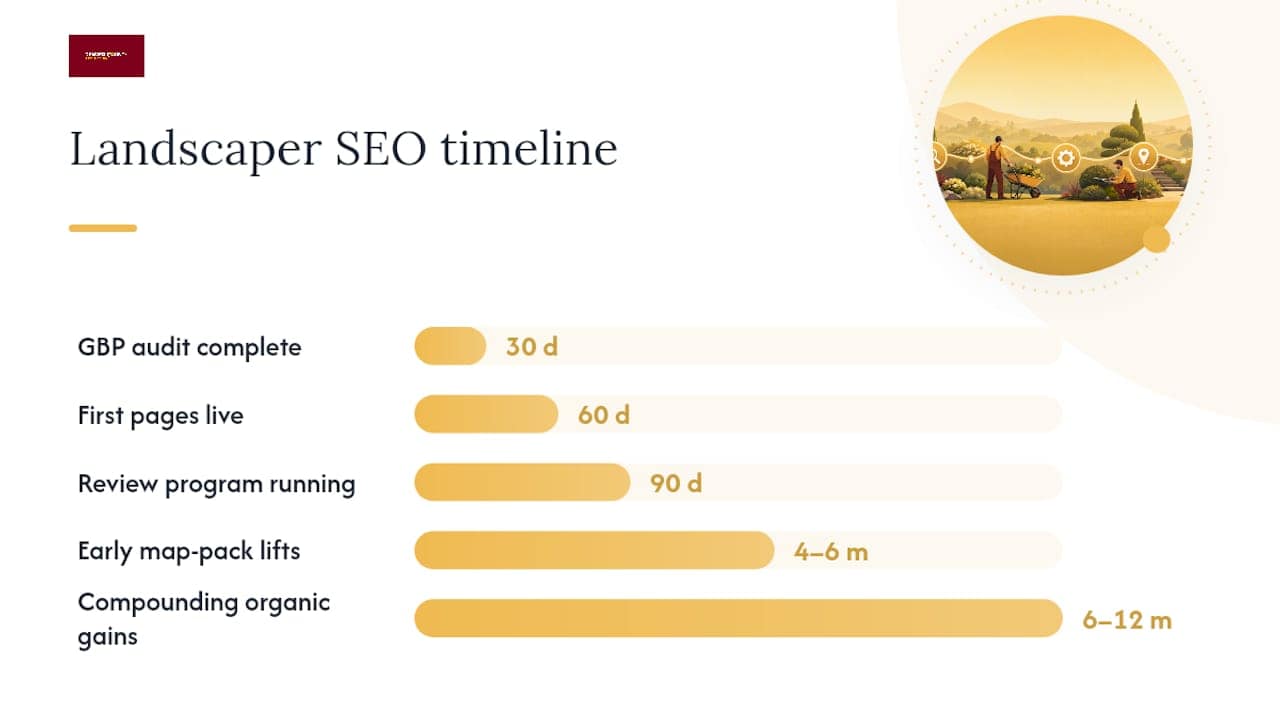
Google Business Profile improvements tend to show up faster than organic content rankings, since map-pack visibility can shift within weeks of a profile overhaul, while ranking for competitive organic terms typically takes 3 to 6 months for initial movement and 6 to 12 months for compounding gains. If an agency promises page-one rankings inside 30 days, that promise should worry you more than reassure you.
At the 30, 60, and 90-day marks, you should expect concrete deliverables: a completed GBP audit and optimization by day 30, the first batch of new service and location pages live by day 60, and an initial review-velocity program running with measurable call or form tracking by day 90. If an agency can’t commit to milestones like these in writing, ask why.
How Were These Landscaping SEO Agencies Evaluated?
This shortlist was built around five weighted criteria: demonstrated Google Business Profile capability, direct experience in landscaping or the broader home-services space, the presence of published case studies with real metrics, verifiable review counts and client testimonials, and pricing transparency.
| Criterion | What It Measures | Why It Matters |
|---|---|---|
| GBP capability | Depth of experience optimizing local map-pack presence | Primary driver of landscaper leads |
| Industry experience | Direct work with landscaping or home-service clients | Content and strategy fit customer search behavior |
| Published case studies | Availability of before-and-after metrics | Signals real, reproducible results |
| Review base | Volume and recency of client testimonials | Independent confirmation of service quality |
| Pricing transparency | Willingness to publish or discuss cost ranges | Reduces surprise costs and scope creep |
Sources for this evaluation included public case studies, agency service pages, third-party industry commentary such as Moderate Murmurations’ analysis of 2026 local SEO trends, and direct comparisons of published pricing structures where agencies made them available.
One limitation worth stating plainly: not every agency publishes detailed pricing or case metrics publicly, which means some comparisons rely on category-level patterns (typical retainer ranges, common contract lengths) rather than an exact number for every single vendor. Treat this table as a strong starting filter, then confirm specifics directly with any agency before signing.
What Does a Real Landscaper SEO Result Look Like?
A Colorado home-service client came to a local SEO overhaul with a Google Business Profile that had sat mostly untouched for over a year: no recent photos, an incomplete service list, and a review count that hadn’t moved in months. The website had one generic “Services” page covering everything from mowing to hardscaping, with no dedicated content for the specific towns the business actually served.
The intervention followed the same pattern outlined earlier in this guide: a full GBP rebuild with accurate categories and a fresh photo upload schedule, five new service and location pages built around the neighborhoods the crews already work in, and a structured review-request workflow triggered after every completed job.
By day 90, the client’s organic traffic had increased 243% compared to baseline, a jump Denvercountywebdesign has documented across multiple home-service clients using this same GBP-first, page-depth approach.
The traffic increase alone wouldn’t mean much without confirming it turned into actual work. Call tracking tied to each landing page and a dedicated tracking number on the Google Business Profile confirmed the lift wasn’t just curious clicks. It matched an increase in quote-request form submissions and booked estimate calls over the same 90-day window, the kind of closed-loop measurement that separates a real SEO win from a vanity metric.
When Should You Hire an Agency Versus Handle SEO Yourself?
There’s a point where doing landscaper SEO in-house stops making sense, and it usually arrives earlier than most owners expect.
If you’re a two-truck operation covering a single town, you can likely handle the basics yourself: claiming and filling out your Google Business Profile, uploading photos after every job, and asking satisfied customers for reviews. None of that requires an agency, just consistency. Where owners run into trouble is technical work: structured data, site speed optimization, and building genuinely unique content for multiple service areas at once. That’s where the return on hiring outside help climbs fast.
The trigger points I’d watch for are revenue scale, internal bandwidth, and geographic ambition. A company doing under $500,000 in annual revenue with one or two crews rarely needs a full agency retainer; the owner or a part-time marketing hire can manage GBP and reviews without much trouble. Past that point, or the moment you’re trying to expand into three or four new towns at once, the math flips. Building unique, deep content for each new service area while also running daily operations is close to a full-time job on its own.
The DIY tasks worth doing yourself regardless of budget: GBP photo uploads, review requests after every job, and responding to every review, good or bad. The tasks worth outsourcing almost immediately: technical SEO audits, structured data implementation, and building the initial batch of location pages, since getting the foundation wrong here is expensive to unwind later.
What surprises most landscaping owners isn’t the cost of a good program. It’s how much of the early plateau comes from a Google Business Profile that was never fully filled out in the first place, not from some complex algorithmic problem requiring an expensive fix.
Get an SEO-Ready Website Built for Colorado Landscapers
Denvercountywebdesign is the alternative to a long-term agency retainer for landscaper SEO in Colorado: you get a fully built, SEO-ready website with your Google Business Profile set up correctly from day one, and you own the site outright with no monthly fee just to keep it running.
That last part matters more than it sounds. A lot of landscaping companies discover, years into a contract, that their website disappears the moment they stop paying a monthly hosting or “platform” fee. Denvercountywebdesign builds the site, hands over full ownership, and bundles in the local SEO foundation, GBP setup, citation cleanup, technical on-page work, so you’re not stitching together three separate vendors to get one functioning local presence. For landscapers weighing a custom WordPress build against a slower agency onboarding process, the turnaround is built for speed without cutting corners on the SEO fundamentals covered throughout this guide.
If your Google Business Profile hasn’t been touched in a while, or you’re not sure your site is even showing up in the map pack for your own service area, start with a free map-pack audit to see exactly where the gaps are before committing to any provider.
Sources
These are the sources worth bookmarking if you want to go deeper on landscaper SEO or verify any agency’s claims yourself.
Before trusting any case study you find, check the date it was published and see whether the client’s rankings and reviews still hold up today. A screenshot from two years ago tells you very little about what an agency can do for you right now.
FAQ
Is $100 an Hour Too Much for Landscape Work?
That question is about service pricing, not marketing costs, but it matters here because your website and reviews need to justify whatever rate you charge. Landscaping labor rates vary widely by region and specialty, and $100 an hour is reasonable in many markets for skilled design or hardscape work, though basic mowing typically commands less.
How Much Should You Pay for SEO Services?
Costs vary by agency and scope, but most landscaping-focused SEO programs run as a monthly retainer, sometimes paired with an upfront project fee for a website rebuild. Rather than chasing the lowest price, prioritize agencies that publish clear pricing structures and can show real case studies tied to businesses similar to yours.
What Is the 80/20 Rule in SEO?
Applied to landscaper SEO, the 80/20 rule generally means that a small set of high-impact actions, primarily Google Business Profile optimization and a handful of deep service and location pages, drives most of your results, while lower-impact tactics like broad blog content contribute far less.
What Is an SEO Contractor?
An SEO contractor is an individual or agency hired to improve a business’s visibility in search results, typically through Google Business Profile management, on-page content, technical fixes, and local link building. For landscapers, the strongest contractors specialize in home-service or local businesses rather than general digital marketing.
How Long Does Landscaper SEO Take to Work?
Most landscaping businesses see early Google Business Profile lifts within a few months, with compounding organic results typically emerging between 6 and 12 months as service pages, reviews, and local links accumulate.