A construction website that actually works does four things: it tells visitors who you serve within five seconds, shows finished projects, makes contact effortless on a phone, and loads fast on a jobsite connection. Miss any one of those, and prospects bounce to the next contractor in the search results. If you’re building or fixing a site right now, you have two real paths: piece it together yourself with a template, or bring in a specialist who builds contractor sites for a living. We’ll get into both, but here’s what to do before you finish reading this article:
- Rewrite your homepage headline to name who you serve and what you build.
- Publish at least three finished projects with real photos, not stock images.
- Turn on click-to-call so your phone number is tappable from any device.
Key Takeaways
A construction website converts when it pairs an outcome-focused headline and real project photography with a fast, mobile-ready contact path that removes every unnecessary click.
| Point | Details |
|---|---|
| Fix the headline first | State who you serve and what you build so visitors self-qualify in five seconds. |
| Gallery is a sales tool | Structure projects by type, feature one hero project, and add case studies with scope and results. |
| Mobile speed is non-negotiable | Aim under three seconds to load, since mobile traffic now makes up roughly half to two-thirds of visits. |
| Build accessibility and security in | WCAG 2.1 AA compliance and SSL encryption protect both clients and your business from liability. |
| Consider a specialist build | Denvercountywebdesign delivers custom, fully owned sites with local SEO built in and no monthly fees. |
Table of Contents
- What Makes Construction Website Design Different From Other Industries
- Should Your Project Gallery Show Before-and-After Shots?
- How Fast Should a Construction Website Load on Mobile?
- What’s the Best Way to Capture Leads Without Losing Them?
- WordPress, Webflow, or Custom: Which Platform Fits Your Business?
- What Results Should You Expect From a Specialist Build?
- Should Your Website Connect to Your Project Management Tools?
- Is Your Construction Website ADA Compliant?
- How Do You Protect Client Data on Your Contractor Website?
- What Contractors Get Wrong About Website Design
- Ready to Build a Site That Wins the Job Before You Even Bid?
- Sources
- FAQ
What Makes Construction Website Design Different From Other Industries
Contractor sites live or die on trust signals that other industries barely need. A software company can sell on features. You’re selling on proof that you’ll show up, do the work right, and not vanish with a deposit. That changes what “good design” means here.
1. Write a headline that does the qualifying for you. The formula that works: who you serve, what you build, and the typical project size. “Denver’s trusted remodeler for kitchen and bath projects from $15,000 to $80,000” tells a visitor in one line whether they’re in the right place, and it filters out the tire-kickers before they ever call.
2. Build your homepage around six blocks, not twenty. Value proposition, core services, a project gallery, proof (reviews, certifications, logos), and one obvious call-to-action. Best-practice contractor homepages tend to follow exactly this ingredient list, and the ones that don’t tend to bury the phone number under three scrolls of stock photography, according to Bizango’s construction website design guide.

3. Design for thumbs, not mice. High-contrast buttons, tap targets big enough to hit on a moving job truck, and photography that shows actual scale and finish quality. Strong contractor sites treat photos as evidence, not decoration. Every image should answer a question a buyer actually has, like “how big is their crew” or “do they handle tile work like mine,” according to Huemor’s analysis of top construction sites.

Pro Tip: Swap “Submit” or “Learn More” for something concrete like “Get a Free Quote” or “Call Now: Same-Day Response.” Vague button text is friction. Specific button text is a promise.
Should Your Project Gallery Show Before-and-After Shots?
Yes, and it should do more than sit there looking nice. A gallery is your proof ladder: imagery first, quick stats or client logos second, deeper case studies third. That sequencing mirrors how strong contractor sites structure their content around what the visitor still needs to know before they trust you, according to Huemor.
Build it around these habits:
- Filter by project type (kitchens, additions, commercial buildouts) so visitors can find work like theirs in two clicks.
- Lead with one featured project as a hero image, not a grid of thumbnails nobody clicks.
- Use before-and-after sliders for remodels; they outperform static side-by-side photos for engagement.
- Write a short case study for each major project: context, scope, timeline, budget range, and a contact CTA at the bottom.
- Compress and lazy-load every image with a responsive srcset so a 40-photo gallery doesn’t tank your load time.
If you already have a folder of finished-job photos sitting on a hard drive, that’s a gallery waiting to happen. Sort by project type, pick your best five, write two sentences of context for each, and you have a working portfolio by end of day. Portfolio-first layouts with real project photography show up consistently across the strongest examples in the industry, according to SiteBuilderReport’s roundup of construction websites.
How Fast Should a Construction Website Load on Mobile?
Under three seconds, and ideally closer to two. Anything slower and you lose visitors who are standing on a jobsite with two bars of signal, trying to check if you’re worth calling.
A significant portion of all web traffic now comes from mobile devices, which means your site’s mobile experience isn’t a secondary consideration anymore. It’s the primary one, according to Statista’s traffic data.
Local search visibility matters just as much as speed. A few non-negotiables:
- Claim and fully optimize your Google Business Profile with updated photos, service areas, and reviews.
- Add Service and LocalBusiness schema markup so Google and AI search tools can pull your service area, hours, and reviews directly into results.
- Build separate service-area landing pages if you cover multiple towns, instead of one generic “service area” page.
- Compress images, limit plugins, enable caching, and check your Core Web Vitals scores monthly.
Specialized construction builds tend to bake in schema and Google Business Profile integration from day one, which is a meaningful gap between a template site and a site engineered for local discovery, according to Interactive Builds.
What’s the Best Way to Capture Leads Without Losing Them?
Make your phone number impossible to miss, and make your form painless to finish. That’s the whole strategy in one sentence, but the execution matters.
- Put a click-to-call phone number in a sticky header that follows visitors down the page on mobile. If they have a question mid-scroll, the answer is one tap away.
- Keep your contact form to five fields or fewer: name, phone, project type, timeline, and a message box. Add an optional file upload for plans or an RFP for commercial leads.
- Add a response-time promise near the form (“We respond within one business day”) and a link to a relevant case study so the ask feels lower-risk.
- Connect your form directly to a CRM like Jobber or HubSpot so a new lead triggers an instant notification instead of sitting in an inbox until Monday.
Pro Tip: Every extra form field cuts your completion rate. If you don’t need it to give a quote, cut it.
WordPress, Webflow, or Custom: Which Platform Fits Your Business?
Your platform choice should follow your budget and your growth plans, not the other way around.
- WordPress works well for contractors who want an easily editable portfolio and strong SEO fundamentals on a moderate budget. Skip the bloated page builders that slow load times; a lean, purpose-built theme beats a drag-and-drop kit loaded with plugins you’ll never use.
- Webflow or Framer suit contractors who want more visual polish and design control without a full custom build, though their content management gets clunky once your portfolio grows past a few dozen projects.
- A custom-coded build makes sense when you need integration with Procore or Autodesk for RFP workflows, or when enterprise-level performance is non-negotiable. That kind of integration can meaningfully cut the pre-bid admin time on commercial jobs, according to Interactive Builds.
Whatever you choose, insist on full ownership of the finished site. If you’re paying a recurring fee just to keep your own website online, that’s leverage you’re handing away, and it complicates things if you ever sell the business or switch vendors.
What Results Should You Expect From a Specialist Build?
Denvercountywebdesign builds custom WordPress sites and runs local SEO specifically for home service and contractor businesses across the Denver metro area, which means the site isn’t a generic template with your logo dropped in.
The agency reports a 243% increase in organic traffic within 90 days for numerous clients, driven by a combination of on-page SEO fixes, Google Ads management, and AI search optimization working together rather than any single lever.
Every project ships with the same client promise:
- Full ownership of the finished site, with no recurring monthly fees.
- Fast delivery, so you’re not waiting months for a site that should take weeks.
- A day-one checklist: rewritten headline, three live projects, mobile click-to-call, and a speed baseline.
A site that ranks well but converts poorly is a wasted opportunity. A site that converts well but nobody finds is invisible. Contractors need both working at once, not one traded off against the other.
Should Your Website Connect to Your Project Management Tools?
If you’re running commercial jobs or managing multiple crews, yes. A website that only markets your business is leaving work on the table; a website that also connects to your operations saves hours every week.
The most practical integration point is the RFP and bid process. Linking project pages to tools like Procore or Autodesk lets a general contractor pull specs, submit questions, and upload bid documents without ever leaving your site. That single connection can meaningfully shorten the pre-bid admin cycle for commercial work, according to Interactive Builds.
For residential and smaller commercial contractors, a client portal often matters more than deep PM integration. A simple login area where a homeowner can check project status, view photos from the crew that day, approve a change order, or pay an invoice reduces the phone tag that eats up your office manager’s afternoon. It doesn’t need to be elaborate. Even a basic portal that pulls status updates from your existing job management software (Jobber, BuilderTrend, or similar) cuts down on the “just checking in” calls that interrupt real work.

The mistake to avoid: building a custom portal from scratch when your existing project management software already has a client-facing feature you’re not using. Check what you’re already paying for before you commission something new. Most modern construction software has this built in; the website’s job is usually just to link to it cleanly and make the login easy to find, not to duplicate it.
Is Your Construction Website ADA Compliant?
If you don’t know, the honest answer is probably not, and that’s a real liability, not just a nice-to-have.
The Americans with Disabilities Act doesn’t spell out exact web design requirements, but courts and the Department of Justice have consistently treated business websites as covered under Title III, and the standard most commonly referenced is the Web Content Accessibility Guidelines (WCAG) 2.1 at the AA level. That means sufficient color contrast, text alternatives for images, keyboard navigation that works without a mouse, and forms that screen readers can actually parse.
For a construction company, this isn’t abstract. Your project gallery needs descriptive alt text on every photo, not just “IMG_4021.jpg.” Your video walkthroughs and drone footage need captions or transcripts. Your contact form needs labels that a screen reader announces correctly, and your color palette needs enough contrast that someone with low vision can still read your phone number.
Getting sued over an inaccessible website has become common enough across small business sectors that it’s worth treating as basic risk management, not an edge case. A short accessibility audit, whether you run one yourself with a free tool or have your web developer check it during a redesign, is far cheaper than a demand letter.
The fix usually isn’t a full rebuild. Most accessibility gaps come down to missing alt text, poor color contrast on buttons, and forms without proper labels. All three take a developer a day or two to correct on an existing site.
How Do You Protect Client Data on Your Contractor Website?
Every contact form on your site collects personal information, and every RFP upload might include floor plans, budget details, or property addresses you don’t want floating around unprotected.
Start with the basics that too many contractor sites skip. An SSL certificate (the padlock icon in the browser bar) encrypts data in transit and is table stakes at this point, not a bonus feature. If your site doesn’t have one, browsers actively warn visitors it’s “not secure,” which kills trust before a lead ever reaches your form.
Beyond that, a few practices matter more for construction sites specifically:
- Keep your CMS, plugins, and themes updated. An outdated WordPress plugin is the single most common way small business sites get compromised.
- Use a form service or CRM integration that encrypts submitted data rather than emailing plain-text form contents to a shared inbox.
- Limit who has admin access to your website backend, and use strong, unique passwords for that access.
- If you store client documents (contracts, plans, invoices) on your site’s backend, make sure that storage isn’t publicly indexable by search engines.
Full site ownership matters here too. If you’re locked into a platform you don’t control, you can’t always verify what security practices your host actually follows. Owning your build outright means you decide who has access and how it’s maintained, rather than trusting a vendor’s back-end promises on faith.
What Contractors Get Wrong About Website Design
Most contractors treat their website like a digital business card: a place to look legitimate, not a place to generate work. That’s backward. The research on top-performing contractor sites is consistent on this point. Clarity comes first, then proof, then a low-friction next step, and skipping straight to “look professional” without that sequence is why so many contractor sites get traffic but not calls.
The overrated fix is a full redesign. Most contractor sites don’t need new architecture; they need a sharper headline, three real project photos instead of stock imagery, and a phone number that’s tappable instead of buried in a footer. I’d rank speed above aesthetics every time, because a beautiful site that takes six seconds to load on a truck’s hotspot loses the lead before the visitor ever sees the design.
What gets underestimated is the gallery. Owners treat it as an afterthought gallery page instead of the actual sales tool it is. A homeowner deciding between three quotes isn’t reading your “About Us” copy closely. They’re scrolling your finished work, checking if you’ve done a kitchen like theirs, and deciding in about fifteen seconds whether to call. Build for that fifteen seconds first.
Ready to Build a Site That Wins the Job Before You Even Bid?
If you’d rather commission the fixes above than implement them yourself, that’s exactly the gap Denvercountywebdesign fills for contractors across the Denver metro area. The team builds custom WordPress sites bundled with local SEO setup and Google Business Profile management, so the headline, gallery, mobile speed, and contact flow described in this article get handled as one project instead of a dozen separate fixes.
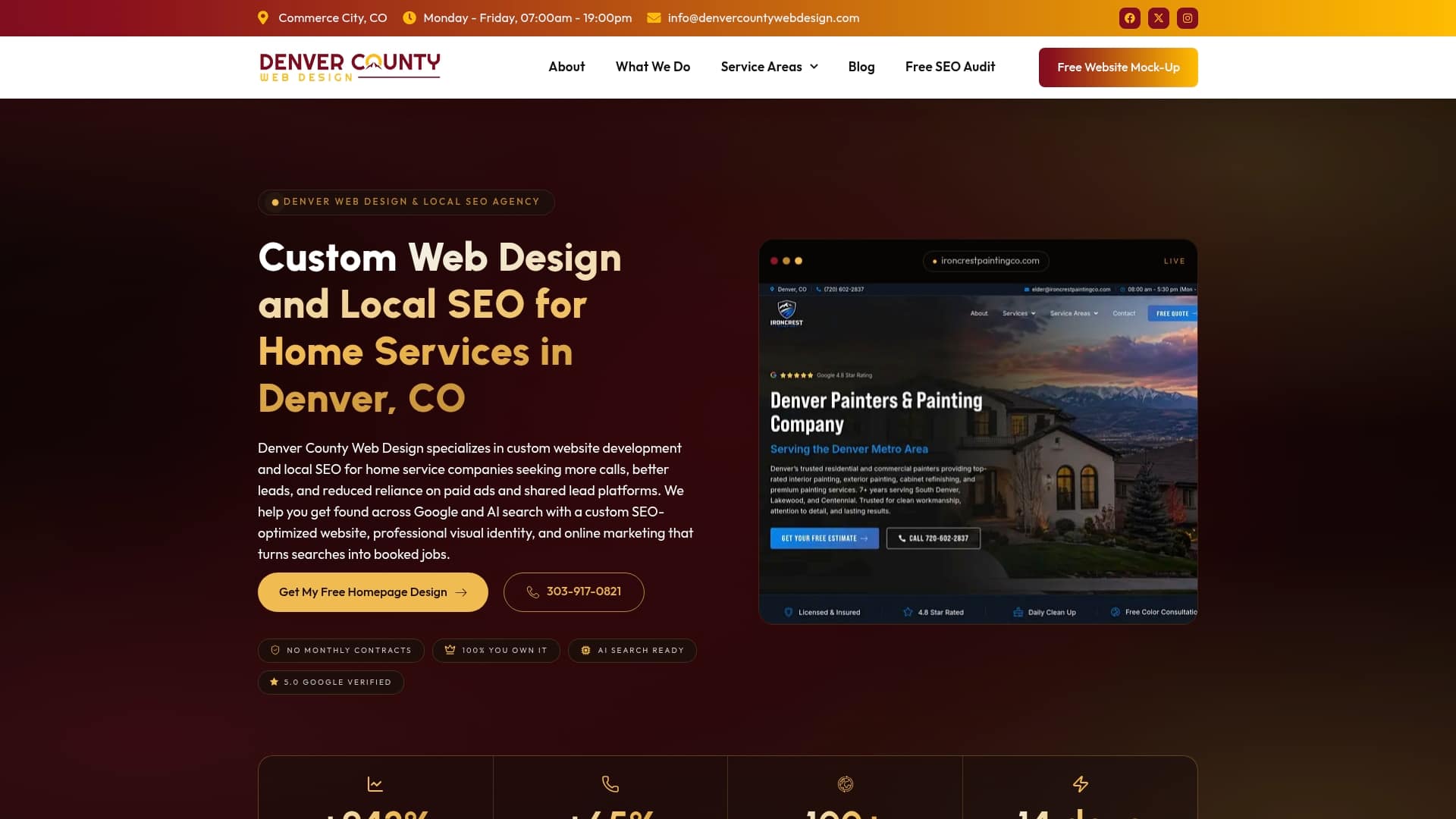
A typical build moves fast: a working, mobile-optimized site with your project gallery live, your click-to-call enabled, and your local SEO foundation in place, without a monthly fee attached to keep it running. You own the finished site outright, which means no vendor lock-in if you decide to sell the business or switch providers later. Start with a free SEO audit to see exactly where your current site is losing leads, or go straight to the construction website design page for Colorado contractors to see what a full build includes.
Sources
- Share of website traffic coming from mobile devices | Statista
- Web design for construction company | Interactive Builds
- The 10 Best Construction Website Designs | Huemor
- 27 Examples of great construction websites | SiteBuilderReport
FAQ
What Should Be on a Construction Company Homepage?
A clear headline naming who you serve, a short services list, a project gallery, trust signals like certifications or reviews, and one obvious call-to-action such as a phone number or quote form.
How Fast Should a Contractor Website Load?
Under three seconds is the practical target, since mobile traffic now accounts for roughly half to two-thirds of all site visits and slow load times drive prospects to the next search result.
Do Small Contractors Need Schema Markup?
Yes. Service and LocalBusiness schema helps Google and generative AI search tools surface your service area, hours, and reviews directly in results, which specialized construction builds typically include by default.
Is WordPress or a Custom Build Better for a Construction Company?
WordPress fits most contractors who need an editable portfolio and solid SEO on a moderate budget, while a custom build makes sense when you need integrations like Procore or Autodesk for commercial bid workflows.
How Quickly Can a New Construction Website Go Live?
Timelines vary by scope, but Denvercountywebdesign focuses on fast delivery for contractor sites, often getting a fully owned, SEO-ready build live in a matter of weeks rather than months.