Do these three things now: fully optimize your Google Business Profile, publish a dedicated EV charger or emergency service page, and launch a simple review workflow. Together, they produce measurable map-pack movement and more calls within 60 to 90 days.
Here’s why those three, and not ten others. Google ranks local businesses on relevance, distance, and prominence, and prominence, built through reviews, citations, and backlinks, is the one factor you actually control day to day. You can’t move your shop closer to a customer’s house. You can absolutely earn 40 more reviews and publish a page that answers exactly what someone typing “EV charger installer near me” wants to know.
- Fix your Google Business Profile first. Categories, services, and photos drive both visibility and clicks.
- Publish one high-intent service page. EV charger installs and emergency repairs convert better than a generic “electrical services” page ever will.
- Start a review workflow you’ll actually keep doing. Velocity and specificity beat a one-time push for 20 reviews.
Expect early movement in the map pack within a couple of months and steadier, more predictable lead flow within several months, assuming you keep the review workflow running the whole time.
Key Takeaways
Local SEO for electricians works when Google Business Profile optimization, one high-intent service page, and consistent review acquisition run together as a system, not as separate one-off tasks.
| Point | Details |
|---|---|
| Fix GBP first | Complete categories, service entries, photos, and attributes before touching anything else. |
| Publish one strong page | An EV charger or emergency service page converts better than a generic services page. |
| Build review velocity | Text within two hours of the job, follow up by day three and day seven, then stop. |
| Clean up citations quarterly | Match your name, address, and phone across licensing boards, dealer locators, and directories. |
| Consider a specialized partner | Denvercountywebdesign builds electrician-ready sites with GBP management and no monthly fees. |
Table of Contents
- Local SEO for Electricians: Fixing Your Google Business Profile
- Website Architecture for Electrician Local SEO
- Building Review Velocity That Actually Moves Rankings
- Citation Cleanup and NAP Consistency
- Local Keyword Research for Electricians That Actually Converts
- Technical SEO Signals Electricians Can’t Skip
- Turning Clicks and Calls Into Booked Jobs
- Tracking Your Local SEO Progress Over 90 Days
- When It Makes Sense to Bring in Denvercountywebdesign
- The One Project Worth Starting This Quarter
- Get a Free Map-Pack Audit From Denvercountywebdesign
- Sources
- FAQ
Local SEO for Electricians: Fixing Your Google Business Profile
Your Google Business Profile is doing more heavy lifting than your website right now, and if you haven’t touched it since you set it up, you’re leaving calls on the table. GBP completeness correlates directly with Map Pack performance and clicks, which means the electricians filling out every field are quietly outranking the ones who aren’t.
Here’s the order to work through it:
- Claim and verify your profile through Google Business Profile if you haven’t already, and confirm the verification method matches your actual business address or service area.
- Pick one primary category that’s as specific as possible. “Electrician” beats “Contractor.” If you install EV chargers regularly, that’s worth a secondary category, along with “Electrical Installation Service” if it fits your work.
- Build out a service entry for every high-value offering. EV charger installation, panel upgrades, emergency electrical repair, generator hookups. Each entry is a small chance to rank for that specific query.
- Upload real job photos, not stock images. Panel boards mid-install, your branded van outside a customer’s house, your crew on a ladder. Geotag them when your camera allows it, and add new photos every couple of weeks rather than dumping 30 at once.
- Use GBP posts and the Q&A section to seed keywords naturally. Answer the questions customers actually ask: “Are you licensed and bonded in this county?” “Do you offer emergency service after hours?”
- Set your attributes and hours accurately. If you run 24/7 emergency service, mark it. If you’re closed Sundays, say so. Nothing kills trust faster than a profile that says “Open” while your phone rings to voicemail.
Pro Tip: Photos with your logo, truck, and a visible job site outperform generic headshots for click-through rate. Customers are hiring a person, not a stock photo.
Website Architecture for Electrician Local SEO
Your site doesn’t need to be complicated to compete. It needs the right pages built the right way. At minimum, you want a homepage, a contact page with click-to-call front and center, a dedicated page for each core service, city pages for the markets where you actually get consistent work, and a lean emergency page built for someone in a panic at 11 p.m.

Each service page should answer the question before explaining the details. Lead with what the service is and what it costs in general terms, then cover the scope of work, your license and insurance information, a short FAQ, and a clear call to action. A page for panel upgrades that opens with three paragraphs of company history before mentioning price ranges is a page nobody finishes reading.
City pages earn their spot only when they say something a generic page can’t: permitting quirks specific to that jurisdiction, neighborhoods you regularly serve, or a review from a customer in that town. Google’s spam policies explicitly flag doorway pages, meaning five city pages with swapped-out city names and identical paragraphs will hurt you more than help.
- Build one pillar page per major service category, then link related blog posts and city pages back to it.
- Keep your emergency page short. Someone with a sparking outlet doesn’t want your company story, they want your phone number.
- Cross-link service pages to each other where the work naturally overlaps, like panel upgrades and EV charger installs.
Pro Tip: If you serve multiple towns without a storefront in each one, set your service area correctly in GBP instead of building a city page for every ZIP code you’ve ever driven through.
Building Review Velocity That Actually Moves Rankings
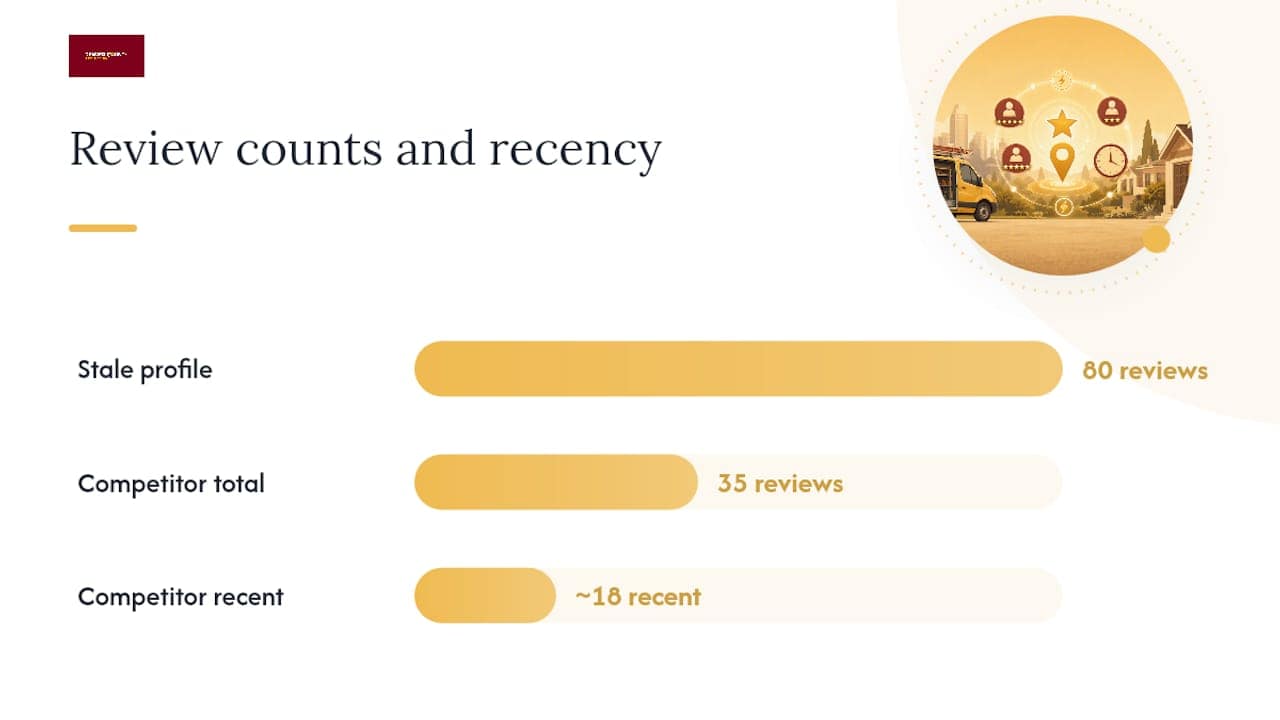
Review count alone doesn’t move the needle the way most electricians think it does. Recency and specific wording matter just as much. A profile with 80 reviews from three years ago reads as stale next to a competitor with 35 reviews, half of them from the last two months, mentioning “panel upgrade” and “same day service” by name.
A workflow beats a one-time push every time. Here’s a sequence that works without becoming a full-time job:
- Text or email within two hours of the job wrapping, while the relief of a fixed problem is still fresh. Keep it short: “Thanks for choosing us today for your panel upgrade. Mind leaving a quick review?” with a direct link.
- Follow up on day three if there’s no response, from a different team member if possible, so it doesn’t read as a bot.
- Send one final nudge on day seven, then stop. Repeated requests annoy customers and can trigger spam flags on the review platform.
Respond to every review, good or bad, within a day or two. For a negative review, acknowledge the specific complaint, offer to make it right off-platform, and never argue in the replies. Google’s own guidance treats incentivized or coerced reviews as a policy violation, so keep the ask genuine and never offer a discount for a review.
Prioritize Google first, since that’s what feeds the map pack directly, then layer in industry directories and local review sites. A review management workflow that automates the texting and tracking piece saves hours a month once your job volume climbs.
Pro Tip: Ask customers to mention the specific service in their review. “Great panel upgrade work” ranks for panel upgrade searches far better than “great service.”
Citation Cleanup and NAP Consistency
Your business name, address, and phone number need to match, character for character, everywhere they appear online. A mismatched suite number or an old phone line still listed on a directory somewhere quietly erodes the prominence signal Google uses to rank you.
Run a citation audit by searching your business name plus city and scanning the first few pages of results, cross-checking against a citation tool if you want a faster pass. Prioritize fixes on the sources that matter most for electricians specifically:
- Your state electrical licensing board listing, since it doubles as a trust signal for both Google and skeptical homeowners.
- Manufacturer dealer locators, like the ones for EV charger brands you’re certified to install.
- Local utility company rebate contractor lists, which often carry real domain authority in your service area.
- Broad aggregators including Apple Maps, Bing Places, and Yelp, which feed data to smaller directories downstream.
Document every correction with a date and screenshot, since directories sometimes revert changes during their own data refreshes. Link quality and local relevance matter more than sheer link volume here too, so a handful of accurate, high-relevance citations beats fifty low-quality ones. Set a quarterly reminder to recheck, or hand the monitoring to whoever manages your marketing.
Local Keyword Research for Electricians That Actually Converts
Start with a seed list: every service you offer, from panel upgrades to ceiling fan installs to whole-home rewiring. Combine each one with your city, the neighborhoods you serve, and intent modifiers like “cost,” “emergency,” “same day,” and “licensed.”
Once you have that list, sort it into clusters and assign each cluster to the page type built to rank for it:
- Homepage keywords cover your brand name and broad terms like “electrician near me.”
- Service page keywords get the specific, high-intent phrases: “EV charger installation cost” or “panel upgrade contractor.”
- Blog posts target informational questions: “how much does an EV charger installation cost” or “signs you need a panel upgrade.”
- City pages carry the location-specific long-tail combinations, but only where you’ve got genuinely local content to back them up.
The EV charger cluster deserves real attention right now. Practitioner playbooks in the electrical trade increasingly point to EV charger content as one of the fastest-growing traffic drivers for electrician sites, and cost guides, brand-specific installation pages, and permitting explainers all feed that demand.
For voice search and AI overview visibility, structure your answers to lead with a direct one or two-sentence response, then follow with supporting detail. “A Level 2 EV charger installation typically runs $800 to $2,000 depending on panel capacity and wiring distance” gives an assistant something clean to pull.
Pro Tip: Write the direct-answer sentence first, save the nuance for the paragraph after it. That’s the format AI tools quote most often.
Technical SEO Signals Electricians Can’t Skip
Mobile experience isn’t optional anymore. Slow mobile pages directly hurt conversions, and someone searching for an emergency electrician on their phone will bounce to a competitor if your site drags.
A short technical checklist covers most of what matters:
- Put a tap-to-call button in the header, visible without scrolling, on every page.
- Compress images and trim unused JavaScript and CSS to cut load time.
- Enable browser caching so return visitors get a faster experience.
- Add LocalBusiness and Service schema, plus FAQPage schema on pages with a Q&A section.
- Add serviceArea schema if you work as a service-area business without a public storefront.
- Include hasCredential schema tied to your license number where your site’s structure supports it, ideally on your homepage and about page, since it’s an emerging trust signal for both search results and AI-generated answers.
- Display license, bonding, and insurance information above the fold, not buried in a footer.
Turning Clicks and Calls Into Booked Jobs
A phone that rings into voicemail during business hours is a wasted click. Keep click-to-call visible on every page, and consider a 24/7 answering service if emergency work is part of your business model.
- Answer with the job type in mind. “Thanks for calling, are you dealing with an emergency or looking to schedule something?” sorts the call in five seconds.
- Confirm the appointment window out loud and send a text confirmation to cut down on no-shows.
- Use an online booking widget for routine work like inspections or estimates, but keep phone lines open for anything urgent.
- Track missed calls and long hold times. These show up as negative engagement signals and quietly work against your GBP performance over time.
Pro Tip: A missed call at 9 p.m. from a panicked homeowner is a lost job by 9:05 a.m. A basic answering service pays for itself the first month.
Tracking Your Local SEO Progress Over 90 Days
Watch five numbers: GBP profile views, calls from your listing, direction requests, organic clicks to your site, and map-pack position for your top three service terms. Layer review velocity on top of that.
- Days 1 to 30: Complete the GBP overhaul, publish your priority service page, and send your first round of review requests.
- Days 31 to 60: Expect early map-pack movement on your least competitive terms and a rising review count.
- Days 61 to 90: Look for organic clicks trending up and calls becoming more consistent week over week.
| Milestone | What to Check |
|---|---|
| Day 30 | GBP fully built out, service page live, review requests sent |
| Day 60 | Map-pack position improving on lower-competition terms |
| Day 90 | Steadier call volume and growing review count |
Use native GBP Insights and Google Search Console weekly at first, then monthly once trends stabilize. If nothing’s moved by day 60, revisit your service pages and category selection before assuming the whole strategy failed.
When It Makes Sense to Bring in Denvercountywebdesign
Doing all of this yourself is entirely possible if you’ve got the time and patience for it. Plenty of electricians don’t, and that’s where a partner built for this exact work earns its keep.
Denvercountywebdesign builds custom WordPress sites for Colorado home service businesses, handles Google Business Profile management, runs Google Ads campaigns, and applies AI search optimization so your business surfaces in generative answers, not just traditional results.
Clients working with Denvercountywebdesign have seen organic traffic climb 243% within 90 days, a direct result of pairing a properly built site with the GBP and review work outlined above.
- If you’re a one or two-truck operation stretched thin on time, delegating this frees up hours you’d otherwise spend fighting with photo uploads and schema markup.
- If you’re scaling into a new Denver-area market, a dedicated service page built correctly the first time beats months of trial and error.
- If you already have a site but it’s slow, thin, or missing service pages entirely, a rebuild often outperforms incremental patching.
The One Project Worth Starting This Quarter
If you’ve got limited hours to spend on marketing this quarter, spend them on the GBP overhaul, one strong EV charger or emergency page, and a review request workflow you’ll actually stick with. Everything else in this guide compounds on top of those three.
Week one checklist: claim and complete your GBP fields, draft your priority service page outline, and set up a simple text template for review requests. That’s a realistic seven days of work that starts producing visible movement within two months.
Get a Free Map-Pack Audit From Denvercountywebdesign
Denvercountywebdesign is the alternative to a traditional agency retainer for electricians in Colorado: you get a fully built, SEO-ready site you own outright, with no ongoing monthly design fees eating into your margin every month.
The agency builds custom WordPress sites specifically for home service businesses, handles Google Business Profile setup and ongoing management, runs Google Ads campaigns tailored to electricians, and layers in review system setup so the workflow described above runs without you chasing it manually. Projects typically move fast, since the team builds for speed rather than dragging clients through months of revisions.
Start with a free map-pack audit to see exactly where your GBP and site are losing visibility right now, then talk through whether a new site build fits your timeline and budget. You keep full ownership of the finished site, no monthly fees attached.
Sources
Search Engine Journal explains Google’s ranking model; Ahrefs and Semrush cover practical tactics; Google’s developer docs and Think with Google back technical and mobile claims.
- What Are Local Ranking Factors? Google’s Relevance, Distance & Prominence
- Search and Discoverability Spam Policies — Google Developers
- Mobile site load time statistics — Think with Google
FAQ
How much should I pay for local SEO as an electrician?
Costs vary widely by market size and scope, but a focused local SEO effort covering GBP, one service page, and reviews typically costs far less than a broad national SEO retainer, since the work is narrower and more targeted.
Is local SEO worth it for a small electrical contracting business?
Yes, because prominence signals like reviews and citations are within your control and directly influence map-pack ranking, unlike distance, which you can’t change.
What’s the highest-impact first move for local SEO?
A complete Google Business Profile overhaul, since GBP completeness correlates with both map-pack visibility and click-through rate.
How long until local SEO produces real results?
Expect early map-pack movement within 60 to 90 days and steadier lead flow by month four to six, assuming the review workflow keeps running the entire time.
Should I build a page for every city I service?
Only if you have genuinely unique local content for that city, like permitting notes or real customer reviews from there. Thin, duplicated city pages risk violating Google’s doorway page policies.
Recommended
- Google Ads for Electricians: Local Leads in 2026 – Denver County Web Design
- Google Ads for Contractors: Get Local Leads Fast – Denver County Web Design
- Best Review Management Software for Local Businesses – Denver County Web Design
- HVAC Google Ads for Contractors: Local Lead Playbook – Denver County Web Design