Optimize your Google Business Profile, build out targeted service and location pages, and launch a post-job review workflow — those three moves drive the fastest local lead growth for landscaping companies. Expect your first ranking lifts in 3 to 6 months, with results compounding through month 12. The sections below break each move into a checklist you can run yourself or hand to your crew.
TL;DR:
- Optimizing your Google Business Profile, adding detailed service and location pages, and actively managing reviews can lead to significant local ranking improvements within 3 to 6 months.
- Focus on claiming all GBP fields, requesting reviews immediately after job completion, and developing detailed service and location pages tailored to local searches.
- Prioritize seasonal content publishing 60 to 90 days before the peak demand to improve rankings and avoid outdated pages that lose its ranking power over time.
- Ensure your website is fast, mobile-friendly, and properly structured with schema markup to prevent losing potential leads due to technical issues.
- Consistently generate 10 to 15 new reviews monthly and build backlinks from local partners, suppliers, and community sources to increase your business’s prominence in local searches.
Table of Contents
- What Is Local SEO for Landscapers and How Does Google Rank You?
- Optimizing Your Google Business Profile for Landscaping Leads
- What Keywords Should Landscapers Target?
- Which Pages Does a Landscaping Website Actually Need?
- When Should Landscapers Publish Seasonal Content?
- Is Your Landscaping Website Fast and Technically Sound?
- How Many Reviews Does a Landscaping Company Need Each Month?
- How Do Local Citations and Backlinks Help Landscapers Rank?
- How Long Until Local SEO Delivers Results for a Landscaping Business?
- Why the 243% Traffic Jump Behind This Checklist Matters
- Get a Free Map-Pack Audit for Your Landscaping Business
- My Take on What Actually Moves the Needle First
- Where to Learn More About Local SEO for Landscapers
- Sources
- FAQ
What Is Local SEO for Landscapers and How Does Google Rank You?
Local SEO for landscapers means the process of getting your business found on Google Maps and in local organic results when homeowners search for services like “landscaping company near me” or “spring cleanup Aurora CO.” Google shows two distinct results for these searches, and each runs on different signals.
The map pack (the three businesses shown with a map at the top of results) draws mainly from your Google Business Profile: category accuracy, proximity to the searcher, review volume, and photo activity. The organic listings below it pull from your website: page content, technical health, and backlinks. A landscaper who ignores GBP but builds a beautiful website often misses the map pack entirely, and that’s where most “near me” clicks go.
Google weighs three factors when deciding who shows up: relevance (does your business match the search), distance (how close are you to the searcher), and prominence (how well known and reviewed is your business online). You can’t change distance, but you control the other two almost entirely.
What does winning actually look like for a landscaping business?
- More phone calls and form fills from your Google Business Profile, not just website traffic
- Higher-value leads, since local searchers with buying intent convert better than cold traffic
- Consistent lead flow through slow months, once seasonal content is built out
- Less dependence on paid ads, since organic and map-pack visibility compounds over time
Optimizing Your Google Business Profile for Landscaping Leads
Your Google Business Profile carries more ranking weight than any other single asset you own, and it’s free to fix today. GBP optimization is consistently cited as the top-priority local SEO task for service businesses, ahead of website changes or link building.
Work through this checklist in order:
- Pick the right primary category. “Landscaper” or “Landscaping Contractor” usually outperforms broader categories like “Gardener” for lawn and design services. Test both if you’re unsure which pulls more map-pack impressions.
- Add every relevant secondary category. Lawn care, irrigation, hardscaping, snow removal — each secondary category widens the searches you can appear in without diluting your primary listing.
- List services with keyword-matched names. Instead of “Yard Work,” write “Weekly Lawn Mowing,” “Retaining Wall Installation,” or “Sod Installation.” Match the phrases homeowners actually type.
- Set your service area by neighborhood, not just city. If you serve five suburbs around your base city, name them individually in the service area settings. This helps Google match you to hyperlocal searches.
- Upload photos weekly. Before-and-after project shots, crew photos, and equipment images all signal an active, real business. Profiles with fresh photo activity tend to earn more map-pack impressions than static ones.
- Use Google Posts, Q&A, and the booking button. Post seasonal offers or completed projects every one to two weeks, seed your own Q&A with the five questions customers always ask, and turn on booking if you take online appointments.
Pro Tip: Answer your own Google Q&A section before customers do. Post questions like “Do you offer free estimates?” and answer them yourself, this controls the narrative and gives Google more indexable content tied to your profile.
What Keywords Should Landscapers Target?
The best keywords for landscapers split into three buckets, and mixing them up is the most common research mistake small landscaping companies make.
Service keywords describe a specific job: “lawn mowing service,” “landscape design,” “paver patio installation.” Problem keywords describe a pain point before the homeowner knows the service name: “grass turning brown,” “drainage issues in backyard,” “yard flooding after rain.” Seasonal keywords spike and fade on a calendar: “spring cleanup,” “fall leaf removal,” “snow removal contract.”

Build your seed list by combining each service you offer with local modifiers: your city name, “near me,” and specific neighborhoods you serve. A company in a mid-size metro might target “landscaping [City],” “landscaper near me,” and “[Neighborhood] lawn care” as three separate page targets rather than one generic page trying to rank for all three.
For research tools on a tight budget, Google’s autocomplete and “People also ask” boxes cost nothing and reveal real search phrasing. Semrush’s long-tail keyword guidance is a solid next step once you’re ready to prioritize by volume and competition, and Ahrefs’ landscaper-specific SEO guide breaks down keyword difficulty by service type.
Once you have your list, map each keyword to a page type:
- Service keywords go to dedicated service pages
- Problem keywords go to blog posts or FAQ content that leads into a service page
- Seasonal keywords go to time-sensitive landing pages published ahead of demand
Prioritize keywords where you can realistically compete: lower search volume with clear local intent beats high volume terms dominated by national franchises.
Which Pages Does a Landscaping Website Actually Need?
A landscaping company website doesn’t need fifty blog posts. It needs a tight set of deep, specific pages that map directly to what customers search for. Practitioner data on landscaper SEO points to five to twenty well built pages consistently outperforming a large volume of thin, generic content.
Build these four page types:
- Service pages — one per core service (lawn care, hardscaping, irrigation, tree trimming), each written for the searcher deciding whether you do that specific job
- Location pages — one per city or major neighborhood you serve, each with unique local detail, not a copy-pasted template with the city name swapped
- Project pages — case-study style pages showing a completed job from start to finish
- Seasonal pages — landing pages for spring cleanup, fall prep, snow removal, published ahead of the season
Location pages need real local substance to avoid getting filtered out of search results: aim for roughly 600 words per page, mentioning specific neighborhoods, local soil or climate conditions, and any permits or HOA rules unique to that area. A location page that just swaps the city name in an otherwise identical template routinely gets suppressed.
Project pages convert well when they follow a consistent template: scope of work, timeline, materials used, and a general cost range. Homeowners researching a $15,000 backyard renovation want to see what similar projects actually involved before they call.
Keep your main navigation focused on services and location pages, with a phone number and quote-request button visible on every page, not just the homepage.
Pro Tip: Put your phone number and a “Get a Free Quote” button in the same spot on every page. Homeowners browsing on a landscaping site rarely scroll far before deciding to call or bounce.
When Should Landscapers Publish Seasonal Content?
Timing beats quality when it comes to seasonal landscaping content. Publish spring cleanup pages, mulch installation guides, and irrigation start-up content 60 to 90 days before the season actually hits, giving Google time to index and rank the page before homeowners start searching in volume.
A simple publishing calendar looks like this:
- January to February — publish spring cleanup, aeration, and mulching pages ahead of the March to May demand spike
- May to June — publish irrigation, patio, and hardscaping project content for summer outdoor living searches
- July to August — publish fall cleanup and leaf removal pages ahead of the September to November rush
- September to October — publish snow removal and winterization pages before the first freeze
The formats that convert best for planning-stage homeowners are cost guides (“What Does a Paver Patio Cost in [City]?”), “how we did it” project write-ups, and short FAQ pages answering the objections that stall a phone call.
Don’t let seasonal pages go stale. Refresh pricing, photos, and any date references every year before the season starts again, rather than publishing a new page from scratch. A page with three years of accumulated links and rankings loses that equity if you abandon it for a fresh URL.
Is Your Landscaping Website Fast and Technically Sound?
A slow, broken website undercuts every other effort on this list. If your service pages take five seconds to load on a phone at a job site, most homeowners bounce before they see your work.
Run through this technical checklist:
- Mobile speed — most landscaping searches happen on a phone, often from someone standing in their own yard. Compress images and avoid heavy page builders that slow load times.
- Core Web Vitals basics — Google measures loading speed, interactivity, and visual stability as ranking factors, not just user experience nice-to-haves.
- Schema markup — add LocalBusiness schema with your name, address, phone, and service area, plus Service schema on individual service pages so Google understands exactly what each page offers.
- Meta titles and descriptions — every page needs a unique title that includes the service and city, not a generic template repeated site wide.
- Indexability — confirm Google can actually crawl and index your pages; a page blocked by a stray robots.txt rule might as well not exist.
Consumer local search behavior data consistently shows that speed and mobile usability directly affect whether a searcher calls or moves to the next result, since most local searches happen with intent to act within a day.
Before publishing any new service or location page, run it through Google’s rich results test to confirm your schema is implemented correctly, and check the mobile-friendly test to catch rendering issues before they cost you rankings. If you haven’t run a technical audit in over a year, start there. A local SEO audit checklist can help you catch broken links, duplicate content, and missing schema in one pass, and fixing those issues usually delivers faster gains than adding new pages.
How Many Reviews Does a Landscaping Company Need Each Month?
Review velocity, meaning how consistently new reviews arrive rather than your total count, is one of the strongest local ranking signals available to a landscaping business. Industry practitioners generally aim for 10 to 15 new reviews per month in competitive metro markets, and that pace should be built into your operations, not treated as an occasional favor you ask happy customers for.
Here’s a workflow that actually produces that volume:
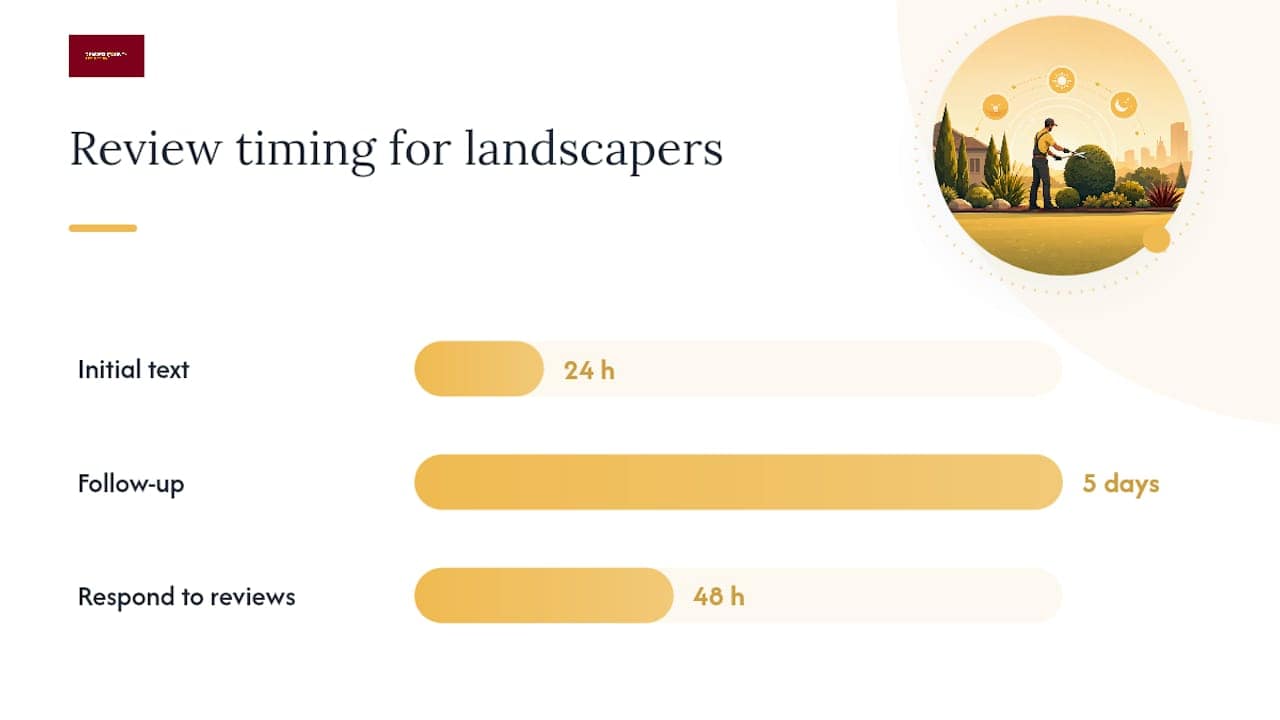
- Text the review link within 24 hours of job completion, while the finished yard is still fresh in the customer’s mind
- Use a short, specific script: “Thanks for choosing us for your patio project! A quick review helps other homeowners in [neighborhood] find us: [link]”
- Follow up once after five days if there’s no response, but never more than twice
- Embed your best reviews directly on project pages, paired with review schema so star ratings can show up in search results
- Respond to every review, positive or negative, within 48 hours
Negative reviews need a calm, specific response: acknowledge the issue, state what you did or will do to fix it, and take the detailed conversation offline. Never argue publicly. A single thoughtful response to a bad review often reassures future customers more than a page of five-star praise.
Pro Tip: Ask for the review by name at the job site, not just through an automated text. A crew lead saying “If you’re happy with the work, a Google review would mean a lot” outperforms a cold text message alone. A dedicated review management tool can automate the timing without losing that personal touch.
How Do Local Citations and Backlinks Help Landscapers Rank?
Backlinks and citations build what Google calls prominence, and for competitive keywords in larger metro areas, you’ll likely need both to outrank established competitors. Ahrefs’ research on landscaper SEO confirms that link building remains necessary once the easier on-page wins are exhausted.
Start with citation consistency. Your business name, address, and phone number (NAP) need to match exactly across every directory: Google Business Profile, Yelp, Angi, Nextdoor, and any trade association listings. Inconsistent formatting (different suite numbers, “St” versus “Street”) can quietly undercut your prominence signals even when everything else is optimized.
For backlinks, pursue tactics you can actually repeat:
- Ask suppliers (nurseries, hardscape material yards, equipment dealers) for a link from their “who we work with” or dealer locator page
- Join local trade associations and chambers of commerce that list member businesses with a link
- Sponsor a youth sports team or local event and request a link from the sponsor page
- Pitch a local news outlet or home-and-garden blog with a completed project story, especially a distinctive one
- Offer a supplier a case study of how you used their product, which they often publish on their own site
Each of these produces a link you can repeat next year with a different partner, which matters more than a single one-off placement.
How Long Until Local SEO Delivers Results for a Landscaping Business?
Set expectations around a realistic timeline instead of judging progress week to week. Local SEO for landscapers moves in three phases: foundational work in the first 0 to 3 months (GBP setup, core pages, technical fixes), first measurable lifts at 3 to 6 months, and compounding growth from 6 to 12 months as reviews, content, and links accumulate.
Track these KPIs monthly:
| Metric | What it tells you | Where to find it |
|---|---|---|
| GBP calls and direction requests | Map-pack visibility and intent | Google Business Profile insights |
| GBP profile views | Overall local search exposure | Google Business Profile insights |
| Organic clicks to service pages | Website ranking progress | Google Search Console |
| Booked jobs from organic/GBP sources | Actual revenue impact | Your CRM or intake form tracking |
A simple ROI framework: if local SEO work generates 10 incremental leads a month and your average landscaping job is worth $1,200, that’s $12,000 in monthly pipeline from work that, unlike ads, keeps producing after you stop paying for it. Compare that figure against what you’d spend to generate the same lead volume through paid ads before deciding whether to run both channels together.
Why the 243% Traffic Jump Behind This Checklist Matters
Every tactic in this guide reflects what actually moves rankings for home service businesses, not generic SEO advice repackaged for landscapers. Denvercountywebdesign has documented a 243% increase in organic traffic within 90 days for home service clients who implemented this exact GBP-first, page-depth approach.
The pattern holds across contractor categories: a fully optimized Google Business Profile, a small set of deep service and location pages, and a consistent review workflow outperform scattered, unfocused SEO spending every time we’ve tracked it.
That pattern shows up in the services Denvercountywebdesign builds for landscaping and other home service clients: custom WordPress sites structured around the service and location pages this guide describes, Google Business Profile setup and management, review system integration, and technical SEO built in from launch rather than bolted on later. Clients own their site outright, with no recurring monthly fee locking them into a platform.
The results in supporting industry guidance echo the same order of operations: GBP and reviews first, site depth second, link building once the foundation holds.
Get a Free Map-Pack Audit for Your Landscaping Business
Reading a checklist and finding the hours to execute it are two different problems, especially during your busiest install season. Denvercountywebdesign built its service model specifically for landscapers and other home service contractors who need this work done correctly the first time, without a monthly retainer tied to it forever.
The process starts with a free map-pack audit: a real look at your current Google Business Profile, service pages, and technical health, compared against what’s ranking above you locally. From there, you get a straightforward proposal covering the quick fixes (GBP corrections, schema, mobile speed) alongside the bigger builds (service pages, location pages, review workflow). Denvercountywebdesign has delivered a 243% organic traffic increase within 90 days for home service clients using this exact sequence, and every site is built for full client ownership, no monthly platform fee required.
If you run a landscaping company in the Denver metro area and want a second opinion on why competitors outrank you, start with the free map-pack audit and see the specific gaps in your current setup before committing to anything.
My Take on What Actually Moves the Needle First
Most landscapers I see get this backward. They pay for a redesigned website before they’ve even claimed all their Google Business Profile categories, and then wonder why the new site doesn’t generate calls. Fix the profile first. It costs nothing, and it’s the single fastest lever you have.
If I had to hand a landscaping owner one sequence for week one, it’s this: claim and complete every GBP field, request reviews from your last ten completed jobs today, and identify your five highest-value service pages that don’t exist yet. That’s it. Everything else in this guide builds on those three moves.
The three mistakes I see most often: treating reviews as an afterthought instead of a weekly operational task, publishing seasonal content the week the season starts instead of 60 to 90 days early, and building ten thin location pages instead of five genuinely detailed ones. Each mistake is fixable in an afternoon, but they compound badly if ignored for a full year.
Local SEO for landscapers rewards consistency far more than cleverness. The company that shows up every week with a new photo, a fresh review, and a well timed seasonal page beats the one that spent a fortune on a single flashy rebuild and then went quiet.
— Luis
Where to Learn More About Local SEO for Landscapers
A few resources are worth bookmarking as you work through this checklist:
- BrightLocal’s local SEO statistics for current consumer search and review behavior data
- Google’s Business Profile help center for official guidance on every profile field
- Ahrefs’ landscaper SEO guide for keyword difficulty and backlink strategy specific to the industry
- Semrush’s long-tail keyword guide for finding planning-stage search phrases
- Spinlisting’s GBP optimization guide for post ideas and profile tactics
- MySearchHero’s local SEO checklist for a step-by-step ranking priority list
Sources
FAQ
How much should I pay for local SEO?
Costs vary widely by market and scope, but many landscaping companies invest a few hundred to a few thousand dollars monthly depending on whether they’re building new pages, running ads, or maintaining an existing site. A one-time website build with local SEO built in, rather than an ongoing monthly retainer, often costs less over a year while giving you full ownership of the site.
Is $100 an hour too much for landscape work?
That question depends entirely on your local market, service type, and overhead, not on SEO. It’s not something a search ranking guide can answer responsibly. Check regional pricing data from landscaping trade associations for a realistic benchmark in your area.
What is the 80/20 rule in SEO?
The 80/20 rule generally suggests that roughly 20% of your SEO efforts, typically Google Business Profile optimization and your core service pages, produce about 80% of your results. For landscapers, that means GBP and a handful of deep service pages consistently outperform dozens of scattered blog posts.
What is the best way to advertise my landscaping company?
The most durable approach combines an optimized Google Business Profile, deep service and location pages, and a steady review workflow, since these compound over time instead of stopping the moment you stop paying for ads. Google Ads can supplement this while your organic and map-pack rankings build, but relying on ads alone means your visibility disappears the day you pause the budget.