The fastest wins in SEO for car detailing come from four moves working together: a fully built-out Google Business Profile, dedicated pages for each core service, a steady flow of reviews, and before-and-after photos optimized for search. Google Business Profile changes can move your map-pack position within two to four weeks; service pages and citations typically take two to four months to show real traffic gains.
TL;DR:
- Completing and maintaining a fully optimized Google Business Profile with weekly photos and posts is the most impactful step, often shifting map-pack rankings within weeks.
- Building dedicated, keyword-rich service pages for each core offering, with clear pricing and process details, improves long-term search rankings for specific services.
- Consistently acquiring recent reviews and responding promptly enhances map-pack position and customer trust, with quality over quantity being most effective.
- Optimizing photo filenames and alt text with descriptive, service-specific language increases visibility in Google Images and search traffic.
- Implementing core technical fixes like image compression, CDN use, and schema markup significantly speeds up site loading and boosts local SEO performance.
Table of Contents
- What Is SEO for Car Detailing, and Where Do You Start?
- How Do You Build Service Pages That Actually Rank?
- How Should You Name and Optimize Detailing Photos?
- How Do You Get More Reviews Without Being Annoying?
- Which Technical Fixes Matter Most for a Detailing Website?
- Which Local Directories and Links Actually Move the Needle?
- What Keywords Should You Actually Target?
- How Long Does Local SEO for Detailing Actually Take?
- Your First 30 and 90 Days: A Prioritized Checklist
- What Results Look Like: A Detailing Shop Playbook in Action
- What This Playbook Gets Right (and Where Most Shops Waste Time)
- Get a Free Map-Pack Audit From Denver County Web Design
- Resources Worth Bookmarking
- Sources
- FAQ
What Is SEO for Car Detailing, and Where Do You Start?
SEO for car detailing is the practice of getting your shop to show up when someone nearby searches for ceramic coating, paint protection film, or “detailing near me.” It blends local SEO for detailing services (map-pack visibility) with on-site content that answers what customers actually want to know before they book.
Most detailers start in the wrong place. They chase blog traffic before their Google Business Profile (GBP) is even complete, or they build one generic “services” page instead of pages that match how people search. You fix the foundation first: profile, pages, reviews, photos. Everything else, from contractor local SEO tactics to link building, builds on that base.
Google Business Profile: your highest-leverage asset
Your GBP is doing more heavy lifting for bookings than your website in most local markets. Detailing-specific SEO guides consistently rank a complete profile with weekly photo uploads as the single highest-impact action a shop can take, and BrightLocal’s research on small service businesses backs that up: local search remains the top lead source, yet plenty of shops never finish the basic setup.
Here’s what “complete” actually means:
- Choose “Car Detailing Service” as your primary category, then add secondary categories like “Car Wash” or “Window Tinting Service” if you offer them.
- List every service as its own line item with a short description and a price or price range, not just a vague “detailing packages” entry.
- Upload fresh photos weekly: real before/afters, your team at work, and your shop or mobile van setup.
- Post weekly using GBP Posts: a finished ceramic coating job, a seasonal offer, or a quick tip.
- Turn on messaging and the booking button, then test both yourself so you know exactly what a customer experiences.
If you run a mobile operation, set your GBP up as a service-area business rather than a fixed storefront, and spell out your service radius in the business description so both customers and Google understand where you actually work.
Pro Tip: Set a recurring calendar reminder for “GBP Friday.” Ten minutes, three new photos, one post. Shops that treat this as a weekly habit outpace ones that binge-update once a quarter.
How Do You Build Service Pages That Actually Rank?
One generic “our services” page cannot rank for ceramic coating, PPF, interior detailing, and mobile detailing at the same time. Search engines reward specificity, and industry playbooks recommend building a dedicated page for each core service, typically 800 to 1,500 words, structured so it answers a buyer’s questions in order.
Use this template for each service:
- URL and title: keep the pattern simple, like
/ceramic-coating-denverwith a title tag such as “Ceramic Coating in Denver, CO | [Your Shop Name].” Avoid stamping out identical pages with only the city swapped. Google treats those as doorway pages, and they tend to get filtered out of results rather than ranked. - Opening summary: two or three sentences that sell the outcome (paint protection, shine, resale value) before you explain the process.
- Step-by-step process: what happens from drop-off to pickup, in plain language.
- Brands and materials used: name the ceramic coating brand, PPF film, or interior products you apply. Specificity builds trust and gives you natural long-tail keywords.
- Pricing ranges: even a rough band (“$400 to $900 depending on vehicle size”) reduces bounce from price shoppers and improves time on page.
- FAQ section: five or six real questions, like how long ceramic coating lasts or whether PPF yellows over time.
- Before-and-after gallery: specific to that service.
- Call-to-action: booking link or phone number, repeated near the top and bottom.
Link from your blog posts into these service pages, and from the service pages into your booking flow. That blog-to-service-to-booking chain is what turns casual searchers into scheduled appointments.
How Should You Name and Optimize Detailing Photos?
Before-and-after photos are your best conversion asset and, done right, a real source of search traffic. Most shops upload them with file names like “IMG_4821.jpg,” which tells search engines nothing. Detailing SEO research points to descriptive naming as one of the simplest, most overlooked wins available.
Use a consistent template: service + vehicle + outcome + city, when a city marker genuinely fits. Examples:
ceramic-coating-tesla-model-3-swirl-removal-denver.webpinterior-detailing-suv-pet-hair-removal.webpppf-front-bumper-installation-lakewood.webp
Alt text should read like a sentence, not a keyword dump: “Ceramic coating applied to a black Tesla Model 3, removing swirl marks, Denver shop.” That is useful to a screen reader and to Google Images at the same time.
On format and speed: convert your galleries to WebP, keep individual images under 200KB where possible, and load anything below the fold with lazy loading so first-page load isn’t dragging ten photos it doesn’t need yet. Image-heavy detailing sites are notorious for slow load times, and Adobe’s usability guidance is blunt about it: uncompressed, non-lazy-loaded galleries actively hurt the SEO gains those same photos are supposed to create.
Organize galleries by service first, then by vehicle make or model if you have volume. A “Ceramic Coating Gallery” that includes a filterable Tesla, BMW, and F-150 sub-section covers more long-tail searches than one undifferentiated photo dump. Reuse the same shots across GBP posts and social media instead of shooting new content for every channel.
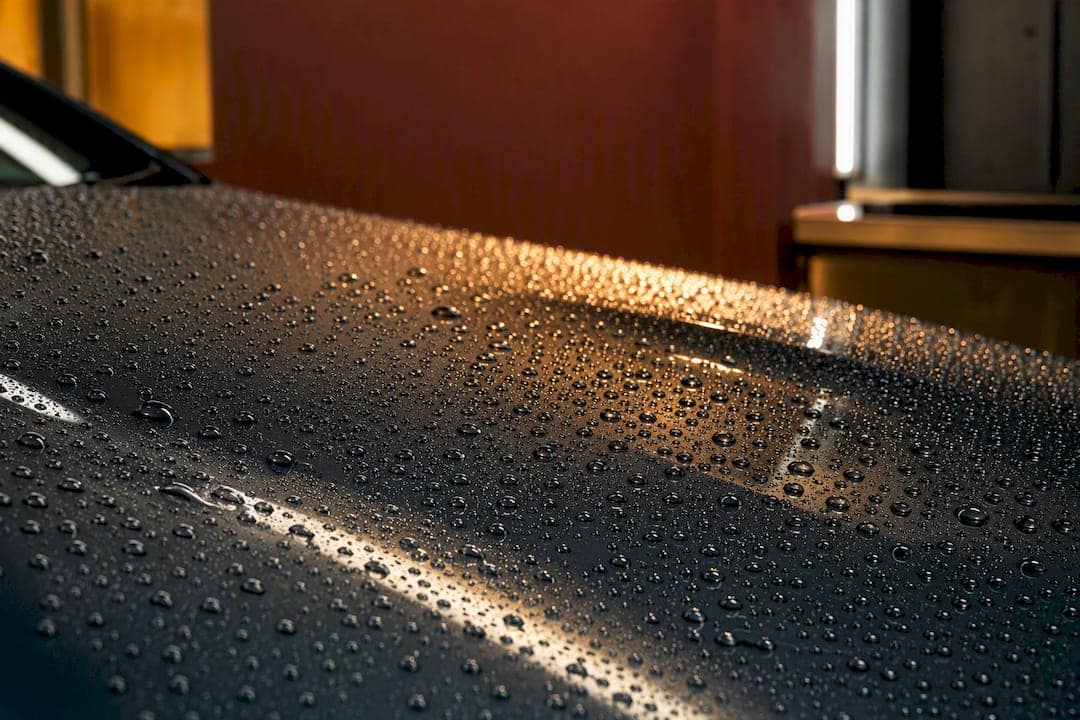
Pro Tip: Batch your photo edits and renaming once a week instead of after every job. It takes ten minutes and keeps your naming convention consistent, which matters more than doing it fast.
How Do You Get More Reviews Without Being Annoying?
Review count and review velocity both influence your map-pack position, and local SEO analyses of detailing businesses show shops with 50 or more recent reviews, and a steady drip of new ones, consistently outrank shops with a handful of old five-star ratings.
The ask matters more than the platform. Timing beats wording:
- Ask in person the moment the customer sees the finished vehicle, when satisfaction is highest. A simple line works: “If you loved the results, a quick Google review helps us a lot.”
- Follow up by text within two hours with a direct review link. Waiting until the next day cuts response rates noticeably.
- Prioritize Google Business Profile first, since it’s what drives map-pack ranking, then layer in Yelp and any relevant detailing directories. Keep your business name, address, and phone number identical everywhere you appear.
- Respond to every review within 48 hours. For positive ones: thank the customer by name and mention the specific service. For negative ones: acknowledge the issue, avoid arguing publicly, and offer to resolve it offline.
Denver County Web Design’s guide on how to get Google reviews walks through scripts you can hand straight to your front-desk staff or techs.
Which Technical Fixes Matter Most for a Detailing Website?
Detailing sites live and die on photos, which makes them uniquely vulnerable to slow load times. Fix these in priority order:
- Compress every image before upload, targeting file sizes under 200KB for gallery photos, and serve WebP instead of JPEG or PNG wherever your platform allows it.
- Use a content delivery network (CDN) so photo-heavy galleries load fast for visitors regardless of location; this is one of the clearest speed wins for image-heavy small business sites.
- Test your mobile booking flow on an actual phone, not just a browser resize. Tap targets, gallery swiping, and the booking form all need to work one-handed since most detailing searches happen on mobile.
- Add LocalBusiness schema with your name, address, phone number, hours, and service area. Add Service schema on each service page, and FAQ schema wrapping your on-page FAQ sections.
That last step matters more than most shop owners realize. Search Engine Land’s guide to SEO fundamentals notes that structured data increases your odds of qualifying for rich results and AI-generated overviews, meaning your FAQ answer can show up directly in a search result or an AI summary instead of requiring a click. A partner resource like West Valley Digital’s website services overview covers the technical implementation side if you want a broader technical SEO reference.
Which Local Directories and Links Actually Move the Needle?
Citation consistency and a handful of earned links do more for a detailing shop than a hundred low-quality directory submissions. Claim your listing on Google Business Profile, Yelp, Apple Maps, and any detailing-specific directories in your area, and make sure your name, address, and phone number match character-for-character across every one. Inconsistent NAP data is one of the quieter reasons shops plateau in the map pack.
For links, skip generic directory spam and go after coverage that’s actually earned:
- Pitch a local blog or news outlet a photo-driven story about a dramatic before-and-after transformation.
- Partner with a local dealership to detail trade-in inventory, and ask for a link from their site in exchange.
- Offer a fleet-detailing case study to a local business association or chamber of commerce newsletter.
Avoid the temptation to spin up identical location pages with only the city name changed. Search engines increasingly detect these doorway pages, and unique local pages with real landmarks, service-area detail, and local context perform far better long term. Denver County Web Design’s contractor local SEO guide covers this pattern in more depth for home-service businesses generally.
What Keywords Should You Actually Target?
Not every keyword deserves equal effort. Sort your targets into three buckets and spend your time in this order:
- High-intent local: “ceramic coating near me,” “mobile detailing [your city],” “car detailing [neighborhood].” These convert fastest because the searcher is ready to book.
- Service-specific: “paint protection film cost,” “interior detailing pet hair removal.” These match your dedicated service pages directly.
- Seasonal: “pollen protection detailing” in spring, “pre-winter ceramic coating” in fall. Short windows, but high urgency.
Vehicle-specific long-tail terms (“ceramic coating for Tesla Model Y,” “PPF for Jeep Wrangler”) are underused and easy to win because so few competitors bother writing for them.
A simple seasonal calendar: February and March for pollen and spring cleaning content, June and July for road-trip prep and bug/tar removal, September and October for pre-winter paint protection, and December for gift-card and holiday detailing pushes.
How Long Does Local SEO for Detailing Actually Take?
Google Business Profile changes can shift your map-pack position within two to four weeks. Service pages, citations, and review velocity take longer, typically two to four months before you see consistent ranking movement and booking increases.
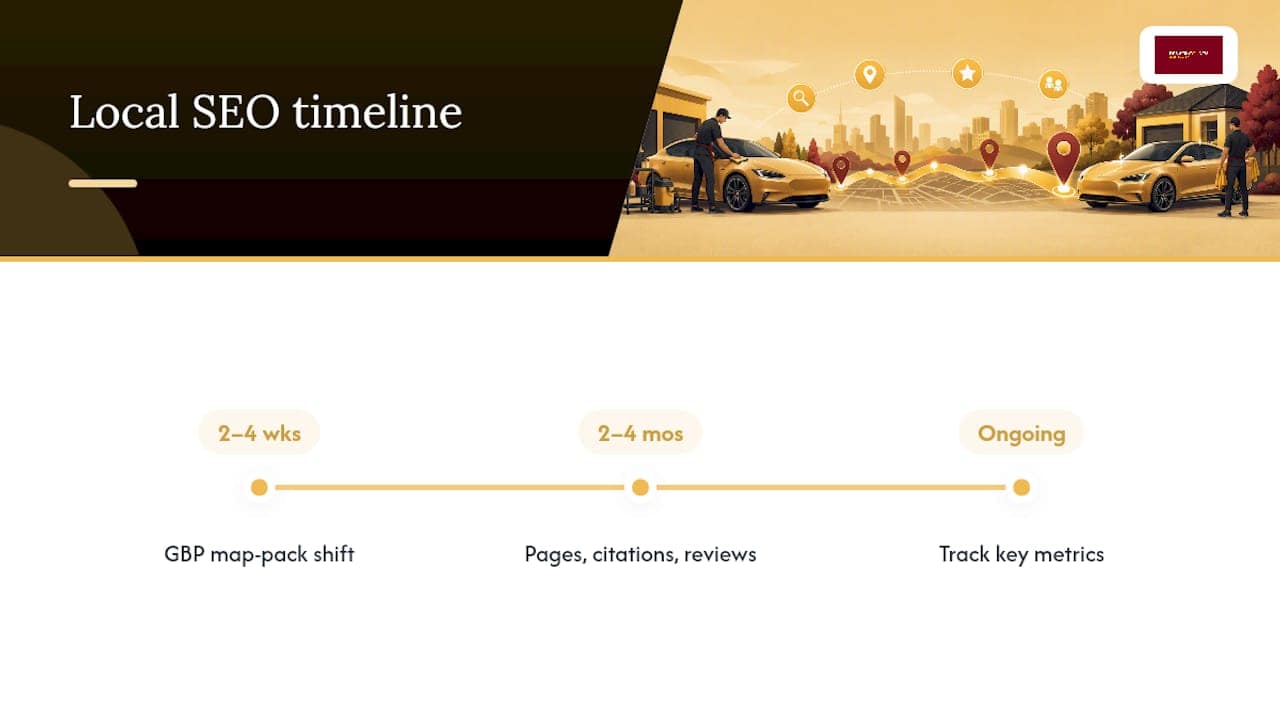
Track four numbers: map-pack position for your top three keywords, phone calls and booking-form submissions, GBP impressions and click-through rate, and review count growth month over month.
On cost: DIY setup (GBP, photo naming, review scripts) costs your time, not money. A one-off technical implementation with a contractor typically runs a few hundred to a couple thousand dollars depending on scope. Ongoing managed local SEO service packages vary widely by market and provider.
Your First 30 and 90 Days: A Prioritized Checklist
- Week 1: Complete every GBP field, add all services with prices, upload 15 to 20 real photos.
- Week 2: Publish your first two service pages (start with your highest-margin service).
- Week 3: Launch your review ask script with staff and send it to your last 10 completed jobs.
- Week 4: Add LocalBusiness and Service schema to your site.
- Months 2 to 3: Publish remaining service pages, build out your photo gallery structure, and start weekly GBP posts.
- Ongoing: One GBP post and three new photos weekly, review follow-ups within two hours of every job, monthly citation audit.
Pro Tip: Keep a simple spreadsheet with four columns: date, task, keyword or service, and result. Ten minutes a week of tracking beats guessing whether any of this is working.
What Results Look Like: A Detailing Shop Playbook in Action
Denver County Web Design built its local SEO approach around exactly this stack: a complete Google Business Profile, service-specific landing pages, structured review collection, and image-optimized galleries.
For detailing shops specifically, that translates into services like custom WordPress site builds structured around service-page architecture, Google Business Profile setup and management, citation and NAP cleanup across directories, and AI search optimization so your FAQ content has a shot at showing up in generative search answers, not just traditional results.
What This Playbook Gets Right (and Where Most Shops Waste Time)
Most SEO advice aimed at small service businesses treats every industry the same: write blog posts, build links, wait. That generic template underserves detailing shops badly, because detailing is one of the most visual services online. A ceramic coating job either looks transformative in a photo or it doesn’t, and most shops leave that advantage sitting untouched in a phone camera roll instead of a structured gallery.
The conventional wisdom oversells content marketing and undersells the profile work. Blog posts about “5 tips for winter car care” rarely move bookings on their own. What moves bookings is a complete GBP, a service page that answers a real pricing question, and a review that showed up three days ago instead of three months ago.
If you do only one thing this month, make it the Google Business Profile. It’s free, it takes an afternoon to complete properly, and unlike a service page or a link campaign, it can shift your map-pack position before the month is out. Everything else in this playbook compounds on top of that foundation, not instead of it.
— Luis
Get a Free Map-Pack Audit From Denver County Web Design
If you’d rather have someone else run this playbook while you focus on detailing cars, Denver County Web Design builds exactly this system for home service and contractor businesses across Colorado, and does it without locking you into a monthly website fee the way most agencies do.
The free map-pack audit checks your current Google Business Profile completeness, gives you a snapshot of where you actually rank for your top local keywords, and hands you the top three fixes with the biggest expected impact. There’s no cost and no obligation attached. From there, Denver County Web Design can build out your service pages, clean up your citations, and manage your GBP directly, with you owning the finished website outright, no ongoing fees required. Visit the Denver County Web Design site to see full packages, or request your audit directly and get a response with your top fixes within a few business days.
Resources Worth Bookmarking
For keyword research and rank tracking, BrightLocal and Ahrefs both offer tools built specifically for local visibility tracking. For technical grounding, Search Engine Land’s SEO guide covers fundamentals including schema and rich results. Google’s own Business Profile help documentation covers the exact fields and category options referenced throughout this guide, and remains the most current source when categories or features change.
Sources
- SEO for Auto Detailing Shops — How to Rank Locally
- 8 ways to make your website more user-friendly — Adobe Business
FAQ
How do I get more customers for my car detailing business?
Complete your Google Business Profile with every service listed, upload photos weekly, collect reviews consistently, and build a dedicated page for each core service like ceramic coating or PPF. Those four actions combined drive most new customer discovery for local detailing shops.
How much should I tip on a $200 car detail?
Tipping is a personal choice, not an industry standard, but many customers tip 10% to 20% for detailing work, similar to other personal service industries, especially for jobs that took several hours or delivered exceptional results.
What is automotive SEO?
Automotive SEO is the practice of optimizing a car-related business’s online presence, including its Google Business Profile, website content, and local citations, so it ranks higher in search results for services like detailing, repair, or sales in a specific area.
How do I advertise my car detailing business?
Start with a complete Google Business Profile and consistent reviews, since those drive the most local search visibility for free. Paid options like Google Ads and targeted social media promotion can accelerate results once your foundation is in place, and Denver County Web Design manages both alongside local SEO for detailing shops that want a hands-off approach.