If you only fix four things for SEO for restoration company websites, make them Google Business Profile activity, dedicated service pages, review velocity, and site speed. Get those four right, and you’re looking at faster Map Pack placement, more phone calls from people standing in a flooded basement right now, and jobs booked before your competitor’s website even finishes loading. A specialized web design company builds this exact stack for home service businesses across Colorado.
TL;DR:
- Focusing on Google Business Profile activity, review velocity, site speed, and dedicated service pages is essential for quick local Map Pack rankings and immediate lead generation.
- Regular GBP updates, including weekly posts and prompt review responses, significantly boost local impressions and engagement over static profiles.
- Building service pages with local details, visible phone numbers, and authentic project references outperforms generic templates and reduces ranking risks from Google updates.
- Improving Core Web Vitals, fixing technical issues, and maintaining consistent NAP citations across directories are crucial for gaining and holding local search positions.
- Consistent review requests, especially immediately after job completion, paired with monthly tracking and fixing citation discrepancies, enhance trust signals and local visibility.
Table of Contents
- Why Local SEO Beats Generic SEO for Restoration Companies
- Turn Your Google Business Profile Into a 24/7 Dispatch Board
- Why Templated Service Pages Fail (and What Wins Instead)
- What Technical SEO Fixes Actually Move Rankings?
- How Often Should Restoration Companies Ask for Reviews?
- Fixing NAP Inconsistencies Across Directories
- What Keywords Should Restoration Companies Target?
- Measuring ROI: What to Track and How
- How Denver County Web Design Builds This for Restoration Clients
- Publisher Perspective: Practical Next Steps for Marketing Decision-Makers
- Get a Free Map Pack Audit From Denver County Web Design
- Sources
- FAQ
Why Local SEO Beats Generic SEO for Restoration Companies
Restoration is a “right now, right here” business. Nobody researches water damage companies for a week before deciding, so your SEO has to win the moment someone types “water damage cleanup near me” with a soaked carpet under their feet. The four pillars below map directly to what gets measured and what gets booked:
- Google Business Profile activity: drives Map Pack visibility and click-to-call, tracked through GBP insights and call volume.
- Service and service-area pages: capture organic search intent beyond the Map Pack, tracked through page-level conversions.
- Review velocity: signals trust to both Google and panicked homeowners, tracked through monthly review counts.
- Site speed and mobile UX: keeps searchers from bouncing to the next listing, tracked through Core Web Vitals and call tracking.
The disaster restoration market topped $41.3 billion in 2023 and keeps growing roughly 6.7% a year. That’s real demand you can capture without paying premium cost-per-click rates for every emergency call.
Turn Your Google Business Profile Into a 24/7 Dispatch Board
Stop treating your Google Business Profile like a business card you filled out once. Restoration companies that run GBP like an active dispatch tool, responding to questions, logging jobs, and posting fresh photos, see stronger behavioral engagement and better rankings than companies that let the listing sit static. That distinction shows up directly in how leads move through the platform.
Here’s the operating rhythm that works:
- Fill every field completely. Choose your primary category carefully (Water Damage Restoration Service, not just “Contractor”), add every relevant secondary category, and list all service areas.
- Post weekly, not monthly. Job-site photos, before-and-after shots, and short updates on jobs completed keep the profile active.
- Upload at least two new photos a month. Fresh visual content correlates with real engagement.
- Answer every Q&A entry and reply to reviews within 24 hours.
- Check GBP Insights weekly to track calls, direction requests, and website clicks generated directly from the listing.
Companies that kept this cadence for three months saw roughly 21% more local search impressions than companies that didn’t.
Pro Tip: Write your GBP posts like a dispatcher, not a marketer. “Crew responded to a burst pipe in Aurora this morning, water extraction complete by noon” outperforms “We’re the best water damage company in Colorado” every time.
Why Templated Service Pages Fail (and What Wins Instead)
A page that just swaps “Denver” for “Aurora” in the same three paragraphs isn’t a service-area page. It’s a shortcut Google increasingly penalizes, and after the 2026 core update targeted this exact pattern, the risk of ranking loss is real.
Build pages that lead with the phone number and the service, not a paragraph of throat-clearing. Every service page needs:
- A visible phone number above the fold, before any explanatory text
- A description of the specific service (mold remediation, smoke damage, sewage backup) with real process detail
- Local specifics: regional weather patterns, common building materials in that area, local permit or insurance quirks
- At least one real project reference with dates and a brief case note
Pages that mix generic templates with real local detail and authentic project photos consistently outperform franchise pages that skip this step, and independents often beat national chains here precisely because they can write about their actual neighborhoods. Add LocalBusiness and Service schema to every page, and structure your service-area content the way experienced local SEO guides recommend.
What Technical SEO Fixes Actually Move Rankings?
Core Web Vitals now function as a practical tie-breaker in local search results, especially when several restoration companies have similar review counts and citation profiles. Auditors regularly find the same handful of problems across restoration sites: missing SSL certificates, slow mobile load times, missing schema, and orphaned pages nobody links to anymore.
Work through these in order:
- Run a PageSpeed Insights test on your homepage and top service page; aim for a Largest Contentful Paint under 2.5 seconds.
- Put the phone number in a sticky header on mobile so it’s tappable without scrolling.
- Add LocalBusiness schema site-wide and Service schema on every service page.
- Fix broken redirect chains and orphaned pages flagged in Google Search Console.
- Confirm mobile rendering matches desktop; Google indexes the mobile version first.
A fast, clean mobile experience with an obvious click-to-call button often converts more emergency searchers than a beautifully written but slow-loading page ever will.
How Often Should Restoration Companies Ask for Reviews?
Total review count matters less than most owners think. Steady monthly review velocity tends to outperform a large static pile of reviews from three years ago.
- Ask for the review right when the job wraps and the homeowner sees their space restored, that’s the emotional peak, not two weeks later by email.
- Text-based review requests sent within an hour of job completion get answered far more often than delayed emails.
- Reply to every negative review within 48 hours, acknowledge the specific issue, and move the conversation offline.
- Track new reviews per month against call volume to see if velocity and lead flow move together.
Pro Tip: Train your field crew to say one sentence before they leave: “You’ll get a text in a few minutes, a quick review helps us more than you’d think.” That single line moves response rates more than any automated follow-up sequence.
Fixing NAP Inconsistencies Across Directories
Your business Name, Address, and Phone number (NAP) needs to match exactly across every directory, or Google gets confused about which listing is authoritative.
- Pull your current citations from Google Search, Bing Places, Apple Maps, and Yelp, and compare them side by side.
- Fix your core citation first: Google Business Profile, Facebook, and your website footer, since aggregators pull from these.
- Claim industry-specific directories: HomeAdvisor, Angi, and IICRC’s referral network carry real weight for restoration specifically.
- Recheck citations every 90 days, since data aggregators sometimes republish old, incorrect addresses months later.
What Keywords Should Restoration Companies Target?
Emergency intent and research intent need completely different content, so don’t mix them on the same page.
- Emergency keywords (“water damage cleanup now,” “24 hour flood restoration”) belong on service pages with the phone number front and center.
- Service plus location keywords (“mold remediation Aurora CO”) anchor your service-area pages.
- Informational keywords (“how to tell if drywall has mold,” “what to do first after a house fire”) belong on blog content that builds topical authority and links back to service pages.
- Comparison and consideration keywords (“how much does water damage restoration cost”) work well as FAQ content or dedicated guide pages.
Support this with a simple editorial calendar: one prevention-focused blog post a month, tied by internal links to the relevant service page, plus a seasonal piece (frozen pipes in winter, flood prep before spring storms) that naturally attracts search traffic ahead of demand spikes.
Measuring ROI: What to Track and How
You need four numbers on one dashboard: phone calls (via call tracking software), booked jobs, GBP impressions and actions, and Core Web Vitals scores.
- Set up call tracking so every GBP call and every website call is logged separately.
- Check GBP Insights weekly, not monthly, since emergency demand spikes fast after storms.
- Run PageSpeed Insights quarterly on your top three pages.
- Review the whole dashboard monthly with whoever owns marketing decisions, and flag any month-over-month call drop within a week, not a quarter.
How Denver County Web Design Builds This for Restoration Clients
The clients who move fastest are the ones who treat their website like part of the crew, not a brochure that sits still while the phone stays quiet.
The company builds these sites with full client ownership and no recurring monthly fees, which matters for restoration owners who’ve been burned by agencies charging for a listing nobody ever updates.
Publisher Perspective: Practical Next Steps for Marketing Decision-Makers

Most restoration owners overcomplicate this. Your first 30 days should go entirely into GBP: complete every field, post weekly, and reply to every review. Days 30 to 60 belong to service pages, rewrite the worst three with real local detail and visible phone numbers. Days 60 to 90 go to technical fixes and review velocity systems.
Hire an agency when you don’t have anyone who can commit two hours a week to this consistently; do it in-house if you already have someone disciplined enough to post weekly without reminders. Pair SEO with paid search only after your GBP and top service pages are solid, running ads to a weak page just burns budget faster.
— Luis
Get a Free Map Pack Audit From Denver County Web Design
This company offers an alternative to a traditional agency retainer for restoration companies fighting for Map Pack placement in Colorado: clients get a custom-built, fully-owned website with no ongoing monthly fee, built specifically around phone-first conversion and GBP optimization.
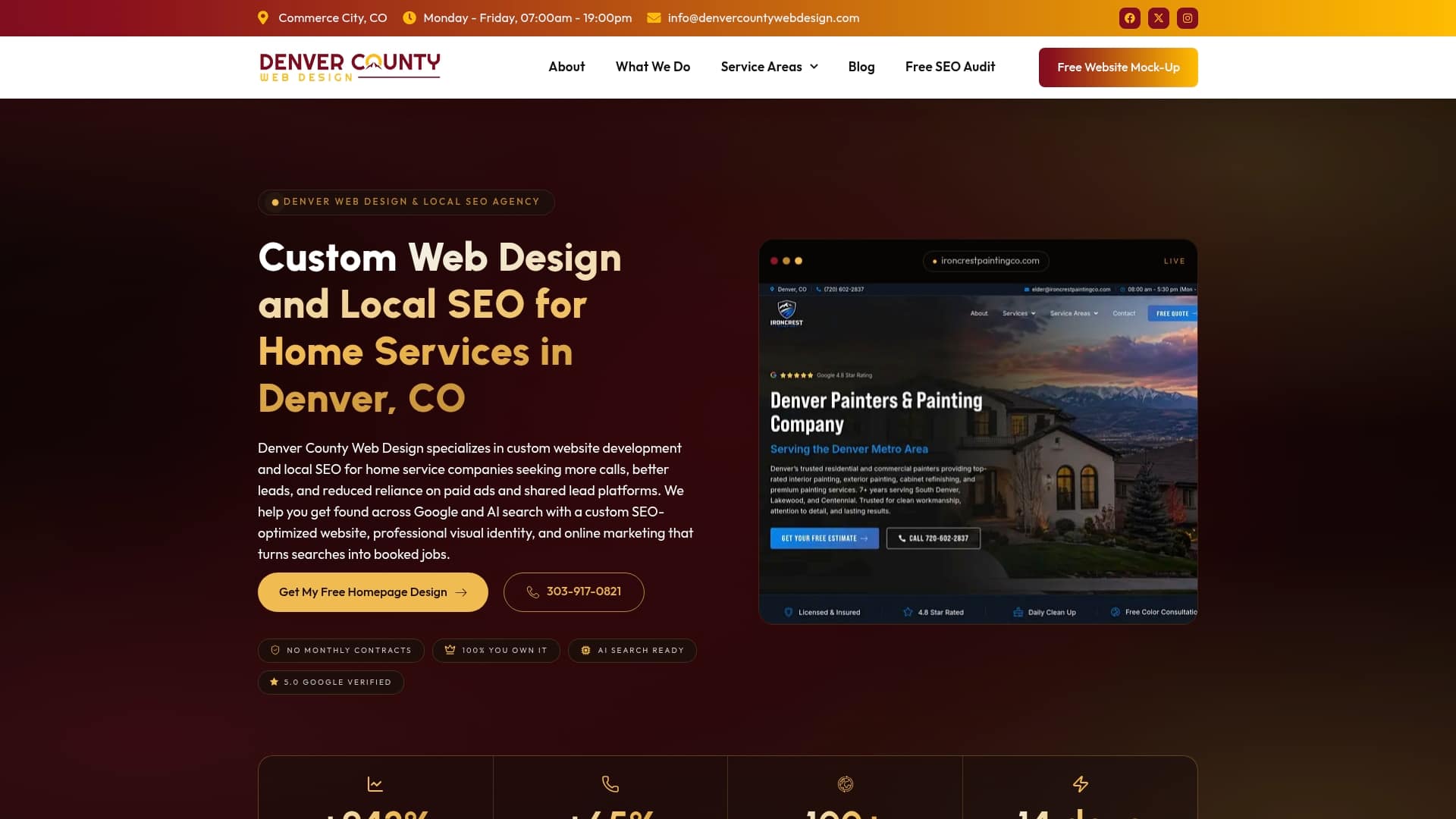
The agency’s core services include custom WordPress builds, Google Business Profile management, local citation cleanup, and technical SEO, offered as one-time projects rather than ongoing contracts. If you want to see exactly where your current site and GBP profile are losing calls, request the free map-pack SEO audit and get a specific breakdown instead of generic advice. Restoration companies in Commerce City, Brighton, and Westminster can also see examples of recent local builds on the Denver County Web Design site before requesting their own audit.
Sources
- How to use Google Business Profile to drive leads for your restoration company – R&R Magazine
- The Restoration Company’s Local SEO Playbook for 2026: What Actually Moves Rankings – Tygart Media
- Restoration Company SEO – The Complete Guide | PushLeads
- Statista — online local business search frequency (US/Canada)
FAQ
Is SEO Still Worth It for Restoration Companies in 2026?
Yes. Local search demand for nearby businesses remains consistently high, and organic visibility costs far less per lead than paid search once your GBP and service pages are built out properly.
How Do You Market a Restoration Company Beyond SEO?
Pair local SEO with a fast, mobile-friendly website, active Google Business Profile management, and paid search reserved for high-value emergency keywords once your organic foundation is solid.
How Much Should Restoration Companies Pay for SEO Services?
Pricing varies widely by scope and market, but a one-time project fee that includes GBP setup, service pages, and technical fixes, like the packages Denver County Web Design offers, avoids the recurring retainer costs many agencies charge indefinitely.
Can ChatGPT Do an SEO Audit for a Restoration Company?
AI tools can flag obvious issues like missing meta tags or slow load times, but they can’t verify real citation errors, test actual mobile call tracking, or judge whether your service pages contain genuine local specifics, tasks that still need a human audit.