Angi Leads works when your average job margin covers a $15 to $120 per-lead cost and you can call new leads back within minutes, not hours. Track cost per booked job as the true measure of cost-effectiveness, rather than just cost per lead. Also know this before you sign up: Angi’s parent company paid up to $7.2 million to the FTC for misrepresenting lead quality, so verify any conversion claim yourself before you budget around it.
TL;DR:
- The true cost per booked job with Angi leads depends on your margins and response speed, requiring quick callbacks and effective follow-ups to succeed.
- Shared lead exclusivity often results in multiple contractors competing for the same lead, making speed and CRM tagging essential for better attribution and dispute management.
- Tracking your actual 90-day cost per booked job is vital, as high-value projects may show a low percentage of revenue spent but can involve paying for multiple unconverted leads.
- Most agencies recommend limiting marketplace marketing spend to 10-20% of total marketing budget, focusing more on owned channels like local SEO and Google Local Services Ads for longer-term growth.
- Contractors should run their own 90-day tracking tests before relying on Angi or similar platforms as a primary growth source, especially for slow-close or high-margin projects.
Table of Contents
- Are Angi Leads Worth It? Breaking Down the Product Family
- What Does an Angi Lead Actually Cost You Per Booked Job?
- How to Run a 90-Day Angi Leads Test the Right Way
- Where Angi Fits Alongside Other Lead Channels
- Our Take on Angi Leads and Lead Ownership
- A Different Path to Booked Jobs, No Per-Lead Invoice Required
- Sources
- FAQ
Are Angi Leads Worth It? Breaking Down the Product Family
The word “Angi” covers four different products, and mixing them up is how contractors end up confused about what they actually paid for. Each one sells a different thing, with a different price structure and a different amount of control over who else sees your lead.
Angi Leads is the shared-lead marketplace most people mean when they ask if Angi is worth it. You pay for membership, then pay again per lead, and that same homeowner request often lands in the inboxes of two or three other contractors at once. HomeAdvisor, now folded under the Angi brand, runs on the same shared-lead model with its own homeowner-facing app and site. Angi Services flips the model: homeowners buy a defined job at a set price, and Angi offers that already-booked job to a pro, which means less price competition but less control over your rate. Angi Ads is closer to a directory placement, a visibility play rather than a lead feed.
Before you commit to any of them, check these pricing components:
- Annual membership fee, commonly reported between $288 and $348 depending on the package and trade
- Per-lead charges, which swing from $15 for small repair jobs to $120 for larger project categories
- Add-on tools like mHelpDesk, which can auto-enroll you into extra monthly charges
- Auto-renew clauses that quietly extend your contract term if you don’t cancel by a specific date
Lead exclusivity matters more than the sticker price. A shared Angi Leads request frequently gets sold to multiple contractors in your area, and the contractor who calls back fastest usually wins the job before the others have even picked up the phone. Dispute and cancellation friction is real too: Angi’s own cancellation process typically requires a phone call rather than a self-serve button, and refund credits for bad leads depend on you documenting the problem inside a set window.
| Product | Pricing components | Lead exclusivity | Best for | Contract terms |
|---|---|---|---|---|
| Angi Leads | Membership + $15–$120 per lead | Shared, often 2–3 pros per lead | Fast-responding shops with strong margins | Auto-renew common; phone-based cancellation |
| Angi Services | Platform-set job price, no per-lead fee | Booked job, not shared at contact | Pros who want capacity-fill work | Bound by Angi’s job-acceptance terms |
| HomeAdvisor (powered by Angi) | Membership + per-lead range similar to Angi Leads | Shared, same marketplace pool | Pros already active on Angi Leads | Same account terms as Angi Leads |
| Angi Ads | Ad placement fee | Not a lead feed; visibility only | Pros wanting brand presence on Angi’s site | Ad campaign terms, not membership |
What Does an Angi Lead Actually Cost You Per Booked Job?
The math that decides whether Angi pays off has nothing to do with the price of a single lead. It comes down to one formula:
Cost per booked job = total Angi spend over a period ÷ number of jobs actually booked from Angi in that same period.
Run this over a 90-day window so seasonal noise and slow-close categories don’t distort the picture. Here’s how it plays out across three job types:
- $600 repair job. Say you spend $900 in membership and per-lead fees over 90 days and book 15 jobs. That’s $60 per booked job, roughly 10% of revenue, easy to absorb given the 40 to 55% close rates typical of emergency-style categories.
- $1,800 mid-ticket remodel lead. Spend $1,200 over the same window and book 6 jobs, putting cost per booked job at $200, about 11% of revenue. Still workable, but project categories often close at only 15 to 25%, so the lead volume you buy needs to be higher to hit that job count.
- $8,000 project. One booked job from $1,500 in spend puts acquisition cost at less than 2% of revenue, which looks great on paper until you remember you may have paid for four or five leads that never converted to get there.
Once you know your cost per booked job, compare it against your gross margin per job type, not your gross revenue.
How to Run a 90-Day Angi Leads Test the Right Way
Winning shared leads is an operations problem before it’s a marketing problem. Angi doesn’t reward the best contractor. It rewards the fastest one.
- Staff intake before you buy leads. A single-truck operation needs a dedicated phone answerer during business hours, even if that’s the owner’s spouse or a part-time hire. A mid-size shop should split intake from field work entirely.
- Contact every lead within 5 minutes. Response speed is the single biggest lever in a shared-lead system, and an automated text autoresponder buys you time while a human calls back.
- Run a five-touch follow-up cadence. First contact immediately, then follow-ups at 1 hour, 4 hours, 24 hours, and 72 hours. Most contractors give up after one voicemail; the ones who stick to all five touches book more jobs from the same lead pool.
- Tag every lead in your CRM at the moment it lands. Use a simple disposition taxonomy: booked, quoted-no-close, unreachable, wrong trade, out of area. This taxonomy is what makes disputes and attribution possible three weeks later when you’re trying to remember which leads actually paid off.
- Document and dispute junk leads within days, not weeks. Angi’s credit and dispute portal generally wants evidence, call logs, and timestamps, uploaded quickly. Contractors who file promptly and escalate persistently recover roughly 10 to 20% of their spend on disputed leads, according to agency-side tracking of the process.
Pro Tip: Keep a screenshot of every lead’s original request details the moment it arrives. If Angi later disputes your claim that a lead was geographically mismatched or a duplicate, that screenshot is your evidence.
Cancellation deserves its own line item in your planning. There’s no simple online cancel button for pro accounts. Expect a phone call, a retention pitch, and a request that you have your account details and billing history ready before you dial in.
Where Angi Fits Alongside Other Lead Channels
Angi is rented volume, not owned infrastructure, and that distinction should shape how much of your budget it gets. Google Local Services Ads tend to deliver higher-intent calls with less shared competition, though they demand a strong Google Business Profile and consistent reviews first. Google Ads gives you more control over targeting but a steeper learning curve to run profitably. Thumbtack behaves a lot like Angi, shared leads, per-quote competition, similar close-rate patterns. Local SEO and a well-built website are the only channel on this list you actually own; leads keep arriving without a per-lead invoice once the groundwork is done.
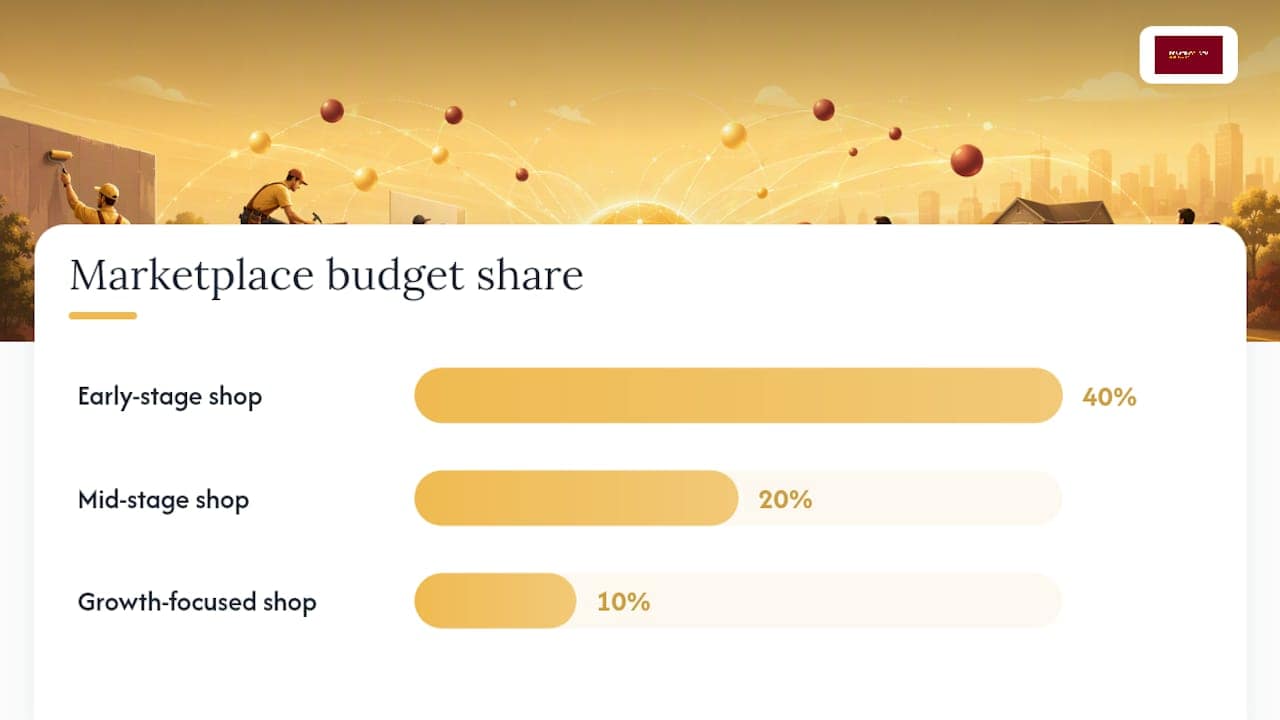
Most agencies suggest capping Angi and similar marketplaces at 10 to 20% of total marketing spend, using it to fill capacity gaps while you build owned channels underneath it. A workable split:
- Early-stage shop: 40% Angi/Thumbtack for immediate volume, 40% local SEO and GBP cleanup, 20% referral incentives
- Mid-stage shop: 20% marketplaces, 50% owned local search, 30% Google Ads for high-intent categories
- Growth-focused shop: 10% marketplaces as overflow only, 60% owned search assets, 30% paid search
Quick wins that move you toward owned lead flow: fix your Google Business Profile categories and service areas, build dedicated service pages for your highest-margin jobs, and put a review-request text into your closing workflow. Our electrician SEO playbook and plumber SEO guide walk through both in more detail.
Our Take on Angi Leads and Lead Ownership
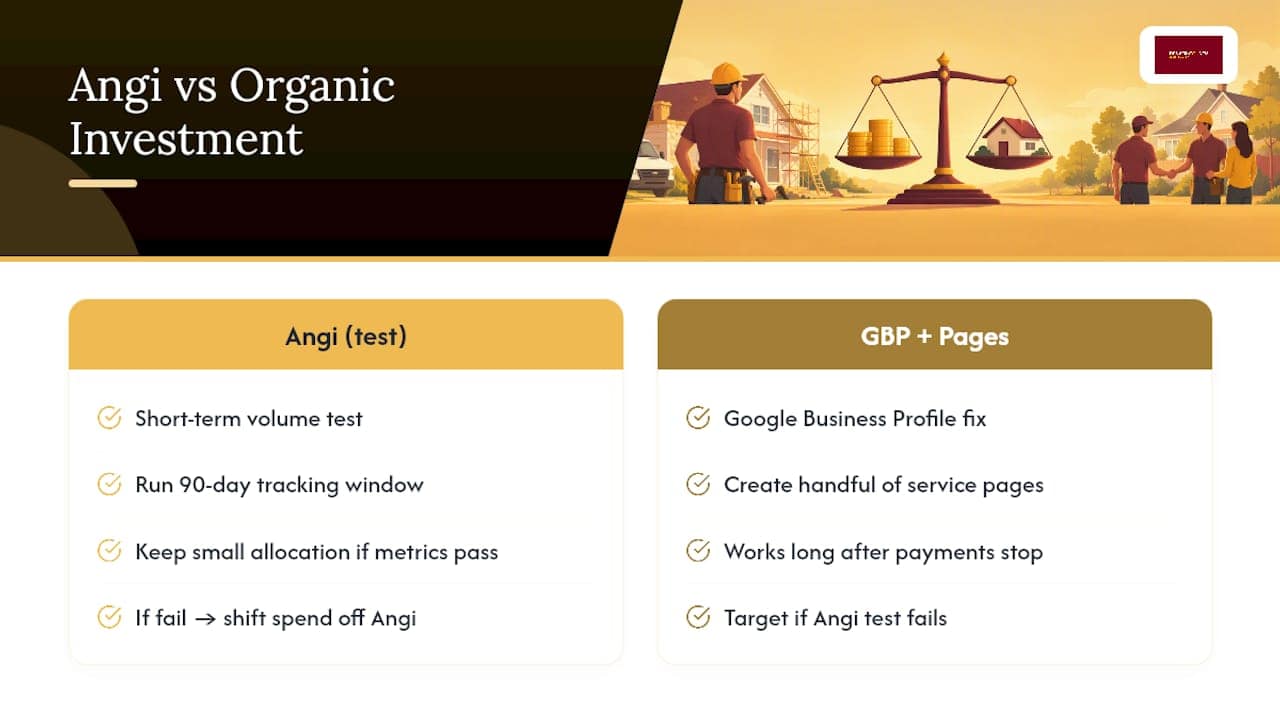
Contractors ask us this question constantly because they’ve been burned by a benchmark that didn’t hold up in their market. The FTC record on HomeAdvisor’s misrepresented conversion claims is exactly why we tell clients to ignore vendor benchmarks entirely and run their own 90-day tracking window before drawing conclusions.
We generally recommend Angi as a short-term volume test for shops with thin lead flow, never as a permanent growth engine. If your close rate, response speed, and margin math clear the bar in 90 days, keep a small allocation running. If they don’t, that spend belongs in a Google Business Profile fix and a handful of service pages that keep working long after you stop paying for them.
— Luis
A Different Path to Booked Jobs, No Per-Lead Invoice Required
Angi, HomeAdvisor, and Thumbtack all rent you access to homeowners who already belong to someone else’s platform. Denver County Web Design builds you a website and local search presence that belongs to you outright, no monthly fee holding your rankings hostage.
Instead of paying $15 to $120 every time a shared lead lands in three other inboxes at once, you invest once in an asset that keeps generating calls. The Solo Operator package offers a one-time fee option aimed at single-truck operations seeking a lead-ready site; other packages add deeper local SEO and Google visibility work for shops aiming to expand beyond marketplace leads. Local search plans are also available to build the Google Maps presence that supports owned leads. Check current packages and get a project quote at Denver County Web Design.
Sources
It depends on your speed to contact and your margin per job. For project-based trades with slower close rates, an owned channel like local SEO or Google Local Services Ads often produces a lower cost per booked job over time.
- FTC: Order requires HomeAdvisor to pay $7.2 million, stop deceptively marketing its leads
- Are Angi Leads worth it? Angi vs Thumbtack math
- Angi Leads Review 2026: Is It Worth the Cost for Pros?
- Are Angi leads worth it for growth-focused service businesses? | Ad Leverage
FAQ
What Does Angi Charge Per Lead?
Per-lead pricing typically falls between $15 and $120 depending on your trade and market, on top of an annual membership commonly reported between $288 and $348. Actual costs vary enough by category that you should request current pricing for your specific service area before budgeting.
How Much Do Contractors Actually Make From Angi Leads?
There’s no fixed answer. Contractors who track their own 90-day numbers, rather than relying on Angi’s marketing claims, get the clearest picture.
What Did Angi (HomeAdvisor) Get Sued For?
The FTC charged HomeAdvisor with misrepresenting lead quality, sourcing, and conversion rates to contractors buying leads. The case resulted in a final order requiring up to $7.2 million in payments and bars the company from repeating those specific claims.
How Do I Cancel Angi Leads?
Cancellation generally requires a phone call to Angi support rather than a self-serve online button, and you should expect a retention offer during the call. Have your account details and billing history ready, following the steps outlined in Angi’s own cancellation guide, to avoid delays.