A landing page is a single-purpose conversion page built to get a visitor to do one thing, a website is a multi-page hub that supports ongoing discovery, trust, and multiple services. If you’re running a paid ad, a promotion, or an event, send traffic to a landing page. If you’re building long-term visibility, showing off your range of services, or investing in SEO, you need a full website.
TL;DR:
- Landing pages significantly improve conversion rates when traffic sources are targeted and match the page’s specific offer or message.
- They should feature a clear headline mirroring the ad, a single visible call to action, minimal navigation, and social proof to maintain focus.
- A full website is essential for long-term trust, organic search visibility, and serving diverse visitor intents with multiple content pages.
- Landing pages fit well with paid search, social ads, and email campaigns, while websites support organic traffic, referrals, and ongoing brand building.
- Combining both tactics—using landing pages for quick campaigns and a full website for sustainable growth—yields the best results for small businesses.
Table of Contents
- 1. What is a landing page and why it converts differently
- 2. What is a website and how it earns trust over time
- 3. Head-to-head: purpose, structure, traffic fit, and upkeep
- 4. A checklist for choosing landing page, website, or both
- 5. How landing pages affect your Google Ads performance
- 6. How Denver County Web Design decides between the two
- 7. Get a landing page or lead-ready website built for you
- Sources
- FAQ
1. What is a landing page and why it converts differently
A landing page is a standalone page built around one goal: getting the visitor to fill out a form, book a call, or make a purchase. There’s no distracting menu, no five other links competing for attention, just one message and one path forward. That focus is exactly why landing pages often convert far better than a typical homepage when the traffic and the offer are well matched, according to Nielsen Norman Group’s research on homepage design.
Every strong landing page shares a few core elements:
- A headline that mirrors the ad or offer the visitor just clicked, so there’s no confusion about where they landed.
- A single, visible call to action repeated once or twice, never buried under competing buttons.
- Minimal or no main navigation, so visitors can’t wander off before converting.
- A short form asking only for what you truly need at this stage.
- Social proof, like a review count or a recognizable client logo, placed near the CTA.
Landing pages work best when they’re built for a specific traffic source: a Google Ads campaign, an email blast, a social promotion, or a direct-mail piece with a printed URL. Each of those sources brings a visitor with a specific expectation, and the page’s job is to meet it instantly.
Pro Tip: Match your headline word-for-word to your ad’s headline. That single change reduces the mental gap between click and conversion.
If you serve contractors or home service clients, seeing copyable contractor landing pages built for fast campaigns can save you from designing one from scratch.
2. What is a website and how it earns trust over time
A website is the collection of pages that make up your business’s permanent home online: a homepage, an about page, individual service pages, a blog, and a contact page. Unlike a landing page, a website is built to serve many different visitors with many different intents, from someone comparing prices to someone simply wanting your phone number.
A well-built website typically includes:
- A homepage that orients new visitors and points them toward the right section.
- Service or product pages that go deep on what you offer, one topic per page.
- A blog or resource section that answers common questions and supports organic search visibility.
- An about page that builds trust through your history, credentials, or team.
- A contact page with clear ways to reach you, not just a single form.
Navigation and internal linking matter enormously here. A visitor might land on a blog post, click through to a service page, then check your about page before finally calling. That multi-step journey is normal on a website and would be a distraction on a landing page.
Some businesses try to make their homepage double as a landing page for paid campaigns. It can work in a pinch, but a homepage still carries a full navigation menu and competing messages, which tends to dilute the one action you actually want a paid visitor to take.
3. Head-to-head: purpose, structure, traffic fit, and upkeep
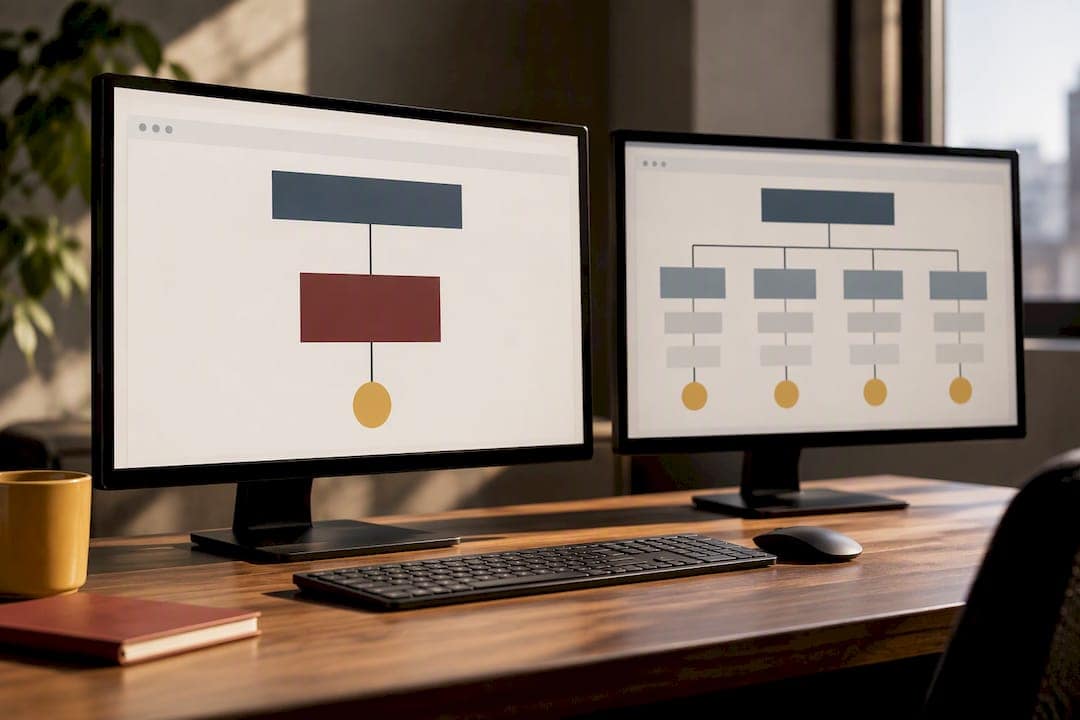
The clearest way to separate these two tools is to look at what each one optimizes for. A landing page optimizes for a single conversion, usually measured by conversion rate and cost per lead. A website optimizes for discovery and trust, usually measured by organic traffic, time on site, and search rankings over months or years.
Structurally, a landing page gives visitors one path: read, click, convert. A website gives visitors many paths, with a main menu, footer links, and internal links between pages. That’s a feature for a website and a liability for a landing page, since Google Ads’ own guidance on landing page experience points to navigation ease as one of the factors that shapes how an ad’s landing page performs.
Traffic sources tend to sort themselves naturally between the two:
- Landing pages fit paid search, paid social, email campaigns, and any traffic where you control the message before the click.
- Websites fit organic search, referrals, word of mouth, and any visitor arriving without a specific pre-set expectation.
A landing page built for a specific offer often converts several times better than a general homepage when the traffic matches the offer, largely because it removes navigation choices and other distractions, per NN/g’s homepage research.
Measurement approaches differ too. On a landing page, you’re testing one variable at a time: headline, CTA wording, form length, hero image. On a website, you’re watching aggregate patterns: which pages rank, where visitors drop off in a longer journey, which blog posts drive the most service page visits.
Maintenance is the quiet difference that catches a lot of small business owners off guard. A landing page for a spring promotion can be built, run, and retired in a matter of weeks. A website is a standing asset that needs updated content, fresh service pages, and ongoing SEO work to keep earning organic traffic. Neither is more work in general, they’re just work on different timelines.
4. A checklist for choosing landing page, website, or both
Run through this before you build anything:
- Define the goal. One specific action (book a quote, register for an event) points to a landing page; broad brand presence points to a website.
- Check the audience’s intent. Someone clicking a targeted ad already expects a specific offer; someone searching your business name generally wants your whole site.
- Match the traffic source. Paid and email campaigns pair with landing pages; organic search and referrals pair with websites.
- Set the timeline. A short promotion or seasonal push favors a landing page you can retire later; an ongoing presence favors a website you’ll keep updating.
- Decide what you need to test. If you want to run tight A/B tests on messaging, a landing page gives you a cleaner read than a busy homepage.
A few common scenarios make this concrete. A plumber running Google Ads for emergency repairs should send that traffic to a landing page built around one offer, not the homepage. A company launching a new product line needs a dedicated landing page during launch week, then a permanent product page on the main site afterward. An event or webinar almost always calls for a standalone registration page. A local service business that wants to show up in organic search, on the other hand, needs a full website with real service pages, because a landing page alone won’t rank for the range of searches a website can.
Pro Tip: Keep your campaign landing pages linked loosely to your main site (in the footer, not the main nav) so paid visitors stay focused, while your website still gets some of that traffic’s residual value.
You don’t have to choose one or the other permanently. Many home service businesses run both: a full website as the long-term asset and rotating landing pages for specific campaigns, an approach covered in more detail in this guide to choosing between a landing page and a full site.
5. How landing pages affect your Google Ads performance
If you’re running Google Ads, your landing page isn’t just a design choice, it’s a factor in what you pay per click. Google evaluates what it calls “landing page experience” as part of Quality Score, weighing how relevant the page is to the ad, how easy it is to navigate, and how fast it loads, according to Google Ads Help’s guidance on landing page experience. A page that matches the ad’s promise and loads quickly tends to earn a better score, which can lower your cost per click.
Google’s own recommendations reinforce the same points: match your landing page closely to your ad and keywords, keep navigation simple, and prioritize mobile usability, since most paid clicks now arrive on a phone, per Google’s guide to optimizing ads and landing pages.
Performance isn’t a minor technical detail here, it can move revenue directly. In one A/B test documented as a Web, improving a landing page’s load speed, specifically its Largest Contentful Paint, led to a noticeable increase in sales for Vodafone. That’s a meaningful lift from a page that simply loaded faster, not from any change in the offer itself.
A few tests worth running on any ad-driven landing page:
- Headline wording, tested against the exact phrase used in your ad.
- CTA button copy, comparing action-based phrases against generic ones.
- Form length, since shorter forms often lift completion rates.
- Hero image or video, tested for relevance to the offer.
For quick performance wins, compress your images, enable caching, and trim unused CSS that delays rendering. Mobile visitors bounce fastest, so guidance on mobile lead generation for advertisers is worth a look if most of your ad traffic arrives on a phone.
6. How Denver County Web Design decides between the two
When we work with home service businesses in Colorado, the decision between a landing page and a full website starts with the same question every time: what does this traffic already expect? A plumber running Google Ads for a specific repair service needs a tightly focused landing page, while a contractor trying to rank in Google Maps and organic search needs a complete, service-page-rich website.
We build both, often for the same client. A lead-focused website establishes the long-term presence and supports local SEO, while campaign landing pages handle seasonal promotions or paid traffic without cluttering the main site. Pairing a focused landing page with a lead-ready website behind it tends to give contractors the best of both: fast conversions from ads and a growing organic presence that keeps working long after a campaign ends.
— Luis
7. Get a landing page or lead-ready website built for you
If you’d rather skip the guesswork of building this yourself, a specialized web design company can build both campaign landing pages and full lead-focused websites for home service businesses, with clients owning the finished site outright and no monthly fees attached.
Whether you need a single landing page for an upcoming promotion or a complete rebuild that supports organic growth, our WordPress web design services are built around getting your phone to ring, not just looking good. Explore our full range of services to see which fits your next campaign.
Sources
- Homepage design: top navigation and layout principles (NN/g)
- About landing page experience (Google Ads Help)
- Web
- Landing page vs. website: what’s the difference? (HubSpot Blog)
FAQ
Do I need a website if I have a landing page?
Yes, in most cases. A landing page handles a single campaign, but a full website is what supports ongoing organic search visibility, credibility, and the range of services a single page can’t cover, as outlined in HubSpot’s comparison of the two.
Can a landing page be a website?
Technically a landing page can be the only page you have, but it won’t function like a full website. It lacks the navigation, service pages, and content depth that support organic search, so most businesses eventually need both.
Are landing pages still relevant?
Very much so, especially for paid advertising. Landing pages remain a core part of Google Ads performance, since Google factors landing page relevance and speed into Quality Score through landing page experience.
How do I create a landing page?
Start with one clear goal, a headline that matches your ad or offer, a short form, and a single call to action with no distracting navigation. Testing your headline and CTA wording early, as recommended in Google’s ad optimization guidance, helps you improve conversions without a full redesign.