Yes, optimize for Perplexity, but not the way you optimize for Google. Write short, citable passages that answer the question in the first 100 words, keep every page visibly fresh, and back claims with real sources. Your four levers: BLUF openers, visible update dates, topical authority, and distribution to sites that Perplexity already trusts.
TL;DR:
- Content should focus on recency and extractability, with updates every 30 to 60 days based on page importance and content type.
- Structuring pages with clear BLUF openers and self-contained passages increases the chances of being cited by Perplexity’s retrieval system.
- Building schema markup and visible update dates helps improve visibility and signals freshness to the search engine.
- Distributing content beyond the domain, such as on Reddit or niche sites, can boost citation likelihood and related traffic.
- Regularly auditing citations, verifying sources, and ensuring crawlers are not blocked are essential to maintain and improve Perplexity visibility.
Table of Contents
- What Perplexity SEO Actually Means
- How Perplexity’s Retrieval Pipeline Picks Winners
- Your Perplexity Citation Checklist
- The 60 to 90 Day Refresh Loop
- Tracking Whether It’s Working
- Mistakes That Quietly Kill Your Citations
- How Denver County Web Design Applies This for Clients
- What I’d Do First This Quarter
- Want a Perplexity-Ready Audit of Your Own Site?
- Sources
- FAQ
What Perplexity SEO Actually Means
Perplexity SEO is the practice of structuring content so an AI answer engine can find it, trust it, and quote it inline with a citation number. That’s a different job than climbing to position one on Google.
Perplexity runs a live web search for every single query instead of pulling from a pre-built index, then stitches together an answer with numbered citations attached to specific claims. It averages close to 22 citations per response, which means the competition isn’t for one blue link. It’s for a seat among 15 or 20 sources cited in the same answer.
A few things follow from that:
- The win condition is “cited,” not “ranked first.”
- Domain authority still matters, but freshness and extractability carry more weight than they do in classic Google SEO.
- A smaller, focused site can out-cite a bigger competitor if its content is easier to pull a clean quote from.
How Perplexity’s Retrieval Pipeline Picks Winners
Perplexity’s engine runs through roughly six stages every time someone asks a question: hybrid retrieval across the web and its own index, a reranking pass that scores candidate pages, synthesis of an answer from the top results, and citation attachment that ties each claim back to a source. Understanding those stages tells you exactly where your content needs to perform.
Pro Tip: Think of the reranker as a second filter after the initial search grab. Your page can get retrieved and still lose the citation if it’s not extractable once the reranker looks closely.
Here’s what tips the reranker in your favor:
- Recency: content updated within the last 30 days sees meaningfully higher citation rates than stale pages.
- Extractability: a clean, self-contained passage typically between 120 and 180 words is easier to lift than a paragraph buried in fluff.
- Visual placement: answers near the top of the page get pulled more often than answers on page three of scroll depth.
- Niche authority: Perplexity’s transparency around sourcing means a focused specialist site can sit next to a major outlet in the same answer.
That last point matters more than most marketers realize. You don’t need to outrank a national publisher. You need to answer the specific question better and faster.
Your Perplexity Citation Checklist
Work through this in order. Each step builds on the last, and skipping the first two undermines everything after them.
- Rewrite your top five pages with a BLUF opener. Lead with the direct answer in the first 100 words, ideally with one attributed number or fact. Save the backstory and context for after the answer, not before it.
- Build one 120 to 180 word extractable passage per subtopic, placed under a question-shaped H2. That length matches the citable unit Perplexity tends to pull most consistently.
- Add Article, FAQ, and Organization JSON-LD schema, including
sameAslinks to your verified social and business profiles. Structured data gives Perplexity’s retrieval layer a clean, machine-readable version of what your page already says in prose. - Show a visible “updated on” date near the top of every priority page. This isn’t just for readers. It’s a freshness signal the algorithm can read without guessing.
- Submit your sitemap to Bing Webmaster Tools and confirm PerplexityBot isn’t blocked. Perplexity’s retrieval layer leans heavily on Bing’s index, so a page invisible to Bing is often invisible to Perplexity too.
- Distribute the piece beyond your own domain. Post a summary on Reddit, pitch a mention to a niche publisher in your space, or reference it in a YouTube description. Wider distribution raises the odds that one of the several citations in an answer points back to you.
Pro Tip: If you only have time for one change this month, do step one. A BLUF rewrite on five pages takes an afternoon and touches every other tactic on this list.
The 60 to 90 Day Refresh Loop
Freshness isn’t a one-time fix. It’s a maintenance habit, and the cadence depends on how much a page is worth to your business.
- High-priority service and money pages: refresh every 60 days.
- Pages tied to news, pricing, or anything time-sensitive: refresh within 30 days of any change in the underlying facts.
- Everything else: review quarterly and refresh if the content has drifted out of date.
A real refresh means more than changing a timestamp. Update or add one corroborating statistic, swap in a newer source where the old one is dated, update the last-modified metadata, and ping your sitemap so crawlers know to come back. Prioritize by multiplying business impact by citation potential. A page that could drive booked jobs and already gets cited occasionally deserves attention before a low-traffic blog post that’s never once been pulled into an answer.
Tracking Whether It’s Working
You can’t fully automate Perplexity tracking yet, so build a manual habit alongside your existing analytics.
- Pick 20 queries your ideal customer would realistically type into Perplexity, and run them weekly. Log which of your pages get cited and where you rank among the citations.
- Segment AI referral traffic in Google Analytics 4, but expect a high share of it to arrive with no referrer at all. Many AI-driven visits simply don’t pass that data along.
- Watch branded search volume and time on site as a secondary signal. If Perplexity is sending you real readers, branded search and engagement usually climb even when the referral data doesn’t show it directly.
- If budget allows, layer in a dedicated share-of-voice tool for ongoing tracking instead of relying solely on manual spot checks.
| Metric | How to track it | What it tells you |
|---|---|---|
| Citation share | Weekly 20-query manual audit | Direct visibility in Perplexity answers |
| AI referral sessions | GA4 traffic segmentation | Partial signal, undercounts due to no-referrer visits |
| Branded search lift | Search Console / brand query volume | Indirect confirmation people saw your brand in an AI answer |
| Time on site from AI traffic | GA4 engagement metrics | Whether cited visitors actually stick around |
Pages that do get cited tend to perform well once someone clicks through, with practitioner reports showing longer session times and stronger conversion rates than typical organic traffic. That’s the real payoff: fewer visits, but visits from people who already trust the answer they just read.
Mistakes That Quietly Kill Your Citations
Most sites don’t lose Perplexity visibility on purpose. They lose it through neglect.
- Blocking crawlers without realizing it, or never submitting a sitemap to Bing Webmaster Tools in the first place.
- Burying the actual answer under three paragraphs of setup, or leaving off any visible update date.
- Chasing Google rankings alone while ignoring extractable passages, structured data, and topical depth.
- Treating every AI citation as gospel. An audit found that 34.7% of Perplexity citations for numerical claims pointed to pages that didn’t actually contain the stated figure, which cuts both ways: verify what Perplexity says about your competitors, and make sure your own numbers are airtight so you’re never the mismatch someone else catches.
How Denver County Web Design Applies This for Clients
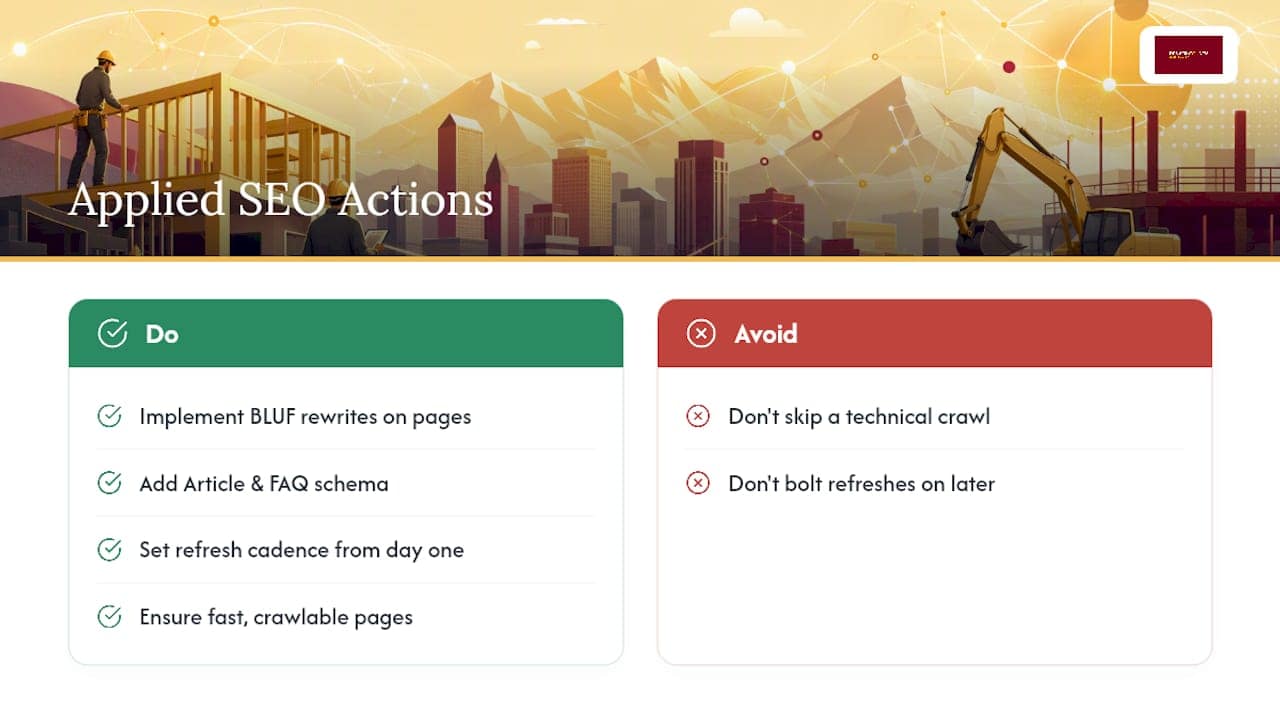
Denver County Web Design builds this playbook directly into the sites and SEO packages it delivers for contractors and home service businesses across Colorado. That means BLUF rewrites on service pages, Article and FAQ schema baked into the build, visible update timestamps, and a refresh cadence set up from day one instead of bolted on later.
Some clients have seen significant increases in organic traffic within 90 days after implementing redesigned sites with BLUF-first page structure, cleaned-up local listings, and ongoing content refreshes.
That kind of jump doesn’t come from one trick. It comes from stacking the fundamentals: fast, crawlable pages; structured data that speaks the same language as Bing and Perplexity’s retrieval layer; and content that answers the question before the reader has to scroll for it.
Pro Tip: If your site has never had a technical crawl check, start there before you touch a single word of copy. A blocked crawler makes every other tactic on this list irrelevant.
What I’d Do First This Quarter

Run the 20-query audit before you rewrite anything. You need to know where you already show up before you can measure whether changes helped. Then fix your five highest-value pages with BLUF openers, ship one piece built around original data you actually own, and push it to a niche site or a relevant Reddit thread.
After that, schedule rolling 60-day refreshes and add schema to your priority pages. Most sites skip the refresh step because it feels like busywork. It isn’t. Freshness is one of the few levers you fully control, and it’s the one most competitors will keep ignoring.
— Luis
Want a Perplexity-Ready Audit of Your Own Site?
Most contractors don’t have time to run a 20-query citation audit, rewrite five pages with BLUF openers, and build out schema markup on a weekend. Some agencies offer this work as part of their website and local SEO packages, with clients owning the finished site outright and no monthly fees required.

The build includes the technical groundwork this article covers: visible update dates, structured data, Bing Webmaster Tools submission, and a refresh cadence that keeps your service pages fresh instead of stale six months later. If you’re a Denver-area contractor wondering whether your current site can even get crawled properly, start with the free SEO audit and see where the gaps are before you spend a dollar on a rebuild. For a full look at what a Perplexity-ready site includes, visit Denver County Web Design.
Sources
- Perplexity’s citation crisis: One in three references fail to back the numbers — WebProNews
- How Perplexity Decides What to Cite: Inside the Most Citation-Dense AI Search — PromptAlpha AI
- How Perplexity Chooses Sources: Citation Mechanics for the Most Transparent AI Engine – DEV Community
- How Perplexity Citations Work (And How to Earn Them) – CitedSpy
- Perplexity SEO: The Complete Guide to AI Search Optimization in 2026 — GeoXylia
FAQ
Is Perplexity Good for SEO?
Yes. Getting cited in Perplexity puts your business in front of people actively researching a purchase decision, and practitioner reports show cited pages often see longer sessions and stronger conversion rates than average organic traffic.
What Is Perplexity in SEO?
Perplexity is an AI answer engine that runs a live web search for each query and cites multiple sources inline, so “Perplexity SEO” means optimizing content to be one of those cited sources rather than a top-ranked link.
Is SEO Dead or Evolving in 2026?
SEO isn’t dead, it’s splitting into two disciplines: traditional ranking work for Google and a parallel practice focused on structure, freshness, and extractability for AI engines like Perplexity.
Which AI Is Best for SEO?
There’s no single winner, but Perplexity stands out for marketers because it shows its sources transparently and cites niche specialist sites alongside major publishers, giving smaller businesses a realistic shot at visibility.
How Often Should I Update Content for Perplexity?
Refresh high-priority pages roughly every 60 days and anything tied to news or pricing within 30 days, since content updated recently tends to earn citations at a noticeably higher rate.