An HVAC SEO audit needs to test five pillars: technical performance, on-page service structure, local and Google Business Profile signals, schema and AI readiness, and review velocity. Those five determine whether your site shows up in the Map Pack and converts panicked “AC repair near me” searches into booked jobs. Run a focused 30 to 90 minute check yourself this week, or request a free Map Pack audit to see exactly where you’re losing calls.
TL;DR:
- Improving local SEO signals and service page structure significantly boosts Map Pack visibility and attracts emergency and scheduled service calls.
- Technical speed issues, especially slow load times exceeding 2.5 seconds for core metrics, are the largest obstacle to high rankings and should be prioritized.
- Creating dedicated, optimized service and location pages with matching metadata and schema helps target specific search intents effectively.
- Consistently managing and growing Google reviews and ensuring GBP details align with actual service areas enhances local trust and visibility.
- Regularly auditing equipment catalog pages, scheduling widgets, and duplicate content issues prevents technical SEO pitfalls unique to HVAC sites.
Table of Contents
- What Does an SEO Audit for HVAC Companies Actually Cover?
- How Do You Run a Technical SEO Audit for an HVAC Website?
- Why One Service, One Page Wins on Google
- Is Your Google Business Profile Actually Optimized?
- Does Your Schema Markup Help AI Assistants Find You?
- Backlinks and Reputation: The Off-Page Half of the Audit
- The Audit Timeline: What to Fix in Weeks 1 Through 12
- Which Free Tools Should You Run Today?
- What Should You Track After the Audit Is Done?
- The Fastest Fixes With the Biggest Payoff
- How Does Your HVAC Site Compare to Local Competitors?
- What Technical Problems Are Specific to HVAC Websites?
- What Actually Moves the Needle vs. What Sounds Good on Paper
- Get a Free Map Pack Audit Before You Spend Another Dollar on Ads
- Sources
- FAQ
What Does an SEO Audit for HVAC Companies Actually Cover?
Most HVAC owners think an SEO audit means checking Google rankings. It’s bigger than that. A real HVAC SEO analysis tests whether a stressed-out homeowner with a dead furnace at 9 PM can find you, trust you, and call you in under 15 seconds.
Each pillar catches a different type of failure, and each failure costs you differently depending on whether the searcher needs you today or is comparing quotes for next month.
- Technical SEO checks whether Google can crawl, index, and load your site fast enough. A slow site loses emergency searchers before the page even renders.
- On-page and service pages determine whether you rank for “furnace repair” separately from “AC installation,” instead of one generic page trying to do both jobs badly.
- Local SEO and Google Business Profile control your Map Pack ranking, which is where most local HVAC clicks happen before anyone reaches your website.
- Schema and AI readiness tell Google, Bing, and AI assistants exactly what you do, where you serve, and when you’re open, which matters more every quarter as more searches never produce a traditional click.
- Review management builds the trust signal that tips a comparison shopper toward calling you over the three other contractors in the Map Pack.
Emergency searches (a cracked heat exchanger, no AC in July) reward speed, click-to-call visibility, and GBP hours. Commercial or scheduled-service searches (a spring tune-up, a new install quote) reward deeper service page content and reviews that speak to expertise. Your website audit for HVAC should score both intents separately, because fixing one without the other leaves money on the table.
Before you touch a single line of code, walk through each pillar with a simple pass or fail test: Can a stranger find your hours in under five seconds? Does your AC repair page mention AC repair at least as often as furnace repair? Those two questions alone surface most of the failures agencies find in a full audit.
How Do You Run a Technical SEO Audit for an HVAC Website?
Technical problems are invisible to homeowners and devastating to rankings. Across 104 HVAC sites, the mean mobile Largest Contentful Paint measured 8.35 seconds, more than three times Google’s 2.5 second target. That gap is often the single biggest reason a well-written, well-reviewed HVAC site still ranks behind a mediocre competitor.
Run these checks in order:
- Crawl your site with a tool like Screaming Frog or Google Search Console’s URL Inspection to surface 404s, redirect chains, and duplicate title tags. Crawl errors on service pages are worse than errors on blog posts because they block the exact pages generating leads.
- Test Core Web Vitals on your five highest-traffic pages using PageSpeed Insights. Aim for LCP under 2.5 seconds, INP under 200 milliseconds, and CLS under 0.1. Most HVAC sites blow past all three because of uncompressed hero images and bloated booking widgets loaded on every page instead of just the contact page.
- Check for JavaScript rendering problems. If your site was built on a heavy page builder or a booking platform that injects content client side, Google Search Console’s Coverage report will show pages stuck as “discovered, currently not indexed.” That status means Google found the URL but decided it wasn’t worth crawling, usually because the page took too long to render or looked thin.
- Validate your sitemap and robots.txt. Submit your XML sitemap in Search Console and confirm it isn’t accidentally blocking your service or location pages. A surprising number of HVAC sites disallow entire directories during a redesign and never notice.
Fast fact: Only about 58% of audited HVAC sites pass the LCP threshold, and just 65% pass INP, according to Web Tonic’s technical audit data. If you fix nothing else this month, fix speed.
The fastest wins are almost always image compression (switch to WebP, resize before upload) and deferring non-critical JavaScript like chat widgets and review carousels so they load after the main content. Fixing render speed first matters because content and Google Business Profile work only compounds once Google can actually crawl and index your pages efficiently.
Why One Service, One Page Wins on Google
A single “Our Services” page trying to rank for furnace repair, AC installation, duct cleaning, and thermostat replacement almost never ranks well for any of them. Search engines reward topical depth per page, not breadth crammed into one page, and automated crawl tools frequently miss this failure entirely because the page technically exists and technically loads — it just doesn’t rank.
Structure your site architecture around two things: the job and the neighborhood.
- One page per service. “Furnace Repair,” “AC Installation,” “Duct Cleaning,” and “Heat Pump Service” each get a dedicated URL with unique content, not a shared paragraph on a combined page.
- One page per primary service area, especially if you cover multiple towns or metro suburbs. A “Furnace Repair in [City]” page targets a real, specific search intent that a generic services page can’t compete for.
- Minimum useful length matters. Thin location pages under 400 unique words rank poorly because they read as duplicate filler; a 47 point HVAC audit found thin location content among the most common failures across contractor sites.
- Match metadata to intent. Emergency pages should lead with urgency (“24/7 Emergency Furnace Repair”) in the title tag and H1. Scheduled-service pages can lead with value (“Affordable AC Installation & Financing”).
- Internal link service pages to each other and to your location pages, and place Service schema on each one so Google understands the specific job, price range, and area covered.
This structure does double duty. It improves your HVAC website SEO check scores because Google sees clear topical signals, and it improves your conversion rate because visitors land on a page that answers their exact question instead of scrolling past three services they don’t need.
Is Your Google Business Profile Actually Optimized?
Your Google Business Profile does more work than your homepage for local visibility. It’s what shows up in the Map Pack, and the Map Pack is where most “near me” clicks happen before anyone visits your website at all.
Run through this sequence:
- Verify service areas match reality. List every city and suburb you actually serve, not just your headquarters. Missing service areas is one of the most common gaps in local SEO analysis.
- Confirm hours reflect emergency availability. If you offer 24/7 emergency service, your GBP hours need to say so explicitly, and your OpeningHoursSpecification schema should match it.
- Audit NAP consistency (name, address, phone) across your top 15 directories: Yelp, Angi, HomeAdvisor, BBB, and industry-specific listings. One 28 point HVAC checklist flagged inconsistent NAP as one of the three most common failures across hundreds of contractor audits.
- Upload real job photos, not stock imagery. Trucks, technicians, and before/after equipment shots outperform generic HVAC stock photos in engagement.
- List every service explicitly in the GBP services section, matched to your actual service pages.
Pro Tip: Steady review growth beats a one-time review push. A consistent monthly cadence of new reviews, often 10 to 20 per month in competitive metro markets, signals ongoing customer activity to Google better than 40 reviews collected in a single week and then silence for six months.
Respond to every review, good or bad, within 48 hours. A thoughtful response to a one star review often does more for trust than five generic five star reviews with no owner reply at all.
Does Your Schema Markup Help AI Assistants Find You?
Structured data used to be a rich results play. Now it’s an AI visibility play too. Schema is now the mechanism both AI assistants and Google’s Map Pack rely on to confirm what your business does, where you work, and when you’re open, and adoption across HVAC sites remains surprisingly low despite the payoff.
Prioritize these JSON-LD types on the right pages:
- LocalBusiness schema on your homepage, with your NAP, service area, and hours.
- Service schema on each individual service page, naming the specific job and area covered.
- OpeningHoursSpecification nested inside your LocalBusiness markup to flag 24/7 emergency availability clearly.
- FAQPage schema on service pages that answer common questions (“How much does emergency furnace repair cost?”).
- Review schema to surface star ratings directly in search results.
Adoption of LocalBusiness and FAQPage schema remains low across local trade sites generally, yet it meaningfully boosts the odds of being cited by AI assistants summarizing local service options.
Implementation is simpler than most contractors assume. Generate the JSON-LD with a schema plugin or a generator, paste it into your page head, then validate it with Google’s Rich Results Test before publishing. A detailed LocalBusiness schema walkthrough covers the field-by-field setup if you want to build it manually, and this guide to AI search visibility explains why structured openness matters more as generative search grows.
Backlinks and Reputation: The Off-Page Half of the Audit
Backlinks still matter for HVAC, but relevance beats volume every time. A single link from your local chamber of commerce or a regional supplier outweighs a dozen generic directory links from sites with no connection to home services.
- Audit your existing backlink profile with Search Console or a paid tool, and flag spammy or irrelevant links pointing at your site for possible disavow.
- Prioritize local relationships: chamber of commerce membership pages, supplier and manufacturer partner pages (Trane, Carrier, Lennox dealer listings), local news coverage, and sponsorships of community events.
- Treat reviews as a link-adjacent asset. A steady review-collection workflow, ideally automated through a text or email follow-up after every job, builds the trust signal that off-page work alone can’t buy.
- Skip mass directory submissions. Most contribute nothing to rankings and just create more NAP inconsistencies to clean up later.
The Audit Timeline: What to Fix in Weeks 1 Through 12
A phased approach prevents overwhelm and produces visible results faster than trying to fix everything simultaneously. Quick wins and foundational fixes show impact on different timelines, so sequence them deliberately.
- Weeks 1 to 2 (quick wins, roughly 6 to 10 hours): Complete your Google Business Profile fully, fix NAP inconsistencies across top directories, add sticky click-to-call on mobile, and rewrite homepage metadata for your primary service and city.
- Weeks 3 to 6 (foundational fixes, roughly 15 to 25 hours): Split combined service pages into dedicated pages per job, implement LocalBusiness and Service schema, resolve Core Web Vitals issues, and submit a cleaned-up sitemap.
- Weeks 6 to 12+ (sustained work, ongoing): Publish location and seasonal content, run local link outreach, maintain review cadence, and hit a 90 day checkpoint to review ranking movement.
Fixes to GBP, schema, and service pages tend to produce measurable local ranking movement within 2 to 8 weeks, while content and link-building work compounds more slowly over three to six months. Set expectations with that split in mind, especially if you’re reporting progress to a business partner or manager who expects instant results from week one.
Which Free Tools Should You Run Today?
You don’t need a budget to start an SEO checklist for HVAC. Run these free checks this afternoon:
- PageSpeed Insights for Core Web Vitals scores on your homepage and top service pages.
- Google Search Console for indexation status, crawl errors, and click/impression data.
- Google’s Rich Results Test to validate your schema markup.
- Mobile-Friendly checks built into Search Console to confirm mobile rendering.
- A manual sitemap check, opening your sitemap.xml URL directly to confirm it lists your real, current pages.
Once your site grows past a handful of service and location pages, bring in a paid crawler like Screaming Frog or a backlink tool such as Ahrefs or Semrush to scale the audit process, especially for catching orphaned pages and toxic links a manual review would miss.
What Should You Track After the Audit Is Done?
Keep your KPI list short enough to check monthly without a dashboard degree. Track GBP calls and direction requests, organic clicks and impressions from Search Console, Map Pack impression share, and your phone call to booked job conversion rate. On the technical side, revisit LCP, INP, CLS, and your total indexed page count every 30 days.
A small, consistent KPI set gives contractors a clearer read on progress than complex reporting dashboards most agencies push.
At your 90 day checkpoint, apply simple decision rules: if calls and Map Pack visibility are climbing, scale your content and outreach. If technical metrics improved but calls didn’t, revisit your service page copy and calls to action. If nothing moved at all, that’s the signal to bring in outside help rather than keep guessing.
The Fastest Fixes With the Biggest Payoff
Some fixes take an afternoon and move the needle within weeks. Prioritize these before anything requiring a developer or a content calendar.
- Add sticky click-to-call and emergency messaging to your mobile header. This alone often lifts emergency call conversion measurably within days.
- Complete your Google Business Profile, submit a clean sitemap, and fix any broken internal links flagged in Search Console.
- Split your generic services page into individual service pages, and add LocalBusiness schema sitewide.
- Correct NAP inconsistencies across your top directory listings, since mismatched business information quietly erodes local ranking trust over time.
Pro Tip: Rank fixes by effort versus impact, not by what feels most urgent. Click-to-call takes an hour and shows results in days; splitting service pages takes a week and shows results in a month. Do both, but do the hour-long fix first.
How Does Your HVAC Site Compare to Local Competitors?
A competitor audit for HVAC works differently than a general niche comparison. Pull up the three businesses ranking above you in the Map Pack for your primary service, and compare five things side by side: number and recency of reviews, whether they have dedicated service pages or one combined page, page load speed, whether their GBP lists emergency hours, and whether they carry visible schema markup.
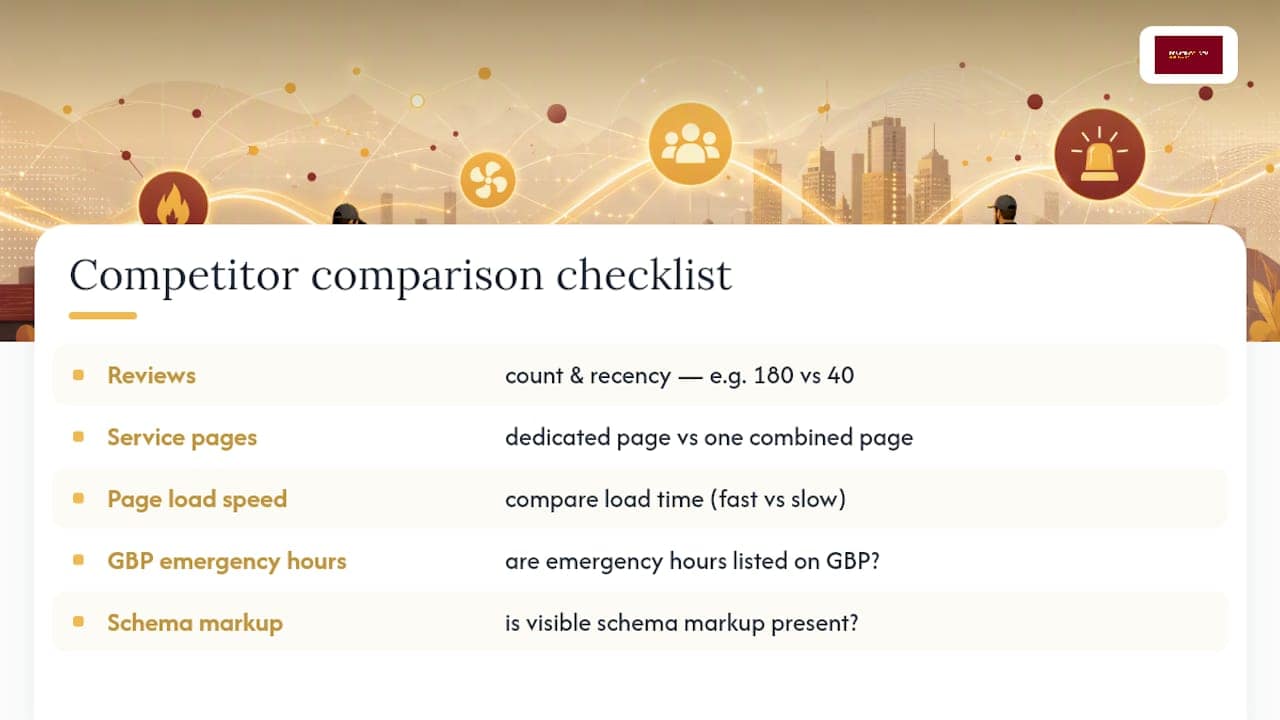
Most HVAC owners assume the top-ranking competitor has some secret advantage. Usually it’s simpler: they just fixed the same five pillars covered in this checklist earlier. A competitor with 180 reviews and a dedicated furnace repair page will consistently outrank a competitor with 40 reviews and one combined services page, even if the second business has better actual service.
Document what you find in a simple comparison, not to copy competitors outright, but to identify where the gap between you and the top three results actually lives. If your speed and schema match theirs but your review count is a third of theirs, that tells you where to focus resources for the next quarter. If your reviews are competitive but your service pages are thin, that’s your priority instead. A competitor snapshot done honestly, even a rough one built in a spreadsheet, often reveals the single highest-leverage fix faster than a generic checklist applied blindly.
What Technical Problems Are Specific to HVAC Websites?
HVAC sites carry technical baggage most industries don’t deal with: equipment catalogs, booking or scheduling widgets, and financing calculators, all of which can quietly wreck your SEO if built carelessly.
Equipment catalog pages, especially ones pulling data from a manufacturer feed (Trane, Carrier, Goodman units), often generate thousands of thin, near-duplicate pages that dilute your site’s overall authority. Audit whether these pages are indexed at all; if they’re not driving traffic, consider noindexing them rather than letting them compete with your real service pages for crawl budget.

Booking and scheduling widgets frequently load through third-party JavaScript embedded on every page, not just the contact page. That’s a major contributor to the slow load times showing up across HVAC sites broadly. Move the booking widget to a dedicated scheduling page and load it only there.
Financing calculators and quote-generator tools sometimes create URL parameters that spawn duplicate content issues, since the same base page gets indexed multiple times with different query strings. A canonical tag on the base URL usually resolves this cleanly. None of these fixes require rebuilding your site, but they do require someone who knows to look for them, since a standard crawl tool often flags the symptom (slow load, duplicate content) without diagnosing the actual HVAC-specific cause.
What Actually Moves the Needle vs. What Sounds Good on Paper
Most HVAC SEO advice online reads like a checklist built for e-commerce and awkwardly retrofitted for contractors. The conventional wisdom says publish blog content weekly and build backlinks aggressively. In practice, the businesses that see the fastest lead increases fix technical speed and Google Business Profile completeness first, because those two levers affect every single search, emergency or scheduled, immediately.
That order matters more than most agencies admit, because content published on a slow, poorly structured site is money spent polishing a house with a cracked foundation.
DIY makes sense for GBP completion, basic schema, and one-off technical fixes like image compression. Hire a specialist when you’re dealing with JavaScript rendering problems, need a sustained local link-building program, or want a content calendar built around real keyword gaps rather than guesswork. Know which category your problem falls into before you spend a weekend on it.
— Luis
Get a Free Map Pack Audit Before You Spend Another Dollar on Ads
Running through every pillar in this checklist yourself takes a full weekend if you’re thorough. Denver County Web Design will hand you the findings in days, not weekends, with a free Map Pack audit that flags exactly which of the five pillars is costing you calls right now.
The audit covers a technical speed check, a Google Business Profile review, a service page structure scan, and a sample list of fixes ranked by effort versus impact. This is the same framework covered above but run against your actual site instead of a generic checklist. Denver County Web Design builds custom WordPress sites for Colorado contractors with full client ownership and no monthly fees, so the fixes you make stick without a recurring bill attached. If you’re weighing whether to tackle this yourself or bring in help, the free Map Pack audit gives you a clear answer either way at no cost. For a full rebuild or redesign, the main services page walks through package options for Denver metro contractors ready to fix the foundation once and stop patching it every quarter.
Request your free audit today and get a prioritized fix list back within days.
Sources
- HVAC Technical SEO Statistics 2026 | Web Tonic™
- HVAC SEO Checklist: 28-Point DIY Guide for Contractors 2026 – Nopio
FAQ
How Much Does HVAC SEO Cost?
Costs vary widely based on scope, from a few hundred dollars for a one-time technical fix to several thousand for a full site rebuild with ongoing local SEO. A free Map Pack audit is a reasonable first step before committing to a paid engagement.
Can I Do My Own SEO Audit?
Yes, for the basics: Google Business Profile completeness, PageSpeed Insights checks, and Search Console indexation review are all free and take under two hours. Deeper issues like JavaScript rendering problems or a full backlink cleanup usually require specialized tools or agency help.
How Much Does an SEO Audit Cost?
A basic self-guided audit costs nothing beyond your time using free tools like PageSpeed Insights and Search Console. A professional audit from an agency typically ranges from a few hundred to over a thousand dollars depending on site size and depth.
Can ChatGPT Do an SEO Audit?
ChatGPT and similar tools can help you understand SEO concepts and draft checklists, but they can’t crawl your live site, measure your actual Core Web Vitals, or verify your Google Business Profile data. Use it to learn the framework, then run the actual checks with tools built for that purpose.