Your fastest path to more local jobs is a fully optimized Google Business Profile paired with dedicated service pages for each trade you offer. Google Business Profile results usually move within a few weeks; organic rankings from your service pages typically take several months to gain traction. Claim your listing today, check every field is complete, and build a page for each service you actually book.
TL;DR:
- Fully optimize your Google Business Profile by claiming, verifying, selecting accurate categories, and regularly updating photos and posts to improve map pack visibility within weeks.
- Create dedicated service pages with clear, location-specific content and schema markup to rank higher in local searches over the course of several months.
- Collect reviews promptly after completing jobs and respond to them within 48 hours to boost local ranking signals and build trust with potential customers.
- Focus on mobile speed, tap-to-call buttons, and structured data to ensure your website loads quickly on phones and converts visitors into booked jobs effectively.
- Use targeted local keywords in service and blog content, and maintain consistent citations and reviews, to sustain ongoing SEO performance and generate steady leads.
Table of Contents
- Google Business Profile Optimization: Your Map Pack Playbook
- What Keywords Should Tradesmen Actually Target?
- How Do You Structure Service Pages That Actually Rank?
- Reviews and Trust Signals: What Actually Moves Rankings
- Mobile Speed, Tap-to-Call, and Schema Essentials
- What Content Should Tradesmen Publish for SEO and AI Search?
- Local Citations and Link Building for Trades Businesses
- How Long Until You See SEO Results, and What Should You Track?
- Turning Website Visitors Into Booked Jobs
- Why Email Marketing Still Works for Repeat Trade Business
- What Contractors Consistently Get Wrong About SEO
- Get a Free Map Pack Audit From Denver County Web Design
- Tools Worth Bookmarking for Ongoing SEO Health
- Sources
- FAQ
Google Business Profile Optimization: Your Map Pack Playbook
Google Business Profile (GBP) is the single most direct route into the map pack, the three listings that show up above organic results when someone searches “plumber near me.” Get this right before you touch anything else on your site.
- Claim and verify your listing. Go to google.com/business, search your business name, and verify by phone, text, or postcard. If someone already claimed it years ago and forgot the password, request ownership transfer.
- Pick your primary category with precision. “Electrician” ranks differently than “Electrical installation service.” Test a few and watch which one Google suggests first when you type your main trade.
- Add secondary categories that reflect real services. A roofer who also does gutter work should add “Gutter cleaning service” as a secondary category, not just rely on the primary one.
- Set your service area correctly. If you work from a shop with walk-in customers, show the address. If you’re a mobile trade like a locksmith or landscaper, hide the address and list service areas by city or zip code instead.
- Fill in every field. Hours, including emergency or after-hours availability, phone number, website, services list, and a business description that mentions your trade and city by name.
- Upload photos weekly. Before-and-after job shots outperform stock photos every time. Google’s own data ties active photo uploads to higher engagement on profiles.
- Post updates weekly. A finished job, a seasonal reminder (“Check your furnace before the first freeze”), or a limited-time offer keeps your profile active in Google’s eyes.
Your review-collection process matters as much as the setup itself. Text the customer a direct Google review link within two hours of finishing the job, while the work is still fresh in their mind. A simple script works: “Thanks for choosing us today! Would you mind leaving a quick review? Here’s the link: [your link].” Respond to every review within 48 hours, thanking positive reviewers by first name and service type, and handling negative ones calmly and specifically.
The most common GBP mistakes are stale hours during holidays, a category that doesn’t match search intent, and zero photos after the first month. All three are five-minute fixes once you know to look for them.
Pro Tip: Set a recurring 15-minute calendar reminder every Friday to upload one job photo and write one GBP post. Consistency beats intensity here.
For a deeper walkthrough of profile settings by category, Denver County Web Design’s guide to Google Business Profile optimization covers field-by-field detail worth bookmarking.
What Keywords Should Tradesmen Actually Target?
Local keyword research for trades splits into two buckets, and confusing them wastes your best pages. Commercial “near me” keywords (“emergency plumber near me,” “roof repair Denver”) signal someone ready to hire now. These belong on your service pages. Problem-aware queries (“why does my water heater make noise,” “how to tell if my roof needs replacing”) signal someone still researching. These belong on blog posts that answer one question and gently point toward a service page.
You don’t need expensive software to build this list. Type your service into Google, and Google’s autocomplete suggestions are actual searches other locals are typing. Scroll to the “People also ask” box for problem-aware phrasing you can turn into blog posts. Low-cost tools help expand the list further, and long-tail keyword tactics tend to convert better for niche trades precisely because fewer competitors bother targeting them.
When deciding what to prioritize, weigh three factors:
- Intent: does the phrase suggest someone ready to book, or someone still comparing options?
- Volume: is this a phrase real people search, or a term only industry insiders use?
- Competitiveness: can a small trades business realistically outrank the national franchises for this exact phrase?
A practical keyword map for a licensed electrician might look like this: “emergency electrician [city]” and “panel upgrade cost [city]” go on service pages. “Why do my lights flicker” and “how many amps does my house need” become short blog posts. “Electrician near me” gets folded into your homepage and GBP description, since it’s too broad for any single service page to own.
Pro Tip: Name your service pages after what customers actually type, not internal jargon. “Water Heater Replacement” beats “Water Heater Services” almost every time in search behavior.
How Do You Structure Service Pages That Actually Rank?
Every distinct service you offer needs its own page. A plumber who lumps “drain cleaning,” “water heater repair,” and “pipe replacement” into one generic “Plumbing Services” page is competing against businesses with three separate pages, each built to rank for one specific search.
The blueprint that works across trades follows a consistent shape:
- H1 that states the exact service and location (“Drain Cleaning in Aurora, CO”)
- Problem lead: open by naming the customer’s actual frustration, not your company history
- What you do: plain description of the service, no jargon
- Process: three or four steps showing what happens after they call
- Time and cost ranges: even a range (“most jobs run $150 to $400”) builds trust and filters out mismatched leads
- Trust signals: license number, insurance status, years in the trade, certifications
- Call to action: phone number, tap-to-call button, or a short inquiry form
Building this on a platform like WordPress gives you flexibility to duplicate the template across services without starting from scratch each time, since its structure supports repeatable page layouts well.
Location pages follow the same blueprint but need a different kind of uniqueness. Google penalizes pages that are copy-pasted with only the city name swapped. Real local evidence beats a template every time: mention specific neighborhoods you’ve serviced, a landmark near a recent job, or a local permit requirement unique to that municipality. A masonry company serving both Denver and Aurora might note that Aurora’s older brick homes need different repointing techniques than Denver’s newer stucco construction. That single detail does more for rankings than three paragraphs of generic filler.
Schema markup ties the whole structure together for search engines. The LocalBusiness schema vocabulary lets you code your business name, address, phone number, hours, and service area in a format Google reads directly, rather than guessing from page text. Add Service schema to each service page to specify exactly what’s offered, and AggregateRating schema once you have enough reviews to display star ratings in search results. Denver County Web Design’s breakdown of local business schema walks through the exact fields worth prioritizing first.
If you serve multiple towns, look at how service-area targeting works before building out a dozen thin location pages. Three well-built pages beat ten hollow ones.
Reviews and Trust Signals: What Actually Moves Rankings
Reviews influence both map pack rankings and whether a stranger picks up the phone. The workflow that works consistently:
- Ask within two hours of job completion, while the work is fresh and the customer is satisfied.
- Text, don’t email. Text messages get opened within minutes; emails sit in inboxes for days or get buried entirely.
- Use a short, direct script. “Hi [name], thanks for trusting us with your [service] today. A quick review would mean a lot: [link].”
- Ask the customer to mention the specific service and city if they’re comfortable doing so. A review that says “fast water heater replacement in Lakewood” carries more SEO weight than “great service, thanks.”
- Respond to every review, good or bad, within 48 hours.
- For negative reviews, acknowledge the specific issue, offer to make it right offline, and avoid getting defensive in public. Google doesn’t remove reviews for being critical, only for violating policy, so a calm, professional response is your best tool for damage control.
Trust signals extend beyond reviews. License numbers, insurance certificates, and manufacturer certifications displayed on your site and GBP profile both increase conversion and reinforce legitimacy signals that support ranking, since customers and Google both favor businesses that can prove they’re real and qualified. Put your license number in your footer, on your about page, and in your GBP business description, not buried on a single “credentials” page nobody visits.
Mobile Speed, Tap-to-Call, and Schema Essentials
Mobile-first indexing means Google evaluates your site’s mobile version first when deciding how to rank you, and mobile traffic now makes up the majority of all internet browsing across most global regions, according to Statista’s traffic share data. A trades website that loads slowly on a phone is losing jobs before the visitor even sees the phone number.
Run your site through PageSpeed Insights and pay attention to the mobile score specifically. A score under 50 usually means real customers are bouncing before the page finishes loading.
Practical fixes that move the needle fastest:
- Compress images before uploading; a single uncompressed hero photo can add several seconds to load time.
- Use caching and a content delivery network so return visitors load pages almost instantly.
- Audit your plugins or theme features and remove anything you don’t actually use.
- Limit third-party scripts like chat widgets and tracking pixels to only the ones earning their keep.
GTmetrix offers a second opinion alongside PageSpeed Insights if you want to cross-check load-time diagnostics before making changes.
Statistic Callout: Mobile traffic dominates internet browsing across most regions worldwide, which means a slow mobile site isn’t a minor inconvenience. It’s turning away the majority of the people who find you.
Put your tap-to-call button above the fold on every page, not buried in a footer menu. A customer standing in front of a leaking pipe doesn’t want to scroll to find your number. Finally, implement LocalBusiness and Service schema across your site so search engines can extract your business details reliably, and add AggregateRating schema once your review count justifies displaying stars in search results.
What Content Should Tradesmen Publish for SEO and AI Search?
Short how-to posts running 400 to 800 words answer one customer question at a time, and they work harder than long-form content ever will for a trades business. “Why is my furnace making a clicking noise” or “how often should gutters be cleaned” are exactly the kind of specific, low-competition questions that build topical coverage over months. One question per post, published monthly, is a manageable cadence that most one-person marketing efforts can sustain without burning out.
AI search optimization is the newer piece of this puzzle, and it changes the calculus slightly. Tools like ChatGPT and Google’s AI Overviews pull from businesses whose information is clear, factual, and structured, meaning they can directly recommend a business by name when the underlying content is unambiguous. That means:
- State your service area, hours, and specialties in plain text somewhere on your site, not just buried in an image or PDF.
- Answer questions directly in the first sentence of a blog post rather than building up to it.
- Keep your business details consistent everywhere they appear online.
Denver County Web Design’s approach to AI SEO for contractors reinforces this: structured, authoritative content is what earns a direct mention from an AI tool, not clever phrasing.
Pro Tip: Every blog post you write is also a GBP post waiting to happen. Trim it to two sentences and a link, and you’ve doubled its value for almost no extra work.
Local Citations and Link Building for Trades Businesses
Citations, meaning your business name, address, and phone number listed consistently across directories, remain a foundational trust signal for local search. Here’s how to build them without wasting a weekend:
- Audit your current NAP consistency by searching your business name plus city and checking every directory that surfaces.
- Fix mismatches first. An old phone number on one directory and a new one on your site confuses both customers and Google.
- Claim listings on the major directories relevant to your industry and region.
- Reach out to suppliers and manufacturers you buy materials from; many maintain “find a contractor” pages that link back to installers and dealers.
- Contact local trade associations you belong to and confirm your listing links to your actual website, not just a phone number.
- Pitch a short story to local press when you complete a notable project, like a historic home restoration or a community donation of labor.
Quality beats quantity here every time. One link from a supplier’s dealer locator page carries more weight than fifty low-value directory submissions nobody ever clicks. For a full local SEO checklist covering citation priorities in more depth, this local SEO playbook walks through the same fundamentals from a slightly different angle.
How Long Until You See SEO Results, and What Should You Track?
Google Business Profile improvements typically show up first, often within a few weeks, since map pack rankings react faster to profile completeness and review velocity than organic rankings react to page changes. Organic growth from service pages and blog content usually takes two to four months to gain real traction, longer in competitive metro markets.
Track these numbers monthly, not daily. Daily checking just creates anxiety over normal fluctuation:
- Phone calls and direction requests from your GBP Insights dashboard
- Messages sent through your GBP profile
- Organic clicks and impressions from Google Search Console
- Website conversions, meaning form fills or calls, tracked in Google Analytics
A monthly fifteen-minute review of these four numbers tells you more than obsessing over daily ranking positions ever will.
When comparing SEO investment to lead-generation platforms, calculate cost-per-job rather than cost-per-lead. A lead platform charging per click can quietly cost more per booked job than an SEO investment that keeps paying off with zero additional cost per lead once you’re ranking. Once a service page ranks, every call it generates is essentially free, which changes the math dramatically over a year.
Turning Website Visitors Into Booked Jobs
A phone number alone isn’t enough anymore. Plenty of potential customers, especially younger homeowners, would rather fill out a short form or book a time slot than make a call, particularly outside business hours. If your site only offers a phone number, you’re losing every visitor who lands on your page at 9 p.m. with a clogged drain and no interest in leaving a voicemail.
A simple inquiry form works for most trades: name, phone, service needed, and a short description field. Keep it to four or five fields maximum. Every additional field measurably reduces completion rates. For businesses handling routine, schedulable work like HVAC tune-ups or lawn care, an online booking calendar that shows real availability converts even better, since it removes the back-and-forth of phone tag entirely.
Whatever system you choose, make it visible in multiple places: the header, the footer, and directly on each service page near the trust signals and cost ranges. Test your own form on a phone before launching it. If it takes more than 30 seconds to complete, it’s costing you customers who would have called instead.
The businesses winning the most jobs from their websites treat the contact method as seriously as the content around it. A brilliant service page with a broken or clunky booking form is a leak in the very system you built the page to feed.
Why Email Marketing Still Works for Repeat Trade Business
Every completed job is a chance to capture an email address, and most trades businesses never bother. That’s a missed opportunity, because repeat customers and referrals cost nothing to acquire compared to a fresh search click.
A basic system needs only three pieces: a way to collect the email (built into your invoice or booking confirmation), a simple sending tool, and a light cadence you can actually sustain. Seasonal reminders work especially well for trades. An HVAC company emailing past customers in September about furnace tune-ups before winter, or a landscaper reminding clients about spring cleanup in March, is tapping into demand that’s already there and simply needs a nudge.
Keep the emails short and useful rather than salesy. A maintenance tip, a seasonal reminder, or a referral request performs better than a hard pitch every time. Referral requests deserve their own occasional email: past customers who were happy with the work are often glad to pass your name along if you simply ask and make it easy, perhaps with a small discount for both parties.
This doesn’t need to be complicated or constant. Four to six emails a year, timed around your trade’s natural seasonal patterns, keeps your name in front of past customers without feeling like spam. The businesses that skip this entirely are leaving repeat revenue on the table every single season.
What Contractors Consistently Get Wrong About SEO
Denver County Web Design focuses exclusively on home service businesses in Colorado, and the pattern that shows up again and again is contractors treating their website as a brochure instead of a lead-generation tool.
What gets missed most often isn’t the technical stuff. It’s the assumption that a nice-looking site automatically converts. A gorgeous homepage with no clear service pages and no tap-to-call button above the fold loses jobs to a plainer competitor who nailed the fundamentals. The tactical fix is almost always the same: strip the site down to what a stressed customer actually needs in the first five seconds, then build the SEO structure underneath that.
The other blind spot is inconsistency. Contractors will optimize their GBP profile for a month, get excited about a jump in calls, and then let it go stale for six months. Local SEO rewards the businesses that treat it like ongoing maintenance, not a one-time project you finish and forget.
— Luis
Get a Free Map Pack Audit From Denver County Web Design
Denver County Web Design builds you a custom WordPress site with the service pages, schema, and GBP setup covered in this guide already handled, and you own it outright with no monthly fees eating into your margins.
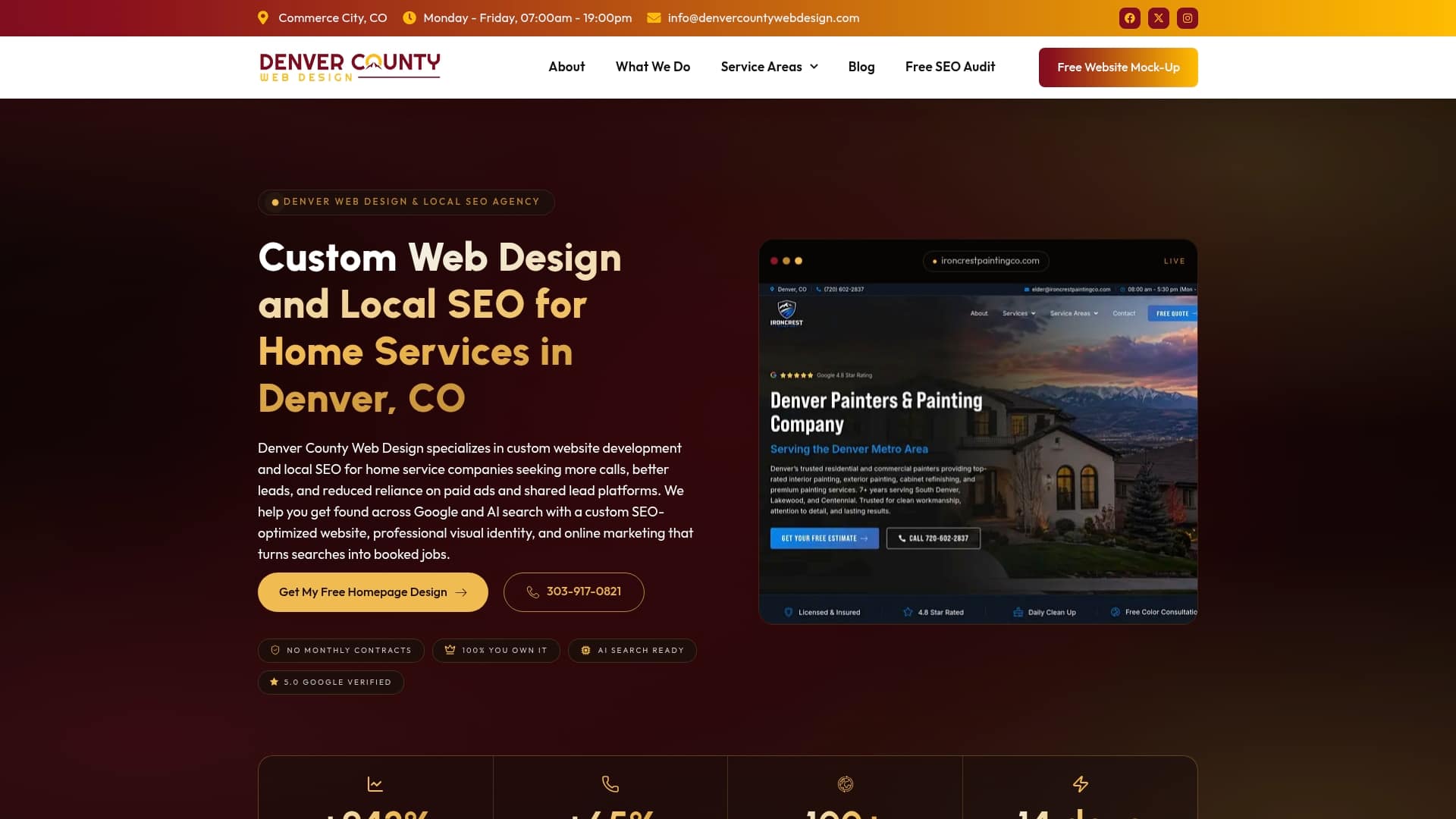
That last part matters more than it sounds. Plenty of website providers lease you a site and charge every month to keep it online. Denver County Web Design delivers a finished, SEO-ready website built around the exact structure that gets contractors ranking, then hands you full ownership. No recurring bill, no hostage situation if you ever want to switch providers.
The build moves fast, too, so you’re not waiting months while competitors keep collecting the calls you should be getting. Services include GBP optimization, custom service and location pages, review-generation systems, and technical SEO setup, all tailored for home service businesses in Colorado.
Start with a free map pack audit to see exactly where your current listing and site are losing you jobs, then book a call to talk through what a rebuild would look like for your trade and your city.
Tools Worth Bookmarking for Ongoing SEO Health
Keep these four resources handy for regular checkups on your site and profile:
- PageSpeed Insights: run your homepage and top service pages through it quarterly to catch mobile speed problems before they cost you rankings.
- Schema: reference this when adding or checking structured data fields on your site.
- WordPress: the platform’s own documentation covers plugin management and site health tools worth learning if you manage your own site.
- Ahrefs’ long-tail keyword guide: a solid primer for expanding your keyword list beyond the obvious “near me” phrases.
Check each of these every few months rather than once and forgetting them. SEO for tradesmen isn’t a project with a finish line. It’s closer to routine maintenance on a work truck.
Sources
FAQ
Is SEO Still Worth It for Tradesmen?
Yes. Local search remains one of the highest-return channels for trades businesses because customers actively searching “electrician near me” are already looking to hire, unlike social media traffic that requires much more convincing.
What Is SEO in Construction and Trades Specifically?
SEO for tradesmen means optimizing your Google Business Profile, building dedicated service and location pages, and earning local citations and reviews so your business shows up when someone in your area searches for the work you do.
How Much Should I Expect to Pay for SEO?
Costs vary widely by market and scope, but comparing SEO to lead-generation platforms on a cost-per-job basis, rather than cost-per-lead, usually favors SEO over time since ranked pages keep generating calls without an ongoing cost per lead.
Can ChatGPT Do SEO for My Trades Business?
AI tools can help draft content ideas or answer research questions, but they can’t claim your Google Business Profile, verify your listing, or build the technical schema structure your site needs. Structuring your business details clearly for AI tools to reference is part of modern local SEO, but it supplements the fundamentals rather than replacing them.
How Long Does Local SEO Take to Show Results for a Trades Business?
Google Business Profile improvements often show up within a few weeks, while organic rankings from service pages typically take two to four months to gain meaningful traction.