A typical U.S. business website redesign in 2026 costs vary widely, with most small and mid-size businesses paying a moderate sum depending on scope, platform, and whether you hire a freelancer or a full-service agency. That wide spread is not a dodge. “Redesign” covers at least five different jobs, and the price reflects which one you actually need.
Here are the three bands most business owners fall into:
- DIY or template-based refresh: typically includes affordable options suitable for simple brochure sites where the goal is a cleaner look, not a platform change or SEO migration.
- Professional small-to-mid-market redesign: generally covers most contractor, service-area, and B2B sites that need custom design, CMS work, and SEO-safe migration.
- Enterprise or complex e-commerce replatform: usually applies when you’re moving platforms, integrating custom systems, or managing a large product catalog.
Your next step: pick the band that matches your page count and feature needs, then ask any vendor you talk to for a line-item quote. A single total number without a breakdown is a red flag.
Table of Contents
- How much does a website redesign cost by project type?
- What factors drive your redesign price up or down?
- What does each price band actually include?
- How do e-commerce redesigns differ in cost?
- What pricing model should you use for your redesign?
- How do you justify the spend and calculate ROI?
- How can you lower redesign costs without hurting results?
- What timelines and hidden costs should you plan for?
- Real results: a Denver contractor’s redesign investment
- Key Takeaways
- The part most agencies won’t tell you about redesign budgets
- Denvercountywebdesign builds sites that pull their weight from day one
- FAQ
How much does a website redesign cost by project type?
The price you pay is almost entirely determined by project scope, not by how long your agency has been in business. Industry analyses consistently place the common professional redesign spend in a mid-market range without specific dollar figures. But those numbers only make sense when you map them to a real project type.

| Project type | Typical cost range | Page count | Key features |
|---|---|---|---|
| Template refresh (DIY/freelancer) | varies at low cost | 1–8 pages | New theme, basic copy edits, no migration |
| Small business brochure site | moderate range | 5–10 pages | Custom template, mobile optimization, basic SEO |
| Mid-market marketing site | mid-range cost | 10–30 pages | Custom design, CMS, SEO migration, contact forms |
| Catalog e-commerce | higher cost range | 30–50 pages | Product templates, checkout, payment integrations |
| Enterprise or complex replatform | premium range | 50+ pages | Full custom dev, integrations, legacy migration |
A broad market survey confirms this spectrum, ranging from small template-based redesigns around $3,000–$15,000 up to enterprise replatforms at $80,000–$160,000 or more. For B2B and mid-market projects specifically, most agency-driven redesigns in 2026 fall between $15,000 and $65,000, with freelancers at $3,000–$12,000, mid-tier agencies at $15,000–$45,000, and specialist partners at $40,000–$120,000+.
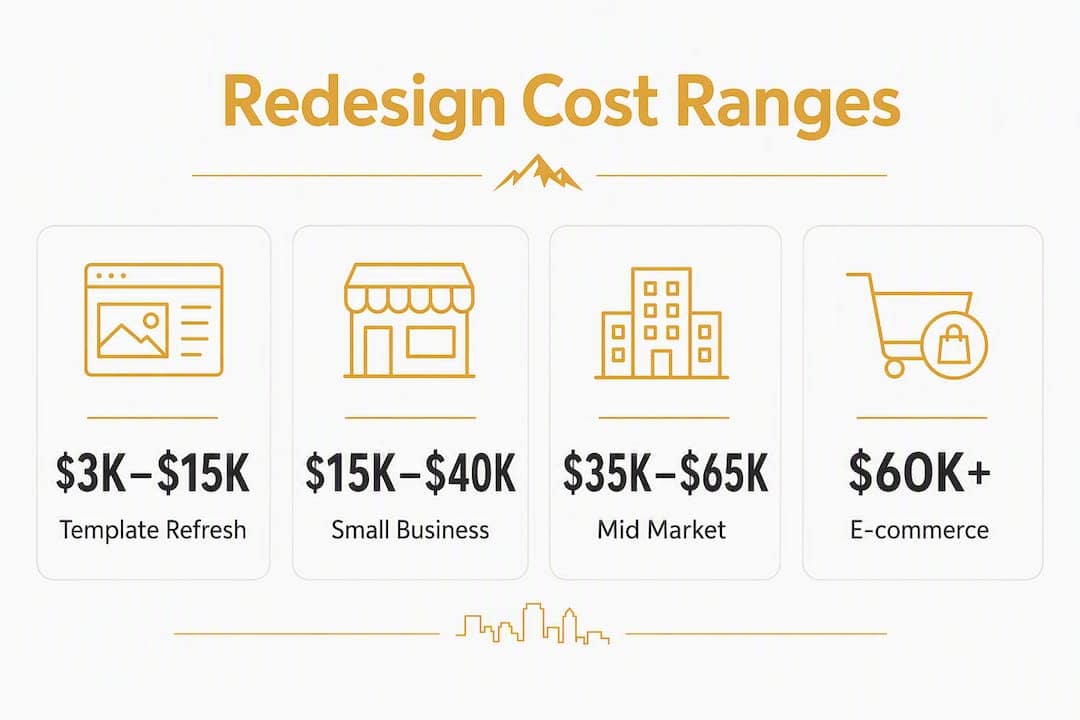
Many small-business redesigns generally land between $10,000 and $40,000 depending on page count and whether custom design or a template is used. That range holds for most contractor and home service businesses.
A few factors that shift you up or down within any band:
- Template vs. custom design: Custom design usually adds a notable increase over a premium template.
- Page count: Per-page costs for a mid-market site typically increase the overall budget based on design and development requirements.
- Vendor tier: A solo freelancer in the Midwest charges differently than a Denver agency with a full project team.
Pro Tip: If a vendor quotes you a single number without breaking out discovery, design, development, and migration separately, ask them to itemize. Bundled quotes make it nearly impossible to compare proposals or spot what’s missing.
What factors drive your redesign price up or down?
Understanding the cost drivers lets you make smarter trade-offs before you ever talk to a vendor. Some of these move the needle by thousands of dollars; others are minor line items that still surprise owners at invoice time.
High-impact drivers:
- Page count and content volume: More pages mean more design templates, more development time, and more content to migrate. A 50-page site costs materially more than a 10-page site even on the same platform.
- Custom functionality and integrations: Booking systems, CRM connections, custom calculators, or API integrations can add significantly to the project cost.
- Platform or CMS choice: Staying on WordPress is generally less expensive than replatforming to a new CMS, which adds migration complexity and increases redesign costs.
- Content creation: Professional copywriting is a significant cost factor often excluded from base quotes.
Medium-impact drivers:
- Design system and UX research: User research, wireframing, and a documented design system add $3,000–$10,000 but reduce revision cycles significantly.
- SEO migration: Redirect mapping, canonical tag audits, and post-launch monitoring are often priced separately. Skipping them risks losing rankings you’ve built over years.
- Accessibility and compliance: ADA/WCAG 2.1 compliance work adds $2,000–$8,000 depending on site complexity.
Lower-impact but frequently missed:
- Photography and video: Stock images are cheap; custom photography is not. Budget $1,500–$5,000 for a professional shoot if your site needs it.
- Post-launch support: Most quotes cover launch day, not the three months after it.
- Third-party licenses: Premium plugins, font licenses, and stock asset subscriptions add up quietly.
Pro Tip: Ask every vendor to list what is explicitly NOT included in their quote. The exclusions list tells you more about total cost than the headline number does.
What does each price band actually include?
Knowing the number is one thing. Knowing what you get for it is what protects your budget. Discovery alone typically accounts for 15–20% of total project cost at professional agencies, which surprises many owners who expect it to be free.

| Price band | Typical inclusions | Common exclusions |
|---|---|---|
| $3,000–$15,000 | Template setup, mobile optimization, basic on-page SEO, CMS training | Custom design, copywriting, photography, SEO migration, integrations |
| $15,000–$65,000 | Discovery, wireframes, custom visual design, CMS build, SEO migration, QA testing | Professional copywriting, photography, advanced integrations, post-launch retainer |
| $65,000–$120,000 | Full UX research, custom design system, dev, integrations, SEO migration, 30-day post-launch support | Long-term analytics management, paid media setup, ongoing content |
| $80,000+ | All of the above plus custom functionality, performance optimization, accessibility audit, extended support | Ongoing retainer, paid media management, content production |
A few line items worth watching in any quote:
- Discovery and strategy: If it’s not listed, it’s probably not happening. That means you’ll pay for misaligned revisions later.
- Wireframes: Some agencies skip straight to visual design. That’s faster but riskier for conversion.
- SEO migration: Redirect mapping and 301 setup should be a named deliverable, not an assumption.
- Post-launch QA: At minimum, ask for two weeks of bug fixes after go-live.
When a quote looks unusually high, ask the vendor to justify each line item. When it looks unusually low, check what’s missing. Some agencies submit high initial quotes as anchoring devices; these are often outliers driven by very different scopes rather than a market average. Comparing line items, not totals, is the only reliable way to evaluate proposals side by side.
How do e-commerce redesigns differ in cost?
E-commerce redesigns carry their own cost logic, and the gap between a basic WooCommerce refresh and a full custom commerce build is significant. The main drivers are catalog size, checkout complexity, and how much of the existing product data needs to be migrated cleanly.
Specific costs that don’t apply to standard marketing sites:
- Product catalog migration: Moving 500+ SKUs with images, variants, and metadata is a project in itself. Budget $2,000–$10,000 depending on catalog size and data quality.
- Custom product templates: A catalog with multiple product types (configurable, downloadable, bundled) needs separate templates. Each adds design and development time.
- Checkout and payment integrations: Stripe, Square, and PayPal are straightforward. Custom checkout flows, net-30 billing, or B2B pricing tiers are not.
- Shipping and tax logic: Real-time shipping rate calculations and multi-state tax rules require integration work that adds $1,500–$5,000.
- Performance optimization: Large product catalogs stress page speed. Image optimization, lazy loading, and CDN configuration are often necessary add-ons.
On platform choice: WooCommerce redesigns tend to run $15,000–$60,000 for mid-size catalogs, with costs rising when custom plugins or complex shipping logic are involved. Shopify redesigns often start lower for template-based work ($5,000–$20,000) but climb quickly when you need custom theme development, app integrations, or a migration from another platform.
Pro Tip: Before committing to a full rebuild of your commerce stack, ask whether a reskin (new theme, same platform, same product data) solves your actual problem. If your conversion issue is design and trust signals rather than platform limitations, a reskin at $8,000–$20,000 often delivers 80% of the result at 30% of the cost.
What pricing model should you use for your redesign?
How you pay matters almost as much as how much you pay. The pricing model you agree to shapes your risk exposure, your flexibility, and how easy it is to hold a vendor accountable.
Hourly: You pay for time logged. Transparent but unpredictable. Works well for small, well-defined tasks; risky for full redesigns where scope can drift.
Fixed-price: A set fee for a defined scope. Predictable for your budget, but requires a tight brief. Any scope change triggers a change order, which is where fixed-price projects often get expensive.
Milestone-based: A fixed-price project broken into payment stages tied to deliverables. This is the most common model for mid-market redesigns and the one that best protects both sides.
Retainer: A monthly fee for ongoing design, development, or SEO work post-launch. Useful for continuous improvement but easy to let run without clear deliverables.
A sample milestone payment schedule for a $30,000 mid-range redesign:
- Deposit (25%): $7,500 at contract signing. Covers discovery, kickoff, and initial wireframes.
- Design milestone (25%): $7,500 on approval of visual design comps.
- Development milestone (25%): $7,500 on delivery of a staging site for review.
- Launch milestone (20%): $6,000 on go-live approval.
- Post-launch support (5%): $1,500 held for 30 days of bug fixes and minor revisions.
Negotiation tips that actually work:
- Define “done” in writing before signing. Acceptance criteria for each milestone prevent disputes.
- Cap change orders at a percentage of total contract value (10–15% is standard).
- Ask for a scope-change clause that requires written approval before any out-of-scope work begins.
- Get clarity on who owns the site files and CMS credentials at project end.
How do you justify the spend and calculate ROI?
A redesign is a capital expense, and most owners need to present it to someone, whether that’s a business partner, a CFO, or themselves at 11 PM reviewing a proposal. The math is simpler than it looks.
Start with a basic break-even model. If your redesign costs $30,000 and your average customer is worth $2,500 in revenue, you need 12 new customers to break even. If your site currently generates 5 leads per month and closes 20% of them, that’s 1 new customer per month from organic traffic. A well-executed redesign with strong local SEO and conversion-focused landing pages can realistically double or triple that lead volume within 90 days.
Denvercountywebdesign clients have seen a 243% increase in organic traffic within 90 days of launch. At that rate, a site generating 5 leads per month becomes one generating 17+, compressing the payback period from 12 months to roughly 4.
The line items that drive the fastest payback:
- Technical SEO and redirect mapping: Protects existing rankings and often recovers lost traffic within 60–90 days.
- Conversion-focused landing pages: A single high-converting service page can generate more leads than an entire site that wasn’t built with conversion in mind.
- Google Business Profile optimization: For local service businesses, GBP visibility directly drives phone calls and map-pack clicks.
When presenting the budget to an owner or finance team, frame it this way: “We’re not spending $30,000 on a website. We’re spending $30,000 to build a lead generation asset that we own outright and that compounds over time.” That framing shifts the conversation from cost to investment.
Pro Tip: Build a simple spreadsheet before your vendor meeting: current monthly leads × close rate × average job value = current monthly revenue from web. Then model what a 2× lead increase does to annual revenue. That number, not the redesign cost, is what you’re actually deciding.
How can you lower redesign costs without hurting results?
Cutting budget in the wrong places costs more in the long run. Cutting it in the right places barely affects outcomes. The key is knowing which parts of a redesign drive revenue and which are nice-to-have polish.
Practical ways to reduce cost without sacrificing conversion:
- Phase the build: Launch with discovery, homepage, and your three highest-traffic service pages. Defer the full content library, team bios, and secondary pages to phase two.
- Use a premium template as a starting point: A well-chosen WordPress theme costs $60–$200 and can be customized to feel fully branded. AI-assisted tools plus a freelancer can reduce typical agency costs by roughly 30–50% for structural work like site architecture and template setup.
- Handle content internally: If your team can write first drafts, a copyeditor costs far less than a full copywriting engagement.
- Reuse your existing design system: If your brand has established colors, fonts, and component styles, share them with your vendor. Starting from scratch adds time and cost.
- Use stock photography strategically: For secondary pages, stock works fine. Reserve budget for custom photography on your homepage and key service pages, where trust signals matter most.
A phased project example for a $20,000 budget:
Phase 1 ($14,000): Discovery and strategy, homepage redesign, three service landing pages, mobile optimization, SEO migration, and CMS setup.
Phase 2 ($6,000, 60–90 days later): Remaining service pages, blog setup, photography integration, and Google Business Profile optimization.
Pro Tip: Never cut the SEO migration or conversion-critical landing pages to save money. These are the line items that pay for the redesign. Cut animations, secondary pages, and advanced interactions instead.
What timelines and hidden costs should you plan for?
Timeline surprises and hidden costs are the two most common reasons redesign budgets blow up. Planning for both upfront keeps the project on track.
| Project scope | Typical timeline |
|---|---|
| Visual refresh (template swap, no migration) | 2–4 weeks |
| Small business redesign (5–15 pages, same platform) | 4–8 weeks |
| Mid-market redesign (15–30 pages, CMS migration) | 8–14 weeks |
| E-commerce redesign (catalog migration, new platform) | 12–20 weeks |
| Enterprise replatform (50+ pages, custom integrations) | 20–24 weeks |
Hidden costs that regularly catch owners off guard:
- Professional copywriting: Often excluded from agency quotes. Budget $150–$350 per page for professional copy.
- Custom photography: A half-day shoot with a commercial photographer runs $800–$2,500 in most U.S. markets.
- 301 redirect mapping: For sites with 50+ pages, redirect mapping and testing is a real labor cost. Skipping it risks significant ranking loss.
- Third-party plugin or platform licenses: Premium plugins, form builders, and analytics tools add $200–$1,500 per year.
- Post-launch QA and support: Most quotes cover launch day. Three months of post-launch monitoring and fixes often adds $2,000–$5,000 to the real total.
- Internal time costs: Stakeholder review cycles, content approvals, and feedback rounds add weeks to timelines and real internal labor costs that rarely appear in a vendor quote.
The most common schedule-killer is clients not having final copy ready at kickoff. Provisioning budget for professional copywriting, or committing to a content delivery date before signing, avoids the delays that turn an 8-week project into a 20-week one.
How these cost estimates were derived
These ranges are built from a synthesis of industry guides, agency pricing surveys, and published cost calculators covering U.S. market data.
| Source | What it contributed |
|---|---|
| Launch Day Advisors | Mid-market agency ranges and line-item breakdowns |
| Windmark | Tiered pricing (freelancer/mid-agency/specialist) and hidden-cost lists |
| Tenet | Full-spectrum banding from basic to enterprise |
| Revamp cost calculator | AI-assisted cost reduction estimates and DIY/freelancer ranges |
| Project Cost Estimator | Redesign-vs-new-build cost multipliers |
| BK Web Designs | Small-business-specific examples and budgeting ranges |
| Innowise | Discovery and wireframing cost percentages |
A few important notes on variance:
- Ranges are intentionally wide because geography, vendor tier, and scope create legitimate price differences of 3–5× for the same project type.
- U.S. coastal markets (New York, San Francisco) typically run 20–40% higher than Midwest or Mountain West markets for the same scope.
- These figures represent market rates, not guarantees. Your actual quote will depend on your specific requirements.
To use these ranges for apples-to-apples vendor comparison: ask each vendor to quote against the same scope document, broken into the same line items (discovery, design, development, migration, QA, post-launch). Total numbers without line items cannot be compared reliably.
Real results: a Denver contractor’s redesign investment
A Denver-area home service contractor came to Denvercountywebdesign with a site that hadn’t been updated in four years. It loaded slowly on mobile, had no local SEO structure, and was generating fewer than three inbound leads per month from organic search.
The challenge: Low visibility in Google Maps and organic search, no conversion-focused landing pages, and a site that didn’t reflect the quality of the work the business actually did.
Budget and deliverables: The project included a full WordPress redesign, local SEO setup, Google Business Profile optimization, three service-area landing pages, and technical on-page SEO. The investment was in the mid-market range consistent with the $15,000–$45,000 band described above.
Results:
243% increase in organic traffic within 90 days of launch, with inbound leads climbing from under 3 per month to consistently 10+ per month.
The deliverables that drove the highest return:
- Local SEO and Google Business Profile optimization: Map-pack visibility drove the majority of new phone calls within the first 30 days.
- Service-area landing pages: Three targeted pages, each built around a specific service and location, outperformed the old homepage within six weeks.
- Technical SEO and site speed: Fixing Core Web Vitals issues and implementing proper redirect structure recovered and then exceeded prior rankings.
If you want to see what a free SEO audit surfaces for your current site before committing to a full redesign budget, that’s a practical first step.
Key Takeaways
Most U.S. small business website redesigns in 2026 cost between $15,000 and $65,000, with the final number driven primarily by page count, custom functionality, and whether SEO migration is included.
| Point | Details |
|---|---|
| Budget band by scope | Template refreshes run $3,000–$15,000; professional redesigns run $15,000–$65,000; enterprise replatforms run $80,000–$160,000+. |
| Redesigns cost more than new builds | Content migration, redirect mapping, and legacy platform work often push redesign costs 15–40% higher than a comparable new build. |
| Always request line-item quotes | A single total without a breakdown makes it impossible to compare proposals or identify missing deliverables. |
| Phase the build to protect budget | Launch with homepage and three conversion-critical pages first; defer secondary content to phase two to stay within budget. |
| Denvercountywebdesign for local service businesses | Denvercountywebdesign delivers custom WordPress redesigns with local SEO built in, with documented 243% organic traffic increases within 90 days. |
The part most agencies won’t tell you about redesign budgets
The single thing most clients underbudget for isn’t design or development. It’s the work that happens after launch: SEO monitoring, redirect validation, conversion tracking, and the inevitable round of fixes that surface once real users hit a live site. Standard agency quotes frequently omit three months of post-launch support, CMS updates, and technical SEO monitoring. Adding those items often shifts what looks like a $25,000 project toward a $35,000–$45,000 realistic total.
The other pattern worth naming: clients who try to cut budget by skipping discovery almost always spend more in the end. Misaligned wireframes, redesigned pages, and scope disputes are expensive. A proper discovery phase, even at 15–20% of total project cost, is the line item that keeps everything else on budget.
From an agency perspective, the most common mis-scope is treating a replatform as a redesign. If you’re moving from one CMS to another, you’re not just getting a new look. You’re migrating content, rebuilding URL structures, remapping redirects, and potentially rebuilding integrations from scratch. Budget accordingly, and make sure your vendor has done it before.
One practical rule: before signing any contract, ask your vendor to walk you through their post-launch monitoring process. If they don’t have one, that’s your signal to negotiate it in or find someone who does.
Denvercountywebdesign builds sites that pull their weight from day one
If you’re a home service business or contractor in Colorado and you’ve been putting off a redesign because the quotes felt too high or too vague, Denvercountywebdesign offers a different path. You get a custom WordPress site built specifically for local lead generation, with local SEO, Google Business Profile optimization, and Google Ads setup included in the package, not bolted on as expensive add-ons later.
No monthly fees. No lock-in. You own the site outright from day one. That’s a meaningful contrast to agency models that charge ongoing retainers just to keep your own site running.
Services that directly address the cost drivers covered in this article:
- Custom WordPress design and full redesign builds
- Local SEO setup and on-page technical optimization
- Google Business Profile management and map-pack targeting
- Service-area landing pages built for conversion
- Google Ads campaign setup and management
- Post-launch support and performance monitoring
Ready to see what your current site is leaving on the table? Request a free audit and get a clear picture of where you stand before committing to a full redesign budget. Or browse the Denver web design services page to see what a full project looks like from start to finish.
Primary sources and further reading
These are the core resources used to build the ranges in this article. Each is worth a read if you want to go deeper on a specific aspect of redesign pricing.
- Launch Day Advisors: Website Redesign Cost 2026 Buyer’s Guide: The most detailed line-item breakdown available for mid-market agency projects. Start here if you want to understand discovery and handoff costs.
- Windmark: Website Redesign Cost 2026 Breakdown: Strong on tiered pricing and the hidden costs that push headline numbers higher.
- Tenet: True Website Redesign Cost 2026: Covers the full spectrum from basic to enterprise with per-page cost guidance.
- Revamp Free Redesign Cost Calculator: Run your own scope through this to get a quick range before talking to vendors.
- Project Cost Estimator: Website Redesign Cost: Useful for understanding how redesigns compare in cost to new builds.
- Innowise: Website Redesign Cost Guide: Good detail on discovery and wireframing as percentages of total project cost.
- Denvercountywebdesign: Free SEO Audit: If you want a quick read on your current site’s performance before scoping a redesign, this is a low-friction starting point.
FAQ
How much does a website redesign cost for a small business in 2026?
Most small business redesigns in 2026 run between $10,000 and $40,000, depending on page count and whether custom design or a template is used. A basic template refresh can start near $3,000, while a professionally designed site with SEO migration typically lands in the $15,000–$40,000 range.
How much will it cost to redesign a website in 2026 for a mid-size company?
Mid-market redesigns commonly fall between $35,000 and $65,000 when handled by a professional agency, covering discovery, custom design, CMS development, SEO migration, and QA. Specialist partners handling complex integrations or large catalogs can quote $80,000–$120,000+.
How much does it cost to design a website in the U.S.?
A professional U.S. website design or redesign ranges from $3,000 for a freelancer-built template site to $160,000+ for an enterprise replatform. The most common range for small and mid-size businesses is $15,000–$65,000, with regional variation of 20–40% between coastal and Mountain West markets.
How much does it cost to update an existing website?
Minor updates (copy changes, new pages, plugin updates) typically run $500–$3,000. A meaningful refresh that includes new design, mobile optimization, and SEO improvements without a full replatform usually costs $5,000–$20,000, depending on the number of pages and whether content migration is required.