
Three levers drive most of the booked jobs that come from search: a fully optimized Google Business Profile, a handful of genuinely local service-area pages, and a steady flow of fresh, keyword-rich reviews. Get those three working together and you can typically see movement in the map pack within 60 to 90 days. Organic rankings compound after that. Everything below breaks each lever into steps you can start this week.
TL;DR:
- Improving Google Business Profile with precise categories, multiple images, and detailed service areas can lead to local visibility improvements within 60 to 90 days.
- Building authentic, location-specific pages for high-demand towns, including local content and testimonials, significantly enhances ranking potential.
- Prioritizing technical site fixes such as HTTPS, fast loading times, and image optimization is essential before developing additional content or pages.
- Gathering recent, specific reviews and automating review requests boosts profile freshness, which strongly influences local rankings.
- Combining Google Ads with organic SEO efforts targeting urgent problem keywords accelerates visibility and booked jobs in the early months.
Table of Contents
- What Should You Fix First for Carpet Cleaning SEO?
- How Do You Optimize Google Business Profile for Carpet Cleaning?
- Do You Need a Page for Every Town You Serve?
- Which Keywords Actually Bring in Bookings?
- Does Site Speed Really Affect Carpet Cleaning Bookings?
- How Do You Get More Reviews Without Feeling Pushy?
- What Should You Actually Track Every Month?
- Do Backlinks Still Matter for a Local Carpet Cleaning Business?
- Can Social Media Actually Help Your Local Rankings?
- Should You Run Google Ads Alongside Your SEO Work?
- Which Tools Should You Use to Track SEO Progress?
- What Actually Moves the Needle for Carpet Cleaning Clients?
- How Denver County Web Design Builds This for Carpet Cleaning Businesses
- Sources
- FAQ
What Should You Fix First for Carpet Cleaning SEO?
Getting carpet cleaning SEO right is a sequencing problem more than a knowledge problem. Most owners know they need “better SEO,” but they burn weeks writing blog posts before fixing the basics that actually move the needle. Here’s the order that works, broken into 30-day sprints.
Days 1 to 30: Fix what’s broken.
- Confirm your site runs on HTTPS, loads fast on a phone, and has a click-to-call button visible without scrolling.
- Compress every image on the site. Big photo files are the single most common speed killer for carpet cleaning sites, since your best marketing asset (before-and-after shots) is also your biggest liability if left unoptimized.
- Change your Google Business Profile’s primary category to “Carpet cleaning service” if it’s currently sitting under something generic like “Cleaning service.”
- Add every suburb and neighborhood you actually service to your GBP service area, not just your home city.
- Upload at least ten real before-and-after photos, geotagged when possible.
Days 30 to 60: Build the pages that convert.
6. Publish three high-intent location pages for your top service areas, each with real local detail.
7. Build out your core service pages: pet odor removal, stain removal, upholstery cleaning, water damage response.
8. Turn on call tracking so you know which pages and campaigns actually generate calls.
Days 60 to 90: Automate what keeps you visible.
9. Set up an automated review request flow triggered right after job completion.
10. Start a monthly cadence of new GBP photos and Q&A responses to keep your profile active.
That sequence matters because Google rewards consistency over bursts of activity. A cleaning company that posts photos once and disappears for six months signals a different kind of business than one updating weekly. Do the technical fixes first. Everything else built on a slow, broken site is wasted effort.
How Do You Optimize Google Business Profile for Carpet Cleaning?
Your Google Business Profile carries more weight for local visibility than your website does, at least in the early months. Treat it as a living asset that needs monthly attention, not a form you fill out once and forget.
Start with your primary category. “Carpet cleaning service” beats a generic “Cleaning service” label almost every time, because Google matches search intent to category specificity. Add secondary categories like “Upholstery cleaning service” or “Rug cleaning service” only if you genuinely offer them.
Your service area setting should list every suburb, neighborhood, and nearby town you’re willing to drive to, not just your business address. Google’s own guidance on service-area businesses confirms this setting directly affects which searches your profile can appear in. Most operators only think about their home city and miss out on residential demand from surrounding areas that would happily book them.
A few maintenance habits separate the profiles that rank from the ones that stall:
- Upload new photos monthly, not once at setup. Vertical guides for the industry call this “visual velocity,” and it’s a real differentiator when most competitors upload once and never return.
- Answer every Q&A question within a day or two, even ones you seed yourself with common customer questions.
- Turn on the “identifies as women-owned” or “same-day service” attributes if they apply. Attributes feed Google’s matching algorithm directly.
- Post weekly updates about seasonal promotions, new service areas, or recent jobs.
- Link your booking or appointment system if your scheduling software supports GBP integration.
Pro Tip: Ask happy customers to mention the specific service in their review, like “pet urine removal” or “same-day emergency cleaning.” Reviews that use real service language help reinforce which searches your profile should show up for.
Do You Need a Page for Every Town You Serve?
Not every town, no. Only towns where you have real work to show. A service-area page built on fifty words swapped out from a template does nothing for rankings and can actively hurt you, since service-area pages need genuinely unique local content to avoid looking like a doorway page built purely for search engines.
A page worth publishing includes:
- A headline naming the specific town or neighborhood, not a generic service title.
- A short local intro that references something real: the housing stock (older homes with hardwood-adjacent carpet, new-build townhomes), a known neighborhood landmark, or a common local issue like flood-prone basements.
- Your full service list with pricing cues, even ballpark ones.
- At least one testimonial or job reference tied to that specific area.
- A clear call-to-action and phone number above the fold.
- LocalBusiness and Service schema markup with the correct
areaServedvalue.
Aim for 500 to 1,000 words of real content per page, per the same service-area guidance. If you can’t write that much honest, specific detail about a town, you probably shouldn’t build the page yet.
Prioritize by demand, not geography. Pull your last twelve months of job addresses, rank the towns by job count and average ticket size, and build pages for your top five before touching your fifteenth-favorite suburb.
Which Keywords Actually Bring in Bookings?
Neighborhood names alone don’t convert. The keywords that book jobs combine a location with a problem and, often, urgency. “Carpet cleaning Wheat Ridge” gets searched, but “pet urine removal Wheat Ridge” or “carpet cleaner now” converts at a different rate entirely, because the searcher already knows what they need and is close to calling someone.
Build your list in this order:
- Start with your top five service categories: general cleaning, pet odor, stain removal, upholstery, water damage.
- Cross each one with your top service-area towns to generate location plus problem combinations.
- Layer in urgency modifiers: “emergency,” “same-day,” “now,” “24 hour.” These tend to convert fastest since panic and emergency searches come from people ready to book immediately, not people comparison shopping.
- Score each keyword by rough search volume and intent strength, then build content in that order.
Emergency and stain-removal pages convert the fastest because the visitor already has a problem and a deadline. A strong page for these topics needs a clear process walkthrough (what happens when we arrive, how long it takes), pricing signals, a short FAQ addressing common objections, and trust elements like your review count or years in business.
Structure your site as a hub-and-spoke model: a core “Carpet Cleaning Services” hub page links out to each individual service page (stain removal, pet odor, upholstery), and each service page links to your top location pages. That internal link structure signals topical depth to search engines and keeps visitors moving toward a booking decision instead of bouncing.
Does Site Speed Really Affect Carpet Cleaning Bookings?
Yes, and the effect is larger than most owners assume for a visually driven business like carpet cleaning. Your before-and-after photos are your best sales tool, but unoptimized images are also the most common reason these sites load slowly on mobile, where most local searches happen.
Google measures three Core Web Vitals: how fast the main content loads, how quickly the page responds to a tap, and how much the layout shifts while loading. Fixing all three on an image-heavy site usually comes down to:
- Convert JPEGs to WebP format, which typically cuts file size substantially without visible quality loss.
- Lazy-load images below the fold so the page doesn’t wait on your entire gallery to render.
- Serve images through a CDN so a visitor in Denver isn’t pulling data from a server across the country.
- Strip unnecessary EXIF data but keep descriptive alt text on every photo (“before photo, pet stain removed from living room carpet, Aurora CO”).
A fast site converts better on mobile, where a slow-loading before-and-after gallery is often the last thing a visitor sees before they hit the back button and call a competitor instead.
On the schema side, implement LocalBusiness markup on your homepage, Service schema on each service page, areaServed values matching your GBP service area exactly, and AggregateRating markup if you have enough reviews to support it honestly. Place schema in the page header, not buried in a footer script, so search engines parse it reliably.
How Do You Get More Reviews Without Feeling Pushy?
Volume and recency beat a flawless average rating almost every time. A profile with forty reviews from the last six months tends to outperform a profile with four hundred reviews that stopped coming in two years ago, because Google’s local algorithm weights recent activity as a freshness signal.
The fix is a system, not a hope. Send a review request by text or email within an hour or two of job completion, while the client is still looking at clean carpets and feeling good about the result. That “peak satisfaction” window closes fast. Waiting a week to ask cuts your response rate noticeably.
A few practices keep this both effective and honest:
- Automate the request through your scheduling software or a simple SMS trigger tied to job completion.
- Ask an open question like “What did you think of the pet odor treatment today?” rather than demanding a five-star review, which keeps the language natural and keyword-relevant without scripting anything.
- Feature your best, most specific reviews directly on the relevant service page. A review mentioning “removed old pet stains from three bedrooms” belongs on your pet odor page, not buried in a generic testimonials widget.
Pro Tip: Never offer a discount in exchange for a review. It violates Google’s policies and puts your entire profile at risk. Ask for honesty, not enthusiasm.
For a deeper walkthrough of request timing and templates, our guide to getting Google reviews covers the scripts that tend to get the best response rates.
What Should You Actually Track Every Month?
Rankings don’t pay your bills. Booked jobs do, so your measurement setup needs to trace a call or form fill back to the specific page or campaign that produced it.
- Install a call tracking number on your website and GBP listing separately, so you can see which channel drove each call.
- Connect GBP Insights to Google Analytics 4 and Search Console so profile views, website clicks, and organic impressions live in one dashboard.
- Track four core numbers monthly: booked jobs, calls originating from GBP, organic impressions in the map pack, and new review count.
- Expect early wins in the map pack within 60 to 90 days if GBP and reviews are handled well, since that combination tends to move fastest, while organic location-page rankings build more gradually over three to six months.
Review these numbers monthly and adjust. If calls from GBP are rising but bookings aren’t, the problem is your phone script or pricing transparency, not your SEO.
Do Backlinks Still Matter for a Local Carpet Cleaning Business?
They do, but not in the way most generic SEO advice suggests. Chasing high-authority national links wastes time for a business that only serves a handful of towns. Local relevance beats raw authority here.
The strongest links for a carpet cleaning business come from sources that reinforce you’re a real, active local operator. Get listed in your city’s chamber of commerce directory. Sponsor a local youth sports team or a community event and ask for a link on their sponsors page. Partner with complementary local businesses like flooring installers, real estate agents, or property managers who regularly refer carpet work and can link to you from their resources page.
Local news coverage is another underused source. A quick pitch to a neighborhood news site about a community cleanup event or a charity job you did can earn a link that also builds real trust with future customers who see the coverage.
Industry-specific partnerships work too. If you also handle commercial accounts, resources like Nationwide Maintenance’s guide to commercial floor care illustrate the kind of credential-driven trust signals that commercial clients look for, and cross-referencing that kind of content can support your own commercial-facing pages.
Avoid link farms, paid directory schemes, and generic guest post networks. They rarely help local rankings and occasionally trigger a manual review that costs you more time than it ever saved.
Can Social Media Actually Help Your Local Rankings?
Social platforms don’t feed directly into Google’s ranking algorithm the way backlinks or reviews do, but they support local SEO in ways that matter for a service business built on trust and visible proof.
Before-and-after content performs best on Instagram and Facebook because it’s the same visual proof that works on your GBP profile and website. Post the same geotagged jobs to both platforms, and tag the neighborhood when the platform allows it, so local followers see your work show up alongside their own community feed.
Engagement signals matter more than follower count. A local Facebook group asking for carpet cleaner recommendations is worth more to your booking pipeline than a thousand passive followers who never engage. Join local community groups, answer questions genuinely, and let your profile and reviews do the selling rather than posting a hard pitch every time.
Cross-link consistently: your GBP profile, website, and social profiles should all show the same business name, address, and phone number. Inconsistent NAP details across platforms confuse both customers and Google’s local algorithm, which cross-references these signals when deciding how much to trust your listing.
Respond to every comment and message quickly. Response time on social platforms is increasingly treated as a customer service signal, and a slow or missing response looks the same to a potential customer whether they found you through search or through a friend’s shared post.
Should You Run Google Ads Alongside Your SEO Work?
Yes, and the two work better together than either does alone, especially in your first few months while organic rankings are still building. Google Ads gets you into the map pack and search results immediately, while your GBP and location pages mature toward organic visibility over the following months.
Target the same emergency and problem-based keywords your organic strategy prioritizes: “water damage carpet cleaning,” “pet odor removal near me,” “same day carpet cleaner.” These searches convert quickly because the person searching already needs help now, and a paid ad above the fold captures that intent before a competitor’s organic listing does.
Set a tight radius around your actual service area rather than targeting an entire metro region. Paying for clicks from towns you don’t service wastes budget fast. Pair every ad with a landing page built for that specific service or location, not your generic homepage, since a mismatch between ad promise and landing page content kills conversion rates.
Use call tracking on your ad campaigns separately from your organic call tracking number, so you can see clearly which dollars are producing which booked jobs. Once your organic rankings mature and start pulling steady traffic, you can often scale back ad spend on the keywords where you now rank well and redirect that budget toward new service areas or seasonal promotions.
Which Tools Should You Use to Track SEO Progress?
Service-based businesses don’t need enterprise-grade analytics. You need a handful of tools that answer one question clearly: which SEO efforts are turning into booked jobs?
Google Search Console shows which queries bring people to your site and how your rankings shift over time. Google Analytics 4 connects that traffic to actual conversion events like form fills and phone clicks. GBP Insights, viewable directly in your Business Profile dashboard, shows calls, direction requests, and website clicks generated straight from your profile, separate from organic website traffic.
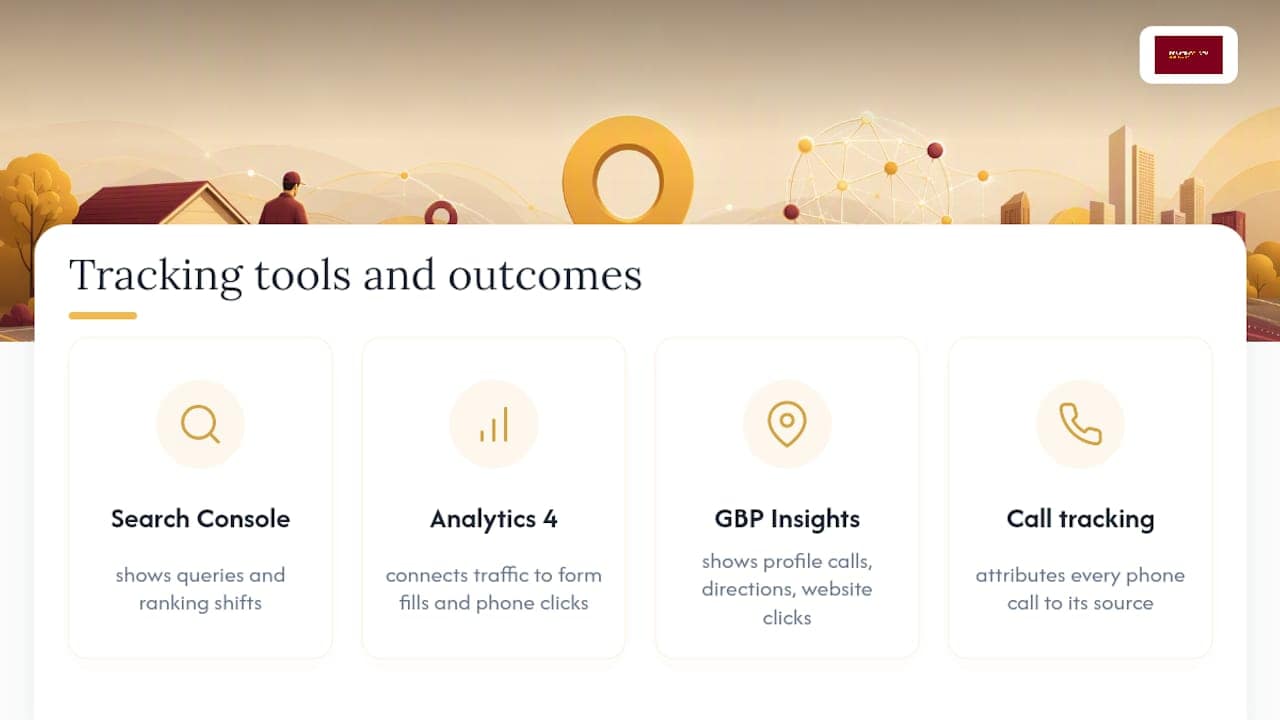
A call tracking platform ties every phone call back to its source, whether that’s an organic search, a paid ad, or a specific service page. Without this, phone-first businesses like carpet cleaning are essentially flying blind, since most bookings for home services still happen over the phone rather than through a web form.
Set a monthly reporting cadence rather than checking daily. Pull your four core numbers (booked jobs, GBP calls, map-pack impressions, new reviews) into a single simple sheet or dashboard, and review trends month over month rather than reacting to daily noise that rarely reflects a real pattern.
What Actually Moves the Needle for Carpet Cleaning Clients?
Working with home-service clients across Colorado, the pattern repeats often enough to trust it: Google Business Profile optimization, review velocity, and a handful of genuinely local pages move visibility faster than any other combination of tactics. Blog content and broad keyword campaigns matter eventually, but they’re rarely what gets the phone ringing in the first ninety days.
The biggest mistake is templated location pages. Fifty towns with the same three paragraphs and a swapped city name look identical to Google and to customers, and they tend to sit invisible in search results. Consistent business name, address, and phone details across every platform matter more than owners expect. A mismatched suite number between your website and GBP profile is a small thing that quietly undermines trust signals everywhere else.
— Luis
How Denver County Web Design Builds This for Carpet Cleaning Businesses
This is an alternative to a slow-moving traditional agency for carpet cleaning businesses in Colorado that need visibility promptly rather than after a long retainer. Clients own their websites outright with no recurring fees once built, and the local SEO work is structured around key levers for local visibility.
The Maps Foundation, Local Growth, and Market Authority plans map directly to your stage of growth: Maps Foundation handles core GBP optimization and citation cleanup, Local Growth adds service-area page builds and review-flow automation, and Market Authority layers in ongoing content and competitive tracking for operators ready to dominate a metro area. If your site itself needs rebuilding first, WordPress Web Design delivers a fast, lead-focused build without the drawn-out timelines typical of custom agency work.
A typical engagement covers a full Google Business Profile setup, priority location pages, a review-request workflow, and call tracking integrated into reporting to monitor results. Request a free map-pack audit to see exactly where your profile and site stand today.
Sources
- Set or edit a service area for your Business Profile – Google Business Profile Help
- 7 Local SEO Tips for Carpet Cleaning Businesses in 2026
- SEO for Carpet Cleaning: The Complete 2026 Guide | RankPill
FAQ
What Is the Average Price to Clean a Carpet?
Pricing varies widely by region, room size, and soil level, and this article doesn’t have a sourced industry figure to cite here. Most carpet cleaning companies list per-room or per-square-foot pricing directly on their service pages, which also helps SEO by matching what searchers are looking for when they compare quotes.
How Do I Advertise My Carpet Cleaning Business?
The fastest results usually come from a combination of an optimized Google Business Profile, a steady stream of recent reviews, and Google Ads targeting emergency and neighborhood-specific searches. Organic location pages build slower but produce more durable traffic once they’re established, typically over three to six months.
Is SEO Worth It for a Small Business?
For a service business that depends on local, high-intent searches, SEO is one of the more reliable ways to generate booked jobs without paying for every single lead. A focused push on Google Business Profile and reviews can show map-pack movement within 60 to 90 days, while organic content builds a foundation that keeps producing leads long after a paid campaign would have stopped.
Is a Carpet Cleaning Business Profitable?
Profitability depends heavily on job volume, pricing, and repeat customers, which is exactly why consistent lead flow from local search matters. A steady pipeline of booked jobs from Google Business Profile and organic location pages reduces reliance on expensive paid ads to fill the schedule every month.
What Does Denver County Web Design Charge for Local SEO?
Denver County Web Design’s local SEO plans are Maps Foundation at 500 USD per month, Local Growth at 750 USD per month, and Market Authority at 1250 USD per month. Website builds like The Solo Operator, The Lead Machine, and The Market Owner are priced separately as one-time projects rather than monthly fees.


