Citation cleanup means correcting and consolidating your business’s name, address, and phone number (NAP) across every directory and platform where it appears online. The single fastest move is picking one canonical NAP and fixing your Google Business Profile first, since that’s the listing Google trusts most. Most businesses see corrections propagate within 30 to 90 days, so patience matters as much as precision.
TL;DR:
- Correcting mismatched business name, address, and phone number across priority directories can improve local rankings by about 2 to 5 positions within three months.
- Focusing on fixing Google Business Profile, then major aggregators, and finally long-tail directories ensures corrections propagate efficiently and reduces repetitive work.
- Merging duplicate listings preserves reviews and history, while deletion risks losing valuable social proof and can harm rankings if not carefully managed.
- Managed citation cleanup services typically cost $200 to $1,250 per month, offering comprehensive support including audits, submissions, and verification for multiple locations.
- Expect to see visible ranking improvements roughly 6 to 12 weeks after corrections, with activity timelines varying based on directory verification and data propagation.
Table of Contents
- What Counts as Citation Cleanup, and Why It Matters
- Your First 1 to 2 Hours: A Quick Action Checklist
- How Do You Run a Full Citation Cleanup?
- Which Directories Should You Fix First?
- Should You Merge or Delete Duplicate Listings?
- Should You DIY, Use Tools, or Hire a Managed Service?
- How Long Does Citation Cleanup Take to Show Results?
- How Do You Verify That Fixes Actually Stuck?
- How Denver County Web Design Handles Citation Cleanup
- A Field Note on What Actually Trips People Up
- Let Denver County Web Design Run the Cleanup for You
- Sources
- FAQ
What Counts as Citation Cleanup, and Why It Matters
A citation is any online mention of your business name, address, and phone number, whether it lives on Yelp, an industry directory, or a data aggregator you’ve never heard of. When those three details don’t match everywhere, search engines lose confidence in which version is accurate, and that hesitation shows up as lower local rankings.
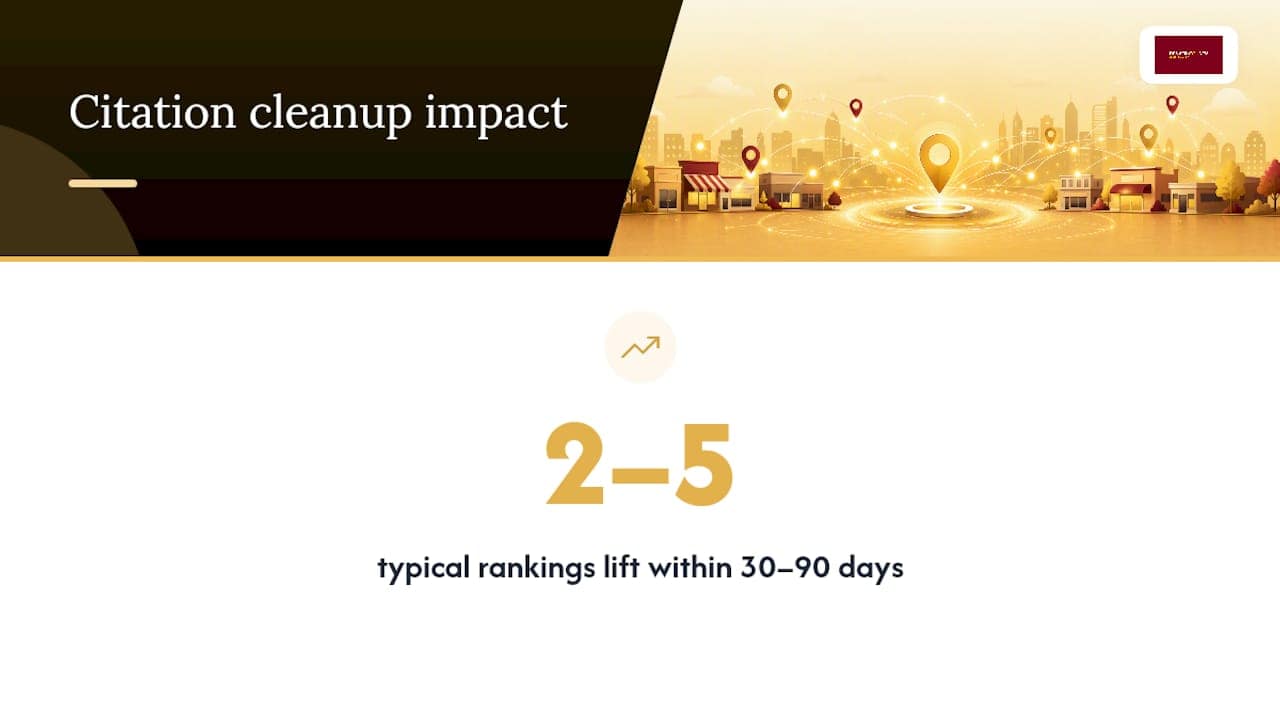
Citation cleanup is the process of finding those mismatches and fixing them, one listing at a time, starting with the sources that carry the most weight. Done right, it typically lifts local rankings by about 2 to 5 positions within 30 to 90 days. That’s not a guarantee, but it’s a realistic bar to set for yourself before you start chasing every long-tail directory on the internet.
Your First 1 to 2 Hours: A Quick Action Checklist
You don’t need a full audit to start stopping the bleeding. Before you dive into a comprehensive duplicate listing cleanup, knock out these five moves:
- Write down your canonical NAP (the exact name, address, and phone format you want everywhere) and save it somewhere your whole team can see.
- Log into your Google Business Profile and correct any wrong details immediately.
- Search your exact business name, phone number, and address in quotes to surface every listing with a mismatch.
- Flag anything urgent, like a wrong phone number, an old address, or an obvious duplicate profile.
- Block time on your calendar for the full audit, and note who has login access to each platform.
This isn’t the whole job. It’s triage, and it buys you breathing room while you plan the rest.
How Do You Run a Full Citation Cleanup?
The complete workflow follows a repeatable pattern: inventory, claim, correct, submit, and monitor.
- Inventory everything. Search your business name and phone number, check your existing citations against your canonical NAP, and log each one in a spreadsheet with columns for directory name, URL, current data, correct data, status, and date submitted.
- Claim and correct what you control. Google Business Profile, Bing Places, Yelp, Apple Maps, and Facebook usually let you log in directly and fix errors on the spot.
- Submit corrections where you can’t self-serve. Some directories require a support ticket or a contact form. Track every submission with a date and a confirmation number if one exists.
- Handle duplicates carefully. Merge instead of deleting whenever the platform allows it, since deletion can wipe out reviews you’ve spent years earning.
- Push your canonical data upstream. Submitting corrected NAP data to major aggregators like Data Axle, Foursquare, and Neustar Localeze feeds hundreds of smaller directories automatically, which saves you from fixing each one by hand.
A focused 21-day sprint covering inventory, aggregator submissions, and duplicate suppression is a common cadence agencies use to standardize NAP across 50 or more directories and recover map-pack visibility within 30 to 60 days.
Pro Tip: Screenshot every “before” listing before you submit a correction. If a platform reverts your fix later, that screenshot proves what the listing looked like and speeds up your follow-up request.
Which Directories Should You Fix First?
Not every citation carries equal weight, and treating them all the same wastes hours you don’t have. Work through three tiers in order.
- Tier 1 (fix immediately): Google Business Profile, Bing Places, Yelp, Apple Maps, and Facebook Local. These directly influence local rankings and get the most consumer traffic.
- Tier 2 (fix next): Primary aggregators, including Data Axle, Neustar Localeze, and Foursquare, which feed data to dozens of smaller sites automatically.
- Tier 3 (fix last): Chamber of commerce listings, industry-specific directories, and long-tail scraper sites that pull data from Tier 2 sources anyway.
Fixing upstream sources before downstream ones matters because correcting one aggregator entry can propagate to hundreds of smaller listings without you touching them individually. Skip that order and you’ll end up fixing the same long-tail directory twice after it re-scrapes your old data from an aggregator you never corrected.
Should You Merge or Delete Duplicate Listings?
Merging almost always beats deleting. When two listings exist for the same location, merging preserves the reviews and history tied to both, while deleting one can permanently erase reviews and hurt your rankings.
- Request a merge through the platform’s official form whenever one exists; most major directories, including Google, offer this option.
- Reserve deletion for listings tied to a permanently closed location or a business that split into separate brands.
- Document every merge or deletion request with a screenshot and a ticket number.
- Follow up if a platform doesn’t confirm the merge within two weeks.
Duplicate-detection tools used in other fields follow the same logic. Reference managers like Zotero recommend merging over deleting specifically because merging keeps the metadata intact, and the same principle applies to your business listings.
Pro Tip: If you’re not sure whether two listings are true duplicates or two legitimately separate locations, check the phone number and suite number before you touch anything. Merging two different locations by mistake creates a bigger mess than the one you started with.
Should You DIY, Use Tools, or Hire a Managed Service?
A single-location cleanup typically takes around 20 hours of hands-on work if you’re doing it yourself, spread across inventory, corrections, and merge requests.
- DIY works if you have one location and can dedicate a few hours a week to the spreadsheet-and-login grind.
- Tool-assisted approaches use citation-tracking software to speed up duplicate detection and batch aggregator submissions, cutting hours off the inventory phase.
- Managed service cleanups typically run $200 to $500 for a single location and make sense when you have multiple locations, no internal bandwidth, or a track record of letting SEO tasks slide.
- Watch for red flags like vague scopes, no reporting on what was actually fixed, or promises of overnight ranking jumps.
If you’re managing five or more locations, the math tips toward hiring help fast.
How Long Does Citation Cleanup Take to Show Results?
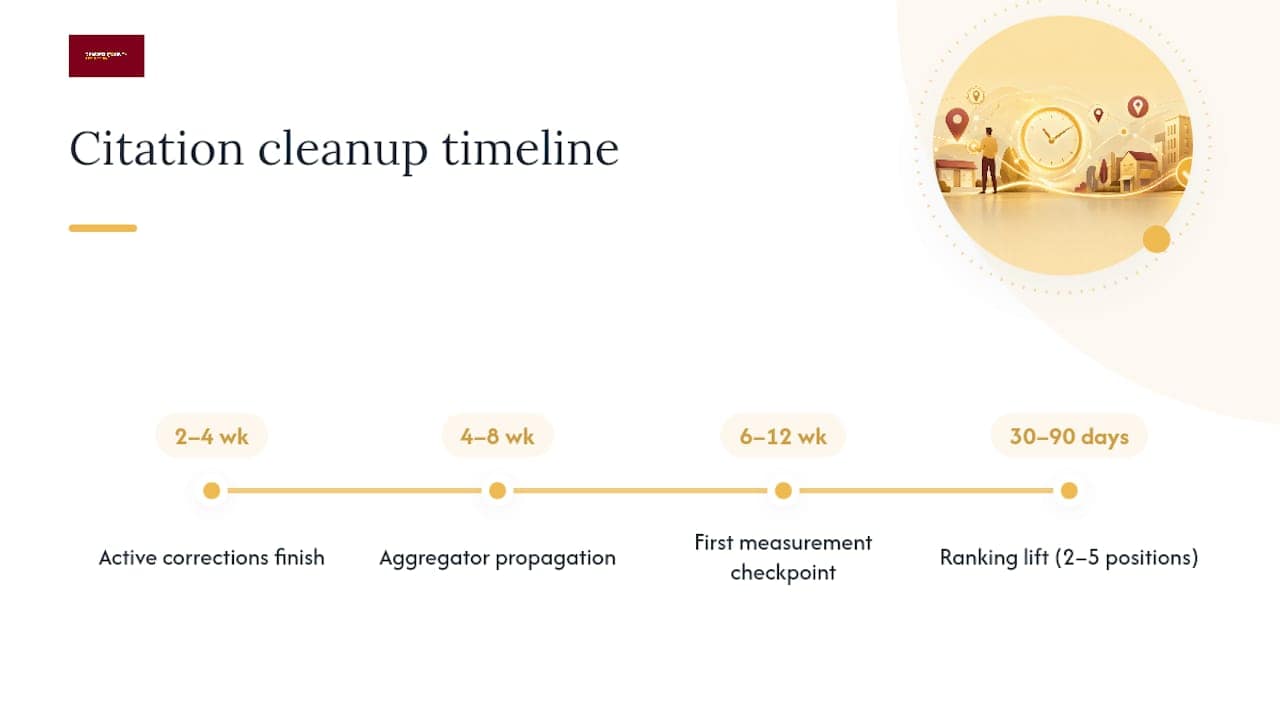
Active corrections on platforms you control usually finish in 2 to 4 weeks. Aggregator propagation to downstream directories takes another 4 to 8 weeks after that.
Set your first real measurement checkpoint at 6 to 12 weeks, not 6 to 12 days. Ranking lifts of 2 to 5 positions inside that 30 to 90 day window are a realistic industry benchmark, not a promise. Track Google Business Profile impressions and your local pack position weekly so you can show stakeholders a trend line instead of a single before-and-after snapshot.
How Do You Verify That Fixes Actually Stuck?
Corrections don’t always stay corrected. Some directories revert to cached data, and some aggregator pushes silently fail.
- Re-run your full audit six weeks after your aggregator submissions to confirm the data actually propagated.
- Add verification columns to your tracker: directory name, URL, submission date, verified date, and notes.
- Schedule a maintenance audit every six months, or immediately after any NAP change, like a new phone number or a move.
- Set a calendar alert to re-open correction requests for any listing that reverts.
Structured data on your own website reinforces the canonical version too. Adding local business schema makes your correct NAP machine-readable, which gives search engines one more consistent signal to trust.
How Denver County Web Design Handles Citation Cleanup
Citation cleanup is built into Denver County Web Design’s local SEO work for home service businesses across Denver and the surrounding metro. The process follows the same tiered logic covered above: Google Business Profile first, then aggregators, then the long tail of industry directories.
For contractors juggling multiple job sites and phone lines, that consistency check often catches problems owners never knew existed, like an old landline still listed on a directory from three moves ago. The duplicate listing removal guide walks through the exact merge process used on client accounts, and the Google Business Profile optimization resource covers the platform that matters most.
A Field Note on What Actually Trips People Up
The mismatch that costs businesses the most isn’t a wrong directory listing. It’s the phone number on their own website not matching their Google Business Profile. Fix your own site first, then work outward. Check the electrician-focused local SEO breakdown for a real-world sequence.
— Luis
Let Denver County Web Design Run the Cleanup for You
Some agencies offer alternatives to a scattered DIY spreadsheet or a generic agency retainer for contractors who need their citations fixed without spending many hours chasing directory logins. Citation cleanup and aggregator management come built into the Local SEO packages, starting with Maps Foundation at $500 per month, Local Growth at $750 per month, and Market Authority at $1,250 per month, each scaled to how many listings and locations your business needs cleaned up and monitored.

The managed service covers the full loop: inventory, Tier 1 corrections, aggregator submissions to Data Axle and Foursquare, duplicate merge requests, and the six-week verification pass that confirms your fixes actually held. Some web design providers build sites that clients fully own without recurring web fees, so the canonical NAP lives on a site controlled by the client. Visit the Local SEO Denver page to see which package fits your listing count, or check the main services page to book a consultation and get your audit started this week.
Sources
- Citation Cleanup: Definition, Process & 2026 Local SEO Guide | theStacc Glossary
- Local Citations Cleanup Playbook | TechStack
- Citation cleanup — the boring digital co.
- Citation Cleanup Guide: Fix NAP, Duplicates & Data Conflicts
FAQ
What Does “Cleaned Up” Mean for a Business Citation?
It means a listing’s name, address, and phone number now match your canonical NAP exactly, with any duplicate or outdated version merged or removed. A cleaned-up citation reflects current, accurate data instead of stale or conflicting information.
How Many Citations Is Too Many to Manage Manually?
There’s no fixed number, but once you’re tracking more than a few dozen listings across multiple locations, a spreadsheet alone becomes hard to maintain reliably. That’s usually the point where a managed service or dedicated tool starts paying for itself in saved hours.
Does a Bad Citation Hurt My Business the Way a Legal Violation Would?
No. A citation in the local SEO sense has nothing to do with legal penalties or fines. It’s simply an online listing of your business details, and a wrong one costs you rankings and customer trust, not a court date.
How Do I Remove an Incorrect or Duplicate Listing?
Request a merge first through the platform’s official form to preserve any reviews attached to the listing, since deleting a duplicate can wipe out review history permanently. Reserve outright deletion for listings tied to a location that’s permanently closed.
Can Denver County Web Design Fix Citations for Multiple Locations?
Yes. The Local Growth and Market Authority plans are built to handle multi-location cleanup, aggregator submissions, and ongoing monitoring, with pricing detailed on the Local SEO Denver page.