TL;DR:
- Optimizing your Google Business Profile and creating dedicated city-level service pages can significantly increase inbound calls for plumbers. Consistently generating reviews, adding photos, and building targeted service and city pages improve local rankings and lead quality. Technical speed, structured data, and citation consistency also play crucial roles in achieving sustainable growth.
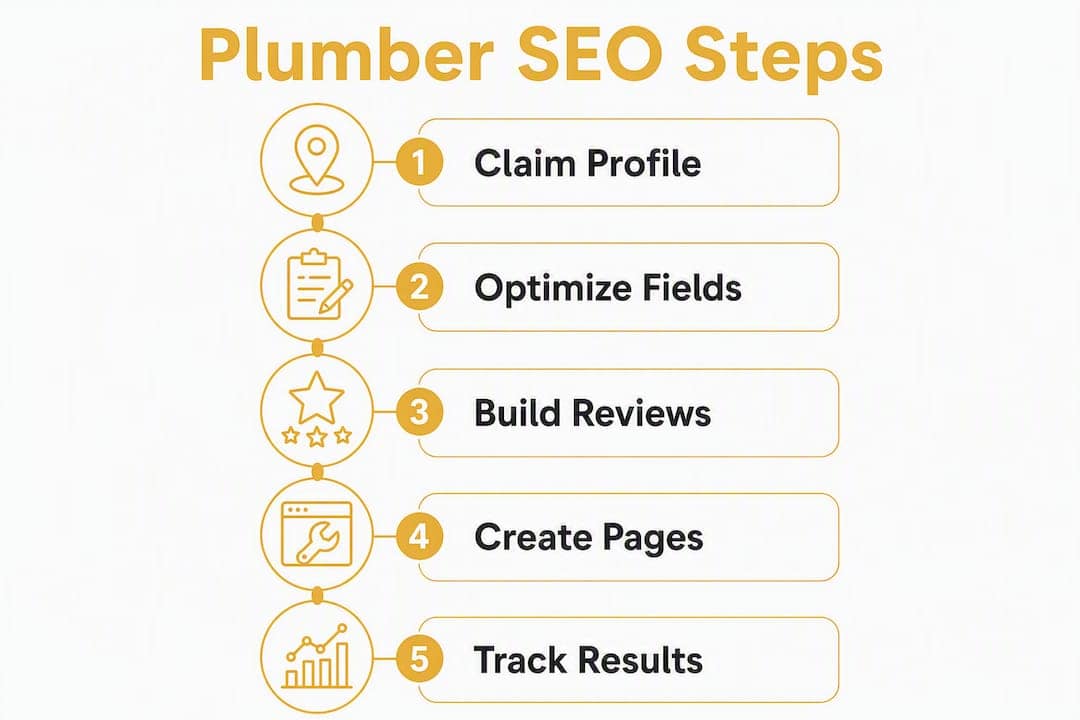
Optimize your Google Business Profile and map each high-intent service to its own city-level page. Those two moves, done well, will generate more inbound calls than almost anything else you can do for your plumbing business. Here is your five-step action plan to start today:
- Claim and complete your GBP. Set your primary category to “Plumber,” add every service you offer, confirm your service area, and fill in your hours. Incomplete profiles lose map pack spots to competitors who simply filled in more fields.
- Ask for a review right after every job. Send a short SMS: “Hi [Name], glad we could help today! If you have 60 seconds, a Google review means the world to us: [link].” Review velocity is one of the strongest local ranking signals.
- Upload 20+ photos to your GBP. Add truck photos, team shots, before-and-after work, and job-site details. Profiles with high photo volume consistently see more calls and direction requests than sparse ones.
- Build one high-intent service page. Pick your most profitable service (water heater replacement, drain cleaning, sewer repair) and create a dedicated page targeting “[service] + [city].” One focused page beats a generic “services” catch-all every time.
- Audit your NAP consistency. Search your business name across Google, Yelp, Angi, and the BBB. Fix any mismatch in name, address, or phone number, including small differences like “St.” vs. “Street.”
What to expect: At 14 days, you may see your GBP phone call count tick up as the profile fills out. At 60–90 days, a well-optimized GBP and one or two targeted service pages typically produce measurable ranking movement. At 6–12 months, compounding reviews and a growing page set translate into a steady organic pipeline. Watch GBP phone calls as your first leading indicator.
Table of Contents
- What is plumber SEO and how does local search actually work?
- Why does SEO produce better leads than ads for plumbers?
- How to optimize your Google Business Profile field by field
- What keywords should plumbers actually target?
- On-page SEO checklist for service and city pages
- Technical SEO basics that affect your local rankings
- How should you structure your plumbing website for SEO?
- How do citations and local links actually move the needle?
- How long does plumber SEO take, and what does it cost?
- Should you do plumber SEO yourself or hire an agency?
- A 90-day local SEO rapid-wins blueprint
- How social media supports your local SEO
- How to track and win voice search queries as a plumber
- Key Takeaways
- What most plumbers get wrong about local SEO
- Your plumbing business deserves a site that pulls its weight
- Useful sources and references
- FAQ
What is plumber SEO and how does local search actually work?
Plumber SEO is the practice of making your business visible when someone nearby searches for plumbing help on Google, whether they type “emergency plumber near me” at midnight or ask their phone “who fixes water heaters in [city].” The goal is not rankings for their own sake. It is calls, booked jobs, and revenue from people who are already ready to hire.
Google surfaces plumbing results across three distinct places, and each one works differently.
| Search Surface | What Appears | Primary Ranking Signals | User Behavior |
|---|---|---|---|
| Local 3-Pack (Map Pack) | Top 3 GBP listings with map | Proximity, GBP completeness, reviews, citations | High click-through; users call directly from the listing |
| Organic results | Website pages ranked below the map | On-page content, backlinks, technical SEO | Users click to read, then call or book |
| AI Overviews / Generative answers | AI-generated summaries at top of SERP | Structured data, FAQ schema, authoritative content | Users read the summary; cited sources get brand exposure |
The Map Pack captures roughly 44% of clicks on local plumbing searches, making it the highest-value ranking position for most plumbing businesses. A user who sees your listing in the 3-Pack can call you without ever visiting your website. That is why GBP optimization comes before everything else in this guide.
Organic results matter too, especially for less urgent queries like “how much does a water heater replacement cost” or “signs of a sewer line problem.” Those pages warm up leads before they pick up the phone. AI Overviews are newer territory, but plumbers who show up in three places, the Map Pack, organic results, and AI answers, hold an early-mover advantage that most competitors have not yet claimed.
Why does SEO produce better leads than ads for plumbers?
The business case for local SEO comes down to lead cost and lead quality. A Google Ads click for “emergency plumber Denver” can cost $30–$80. An organic or Map Pack lead costs nothing per click once the rankings are earned. The math compounds fast when you are booking multiple jobs a week.
Primary KPIs to track:
- GBP phone calls (tracked in your GBP dashboard)
- GBP direction requests
- Website phone calls (use a call-tracking number)
- Contact form submissions
- Booked jobs and conversion rate from lead to job
- Average job value per organic lead
Business outcomes that follow:
- Lower cost per lead compared to paid ads, often dramatically so in markets where ad costs are high
- A steady inbound pipeline that does not stop the moment you pause a budget
- Better margins on organic leads because you are not paying per click
GBP optimization is the highest-impact, free step a plumber can take, and review signals directly influence both Map Pack placement and the trust a prospect feels before calling. Profiles with substantially more and higher-rated reviews tend to convert browsers into callers at a far higher rate than those with fewer and lower-rated reviews. That gap in review velocity can be the difference between ranking in the 3-Pack and not appearing prominently.

How to optimize your Google Business Profile field by field
GBP is your most powerful free tool in local plumber marketing. Most plumbers set it up once and never touch it again. That is a missed opportunity.
| GBP Field | Recommended Input | Why It Matters |
|---|---|---|
| Business name | Exact legal name, no keyword stuffing | Keyword stuffing violates Google’s guidelines and risks suspension |
| Primary category | “Plumber” | The single most important ranking signal in GBP |
| Secondary categories | “Emergency Plumber,” “Water Heater Repair,” “Drainage Service” | Expands the query set you appear for |
| Services | List every service with descriptions | Google uses this to match your listing to specific queries |
| Service area | Every city/zip you serve (up to 20 areas) | Determines where your listing appears geographically |
| Hours | Accurate, including holiday hours | Incorrect hours generate negative reviews and lost calls |
| Phone number | Local number matching your website | NAP consistency across all platforms |
| Photos | 20+ varied images; add new ones monthly | High photo volume correlates with more calls and direction requests |
| Business description | — | Reinforces relevance for key queries |
| Q&A | Seed your own questions and answers | Controls the narrative; Google surfaces these in results |
Fixing your primary category and completing your service list are often the highest-leverage GBP changes a plumber can make, with improvements visible within 30 days.
Review generation that actually works
After every completed job, send this SMS within two hours:
“Hi [Name]! Thanks for choosing [Your Business]. If we did a good job today, a quick Google review helps us a lot: [short link]. Takes about 60 seconds!”
For email follow-ups, keep it equally short: subject line “Quick favor, [Name]?” and one sentence asking for a review with a direct link. The faster you ask after a positive experience, the higher your response rate.
Pro Tip: Add your Google review link to your invoice footer, your technician’s email signature, and a small card you leave at every job site. Multiple touchpoints without being pushy.
What keywords should plumbers actually target?
Most plumbing businesses waste effort chasing broad keywords they cannot rank for. The smarter approach is organizing keywords by intent and matching each one to a specific page.
Intent buckets:
- Emergency/transactional: “burst pipe repair [city],” “24-hour plumber [city],” “emergency plumber near me” — these users need someone now; your GBP and a fast-loading service page win here
- Service + city (money pages): “water heater replacement [city],” “drain cleaning [city],” “sewer line repair [city]” — dedicated service pages with local signals
- Informational (blog): “how much does drain cleaning cost,” “signs of a broken sewer line,” “tankless vs tank water heater” — these warm up leads and support your money pages
- Long-tail symptom queries: “why is my water heater making noise,” “slow drains in multiple rooms,” “low water pressure throughout house” — high-converting because the user has already identified a problem
| Page Type | Primary Keyword Example | Supporting Terms |
|---|---|---|
| Service page: drain cleaning | “drain cleaning [city]” | “clogged drain,” “drain snake service,” “hydro jetting” |
| Service page: water heater | “water heater replacement [city]” | “water heater installation,” “tankless water heater,” “hot water heater repair” |
| Service page: sewer repair | “sewer line repair [city]” | “sewer camera inspection,” “trenchless sewer repair,” “sewer replacement” |
| Service page: leak detection | “leak detection [city]” | “water leak repair,” “pipe leak,” “hidden leak detection” |
| City landing page | “plumber in [city]” | “[city] plumbing company,” “local plumber [city]” |
| Blog post | “how much does drain cleaning cost” | “drain cleaning price,” “plumber cost [city]” |
One primary keyword per page. When two pages target the same term, they compete against each other in Google’s index and both rank lower than a single focused page would. Site architecture that treats each service as its own money page and builds city-specific landing pages prevents keyword cannibalization and raises page-level relevance.
On-page SEO checklist for service and city pages
A service page that ranks and converts needs to do two things simultaneously: signal relevance to Google and persuade a real person to call. Most plumbing pages fail at one or both.
| On-Page Element | Recommended Approach |
|---|---|
| Title tag | "[Service] in [City], [State] |
| Meta description | Include the service, city, a trust signal, and a CTA — keep it concise |
| H1 | One per page; match the primary keyword naturally (“Drain Cleaning in Aurora, CO”) |
| Body content | 600–1,000 words for service pages; cover the problem, your process, pricing context, and FAQs |
| CTAs | Phone number above the fold, click-to-call button on mobile, form below the fold |
| Images | Use real job photos; alt text = “[service] in [city]” |
| Schema markup | LocalBusiness/Plumber, Service, AggregateRating, FAQPage |
| Internal links | Link to related service pages and your city pages; link back to the homepage |
Schema markup deserves special attention. Adding LocalBusiness schema with your NAP, hours, and service area tells Google exactly who you are and where you operate. AggregateRating schema pulls your review score into search results as star ratings, which lifts click-through rates. FAQPage schema on service pages increases your chances of appearing in AI Overviews and voice search answers.
For CTAs, phone-first always wins on mobile. Put your number in the header, make it click-to-call, and repeat it at the bottom of every page. A form is a secondary option, not a replacement.
Technical SEO basics that affect your local rankings
Technical issues are often invisible to the business owner but very visible to Google. A slow, poorly structured site can suppress rankings even when your GBP and content are strong.
Priority list by impact:
- Mobile speed: Most plumbing searches happen on phones. A page that loads in under 2.5 seconds on mobile retains far more visitors than one that takes 5+ seconds. Use PageSpeed Insights to get your score and a specific fix list.
- Core Web Vitals: Google’s LCP (Largest Contentful Paint), CLS (Cumulative Layout Shift), and INP (Interaction to Next Paint) are ranking signals. Failing these hurts both rankings and user experience.
- HTTPS: Every plumbing site must run on HTTPS. An HTTP site triggers browser warnings that kill trust instantly.
- Crawlability: Make sure Google can find and index your service pages. Check Google Search Console’s Coverage report for errors.
- Structured data: Implement schema as described in the on-page section. Validate with Google’s Rich Results Test.
- Canonicalization: Avoid duplicate content by setting canonical tags correctly, especially on city pages that share similar content.
Quick technical wins:
- Compress all images before uploading (use WebP format where possible)
- Defer non-critical JavaScript so the page renders faster
- Enable server-level caching or use a caching plugin if you are on WordPress
- Remove unused plugins and themes that add page weight
A practical SEO approach for plumbers focuses effort on what moves calls rather than vanity metrics, and technical speed fixes often unlock ranking gains that content alone cannot achieve. Watch Google Search Console weekly for coverage errors, mobile usability issues, and Core Web Vitals status. When you see a spike in errors, escalate to a developer before it compounds.
How should you structure your plumbing website for SEO?
Your site’s architecture determines how Google distributes authority across your pages. A flat, unorganized site spreads that authority thin. A hub-and-spoke structure concentrates it where it counts.

The right structure:
Homepage → Services Hub → Individual Service Pages → City/Location Pages → Blog
Internal links flow from the homepage to the services hub, from the hub to each service page, and from service pages to the relevant city pages. Blog posts link back to the service pages they support. This creates a clear signal to Google about which pages matter most.
| Blog Topic | Search Intent | Conversion Placement |
|---|---|---|
| “How much does drain cleaning cost in [city]?” | Informational / commercial | CTA to drain cleaning service page |
| “Signs you need a sewer line replacement” | Symptom-to-solution | CTA to sewer repair page |
| “Tankless vs. tank water heater: which is right for you?” | Informational / decision | CTA to water heater service page |
| “What to do when a pipe bursts” | Emergency informational | CTA to emergency plumber page |
| “How long does a water heater last?” | Informational | CTA to water heater replacement page |
| “Why is my water pressure low?” | Symptom query | CTA to leak detection / pipe repair page |
| “Best plumbers in [city]: what to look for” | Local research | CTA to homepage or contact page |
| “How to unclog a drain (and when to call a plumber)” | Informational | CTA to drain cleaning page |
| “Trenchless sewer repair vs. traditional: cost and process” | Decision / commercial | CTA to sewer repair page |
| “What does a plumbing inspection include?” | Informational | CTA to inspection or general services page |
Adding FAQ schema to service pages increases the chance of being surfaced inside AI summaries and voice assistants. For each service page, add three to five FAQs that answer the questions your customers actually ask: “How long does this take?”, “What does it cost?”, “Do you offer same-day service?” These also capture featured snippets and voice search queries directly.
A minimum viable site for a plumbing business includes a homepage, a services hub, 8–15 individual service pages, and 5–30 city pages for every area you legitimately serve.
How do citations and local links actually move the needle?
Citations are mentions of your business name, address, and phone number across the web. Google uses them to verify that your business is real and located where you say it is. Inconsistency across those mentions creates doubt in the algorithm, and that doubt costs you Map Pack positions.
Citation audit process:
- Search your business name in Google and note every directory listing that appears
- Check the top directories: Google, Yelp, Angi, HomeAdvisor, BBB, Houzz, Bing Places, Apple Maps, and your local Chamber of Commerce
- Flag any listing where your name, address, or phone number differs from your GBP, even small differences like “Ave” vs. “Avenue” or a missing suite number
- Correct each listing manually or use a tool like BrightLocal or Whitespark to manage them at scale
Realistic local link-building tactics:
- Get listed on your plumbing supplier’s website (Ferguson, Hajoca, local supply houses often have contractor directories)
- Sponsor a local youth sports team and ask for a link on their website
- Submit a quote or tip to a local news outlet or neighborhood blog covering home maintenance
- Join your local Chamber of Commerce and get listed in their member directory
- List your business with trade associations like the Plumbing-Heating-Cooling Contractors Association (PHCC)
- Partner with local real estate agents or property managers who can refer and link to you
- Offer to write a guest post for a local home improvement blog
Pro Tip: Before hiring any link-building service, ask for a sample of the sites they place links on. If the sites have no real audience, no real content, and exist only to sell links, those links will not help and may eventually hurt. Vet every vendor with a 30-day pilot before committing to a longer contract.
Red flags in outreach vendors: guaranteed rankings, links from sites with no real traffic, no transparency about which sites they use, and no reporting on link quality.
How long does plumber SEO take, and what does it cost?
This is the question every plumbing owner asks, and the honest answer has two parts: GBP moves faster than organic, and both move faster than most people expect when the fundamentals are done right.
| What You Are Tracking | Where to Track It | Expected Movement Window |
|---|---|---|
| GBP phone calls | GBP Insights dashboard | 2–6 weeks after profile optimization |
| GBP direction requests | GBP Insights dashboard | 2–6 weeks |
| Organic sessions to service pages | Google Analytics / Search Console | 60–120 days for new pages |
| Keyword rankings | Google Search Console, rank tracker | 60–90 days for low-competition terms |
| Call tracking conversions | Call tracking software (e.g., CallRail) | Ongoing; set baseline in month 1 |
| Booked jobs from organic | CRM or booking system | 90 days for meaningful volume |
Timeline expectations:
- Weeks 1–4: GBP fixes and photo uploads produce the fastest movement. You may see call volume increase before any organic ranking changes.
- Months 2–3: New service pages begin to index and rank for lower-competition terms. Review velocity starts compounding.
- Months 6–12: Organic rankings for competitive service + city terms solidify. A well-built site with consistent reviews and citations becomes a reliable lead machine.
Typical cost ranges:
- DIY: $0–$200/month in tools (time cost is 5–10 hours/week; realistic for owners in low-competition markets)
- Freelancer: $500–$1,500/month for GBP management, citation cleanup, and basic content
- Full-service agency: $1,500–$4,000+/month for competitive metros with full content, technical SEO, and link building
A simple ROI example: if your average job value is $400 and local SEO generates 10 additional booked jobs per month, that is $4,000 in monthly revenue from organic leads. At a $1,500/month agency retainer, the return is clear within the first quarter.
Should you do plumber SEO yourself or hire an agency?
The right answer depends on three variables: your market’s competitiveness, your available time, and your comfort with technical tasks.
DIY makes sense when:
- You are in a small or mid-size market with fewer than 10 strong competitors in the Map Pack
- You can commit 5–8 hours per week consistently
- You are comfortable with WordPress, Google Search Console, and basic content writing
- Your budget is tight and you are willing to learn
Hiring an agency makes sense when:
- You are in a competitive metro where the top Map Pack listings have 200+ reviews
- Your time is better spent running jobs than managing marketing
- You have tried DIY for 6+ months without meaningful movement
- You want faster results and can afford a monthly retainer
Agency vetting checklist:
- Ask for specific, measurable deliverables in writing (number of pages built, citations fixed, GBP posts per month)
- Confirm they provide monthly reporting on GBP calls, organic sessions, and keyword rankings
- Ask who manages your GBP and how often they update it
- Check their contract for auto-renewal clauses and exit terms
- Request references from other home service clients, not just general businesses
- Run a 90-day pilot with clear success metrics before committing to a long-term contract
Walk away from any agency that promises a specific ranking within a guaranteed timeframe, refuses to show you which sites they build links on, or cannot explain what they do in plain English.
A 90-day local SEO rapid-wins blueprint
This week-by-week plan reflects the types of actions that produce the fastest GBP and early organic movement for plumbing businesses. Results vary by market competitiveness, starting baseline, and how consistently the work is executed.
| Week | Actions | Expected Signal |
|---|---|---|
| 1–2 | Claim/verify GBP; set primary category; complete all fields; upload 20 photos; fix NAP on top 10 directories | GBP profile completeness score improves; early call uptick possible |
| 3–4 | Launch review request system (SMS + email); build or fix homepage; set up Google Search Console and Analytics | First new reviews appear; baseline data established |
| 5–8 | Build 3 high-intent service pages (drain cleaning, water heater, emergency plumber); add schema markup; fix mobile speed | Pages begin indexing; Search Console shows impressions |
| 9 to 10 | Citation cleanup across 20+ directories; add 10 more GBP photos; publish 2 blog posts targeting informational queries | Citation consistency improves; blog pages begin ranking for long-tail terms |
| 11 to 12 | Build 3–5 city landing pages; internal link audit; request links from suppliers and local partners | City pages index; early ranking movement for service + city terms |
Denvercountywebdesign reports a 243% increase in organic traffic within 90 days for home service clients who complete a full site redesign paired with this type of local SEO sequence. That figure reflects clients starting from a weak baseline in markets where the top competitors had not yet invested heavily in technical SEO. In highly competitive metros, the same actions may take 4–6 months to produce comparable movement.
Disclaimer: Results depend on your starting point, market size, and how consistently the work is maintained. Use this as a framework, not a guarantee.
How social media supports your local SEO
Social media does not directly move your Google rankings, but it supports local SEO in ways that compound over time. The clearest benefit is brand signal reinforcement: when someone sees your Facebook post, then searches for you on Google, and then finds a complete GBP with strong reviews, the conversion rate on that search is far higher than cold traffic.
What actually works for plumbers on social:
- Post before-and-after photos of completed jobs on Facebook and Instagram. These build trust and generate shares within local community groups, which drives branded searches.
- Join and participate in local neighborhood Facebook groups. When someone asks for a plumber recommendation, a consistent presence means community members tag you.
- Share your Google review link in your social bios and periodically in posts. This drives review velocity without requiring a separate outreach campaign.
- Use location tags on every post. Instagram and Facebook use these to surface your content to nearby users, reinforcing your local relevance.
- Respond to every comment and message promptly. Social engagement signals to potential customers that you are responsive, which directly affects whether they call.
The indirect SEO benefit comes from traffic. Social posts that link to your service pages or blog posts drive referral visits, and consistent referral traffic from real users is a quality signal Google notices over time.
How to track and win voice search queries as a plumber
Voice search queries are longer and more conversational than typed searches. Someone typing might enter “plumber Denver.” The same person using voice search says “Who is the best plumber near me open right now?” Your content and GBP need to answer both.
How voice search works for plumbers:
Voice assistants (Google Assistant, Siri, Alexa) pull answers from three sources: GBP listings, featured snippets, and FAQ schema on web pages. If your GBP is complete and your service pages have FAQ schema, you are already positioned for most voice queries.
Optimizing for voice:
- Write FAQ content in natural, conversational language. “How much does drain cleaning cost in Denver?” is a better FAQ heading than “Drain cleaning pricing.”
- Target question-based keywords in your blog posts: “What should I do if my pipes freeze?”, “How do I know if I need a new water heater?”
- Keep your GBP hours accurate at all times. Many voice queries include “open now” as an implicit filter.
- Use schema markup on every service page. Google’s voice results heavily favor pages with structured data.
Tracking voice search performance:
Google Search Console does not separate voice queries from typed ones, but you can filter for long-tail, question-format queries in the Performance report. Sort by queries that start with “who,” “what,” “where,” “how,” and “when.” If those queries are generating impressions but low clicks, your page is being surfaced but not selected, which usually means your title tag or meta description needs to better match the conversational intent.
Key Takeaways
Local SEO for plumbers works when you prioritize GBP first, build reviews consistently, and create dedicated service pages for every high-intent query you want to rank for.
| Point | Details |
|---|---|
| GBP is your highest-leverage asset | The Map Pack captures roughly 44% of clicks on local plumbing searches; optimize your profile before anything else. |
| Reviews drive Map Pack placement | Review velocity and rating directly affect both rankings and conversion rate; ask after every job. |
| One page per service, one per city | Dedicated pages prevent keyword cannibalization and give Google a clear relevance signal for each query. |
| Technical speed matters on mobile | Most plumbing searches happen on phones; a slow page loses calls before a visitor ever reads your content. |
| Denvercountywebdesign accelerates results | Their 90-day local SEO and web redesign approach has produced a 243% organic traffic increase for home service clients. |
What most plumbers get wrong about local SEO
The conventional wisdom says “just get more reviews and you will rank.” That is true as far as it goes, but it misses the structural problems that prevent reviews from doing their job.
The plumbers who struggle most with local SEO share a pattern: a generic homepage that tries to rank for every service at once, NAP information that differs slightly across a dozen directories, and no system for generating reviews consistently. Each of those problems is fixable in a week. Together, they suppress rankings that the business should already be winning.
What I see working consistently in local markets is not the most expensive SEO campaign. It is the most complete one. A fully filled-out GBP, a review ask after every job, and three to five dedicated service pages will outperform a competitor who has spent thousands on backlinks but left their GBP half-empty and their service pages generic.
The three mistakes I see most often:
- Generic homepage: Trying to rank one page for “plumber,” “drain cleaning,” “water heater repair,” and “sewer service” simultaneously. The fix is a dedicated page for each service.
- Inconsistent NAP: A phone number that changed two years ago still appearing on Yelp and Angi. The fix is a citation audit and manual corrections across every directory.
- No review system: Waiting for happy customers to leave reviews on their own. The fix is a two-sentence SMS sent within two hours of job completion.
Denvercountywebdesign works with home service businesses across Colorado, and the pattern holds in every market: the businesses that fix these three things first see the fastest movement.
Your plumbing business deserves a site that pulls its weight
Most plumbing websites are digital brochures. They look fine, but they do not rank, they do not convert, and they do not generate calls without paid ads propping them up. Denvercountywebdesign builds something different: custom WordPress sites for home service businesses that are fast, locally optimized, and built to generate leads from day one.
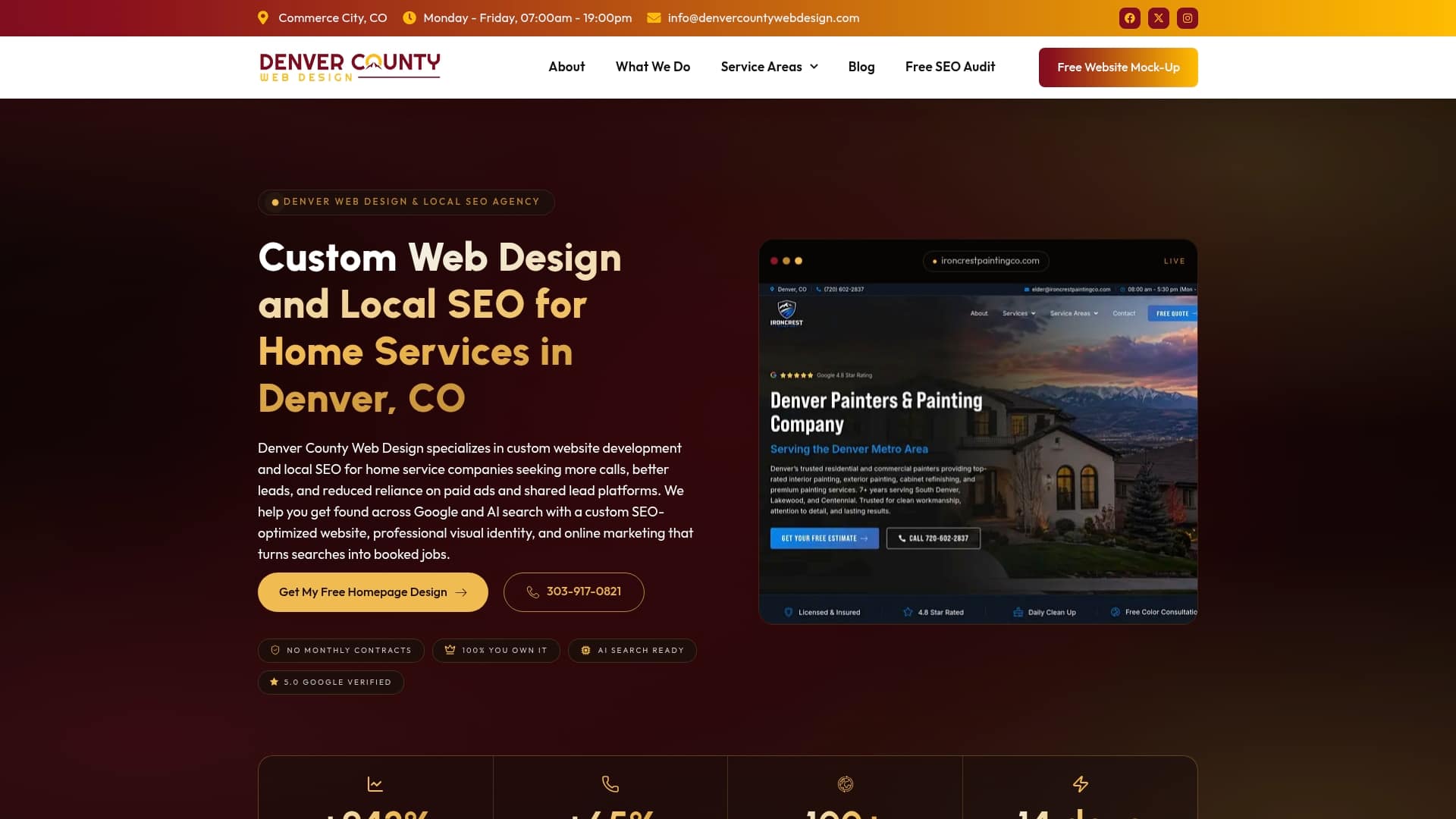
The service bundle includes GBP optimization, local citation cleanup, service and city page builds, review automation setup, and technical speed fixes. You own the site outright with no monthly platform fees and no lock-in. For plumbing businesses in Denver and surrounding Colorado communities, that means a professional web presence that compounds in value over time rather than disappearing the moment you stop paying.
If you want to see exactly where your Map Pack ranking stands and what is holding it back, request your free Map Pack audit. The audit covers your GBP completeness, citation consistency, competitor gap analysis, and a prioritized fix list. No obligation, and you walk away with a clear picture of what to do next. You can also explore the full service offering at denvercountywebdesign.com or see local examples of SEO-ready builds for Commerce City and Westminster.
Useful sources and references
| Source | What to Use It For |
|---|---|
| Local SEO for Plumbers: How to Win the Map Pack | Map Pack click-share data, GBP category and photo benchmarks, review velocity guidance |
| Plumbing SEO Playbook — Hozio | Site structure requirements, minimum page set guidance, keyword-to-page mapping |
| SEO for Plumbers: How to Rank and Get Calls | Three-surface model (Map Pack, organic, AI), FAQ schema for voice search, technical audit starting points |
| SEO for Plumbing Companies: The Complete Guide | GBP priority confirmation, structured data recommendations, local SEO sequencing |
| SEO for Plumbers: Complete Local SEO Guide | Checklist sequencing, DIY vs. agency decision framework, measurement priorities |
| How to Improve Local SEO for Plumbers — Signpost | Citation building process, review generation tactics, service area page guidance |
| SEO for Plumbers: The Definitive Guide — ServiceTitan | Industry-level benchmarks, KPI definitions, content strategy for home service businesses |
| Free Map Pack Audit — Denvercountywebdesign | Use this to get a personalized audit of your GBP, citations, and competitor gaps at no cost |
This article provides general SEO guidance for informational purposes. Results vary by market, competition level, and execution quality. Consult a qualified local SEO professional to confirm the right strategy for your specific business situation.
FAQ
What is the fastest way to improve a plumber’s local ranking?
Completing your Google Business Profile, especially the primary category, service list, and photos, and generating new reviews consistently are the fastest-moving levers. Most plumbers see GBP call volume increase within 2–6 weeks of a full profile optimization.
How many reviews does a plumbing business need to rank in the Map Pack?
There is no fixed number, but your review count and rating need to be competitive with the businesses already ranking in your market’s 3-Pack. In smaller markets, a few dozen reviews with good ratings may be enough; in competitive metros, a higher review count is common among top-ranked listings.
How long does plumber SEO take to show results?
GBP improvements can show movement in 2–6 weeks. New service pages typically take 60–120 days to rank for lower-competition terms. Competitive service + city keywords in major metros may take 6–12 months of consistent effort.
Do plumbers need a separate page for every city they serve?
Yes, if you want to rank in those cities. A single “service area” page listing 15 cities will not rank for “[service] in [city]” queries. Each city you want to rank in needs its own dedicated landing page with localized content.
Can Denvercountywebdesign help with plumber SEO outside Denver?
Denvercountywebdesign focuses on home service businesses across Colorado, including the Denver metro and surrounding communities. Their service bundle covers GBP optimization, citation cleanup, service and city page builds, and technical SEO. Visit denvercountywebdesign.com to confirm availability for your area.