Schema markup does not guarantee your content gets cited by ChatGPT, Google AI Overviews, or Copilot. What it does is make your content machine-readable enough that these systems can extract facts accurately and trust them enough to quote. Get the implementation right and you improve your odds. Skip validation, and you risk confusing the very systems you’re trying to influence.
TL;DR:
- Proper schema implementation makes your content more understandable for AI systems, increasing the chances of being cited, but does not guarantee citations.
- Focus on setting up core schema types such as Organization, Article, Person, and FAQPage, especially in JSON-LD format, to maximize AI visibility with minimal effort.
- Validate schema on a small set of pages first to prevent errors, including conflicts, missing properties, or incorrect data types that can harm trust signals.
- Use stable
@idvalues, link entities withsameAs, and keep schema facts visible in your page content to build a trustworthy knowledge graph for AI.- Accurate, reusable entity data and targeted FAQ schema offer the highest impact, especially when implemented systematically and validated using official tools.
Table of Contents
- How Schema Helps AI Search Understand Your Content
- Which Schema Types Should You Implement First?
- What’s the Best Schema Format for AI Search Engines?
- Common Schema Mistakes That Undermine AI Trust
- How to Test Whether Your Schema Is Improving AI Visibility
- How We Approach AI-Ready Schema for Home Service Sites
- Why Accuracy Beats Coverage Every Time
- Let Denver County Web Design Handle Your Schema Implementation
- Where to Verify Your Schema Implementation
- Sources
- FAQ
How Schema Helps AI Search Understand Your Content
AI search systems don’t read your page the way a human does. They parse it, extract entities, and try to figure out what’s a fact versus what’s marketing copy. Schema removes the guesswork.
When you write “Best Denver Plumber Since 1998” in your header, an AI has to infer whether that’s a claim, a name, or a slogan. When you wrap that same information in Organization schema with a foundingDate property, you’ve handed it a fact instead of a phrase to interpret. That distinction is what Search Engine Land describes as the real value of schema for AI search: it helps machines understand entities and relationships, even though it doesn’t guarantee citations.
Three mechanics matter here:
- Entity definition separates “who/what this is” from the surrounding text, cutting down on inference errors.
- Attribute mapping turns loose facts (price, author, publish date) into structured properties an AI can treat as verified data points.
- Relationship wiring, through
@idandsameAs, tells the AI that this page, this author, and this business are the same connected entity across your site and the web.
Microsoft has confirmed that its Bing and Copilot AI search stack leans on structured data to improve how it retrieves and presents answers. That’s a platform-level confirmation, not a theory.
Which Schema Types Should You Implement First?
Not every schema type deserves equal attention. Some are foundational. Others only matter for specific page types. Here’s the order that gets you the most AI visibility for the least engineering effort.
- Organization schema, sitewide. This is your floor. Give it a stable
@id, your logo, andsameAslinks to your verified social profiles and Wikipedia or Crunchbase entries if you have them. This is the entity anchor every other schema block references. - Article or BlogPosting plus Person, on every editorial post. Pair your content schema with an author
Personobject that includes aurlanddateModified. AI systems weight authorship and freshness heavily when deciding what to cite. - FAQPage schema, on your highest-intent Q&A content. Structured Q&A pairs function as independently citable answer atoms, which is why FAQ schema is one of the highest-leverage, lowest-effort moves available.
- HowTo, Product, Dataset, or LocalBusiness, as needed. Add these when the page genuinely matches the type. A
LocalBusinessblock on a service page needs address, hours, and service-area fields filled out completely, not left blank.
Start with Organization and FAQPage. They take the least time and produce the most visible gains.
What’s the Best Schema Format for AI Search Engines?
JSON-LD is the format to use. Google Search Central’s structured data documentation recommends it explicitly, and it’s easier to validate and maintain than Microdata or RDFa, which most CMS platforms are moving away from anyway.
A few patterns separate schema that actually works from schema that just sits there unread:
- Place your JSON-LD in the
<head>or right before the closing</body>tag, and confirm it validates as proper JSON before publishing. - Use a stable
@id, built from your canonical URL plus a fragment (like#organizationor#author), and reuse that exact identifier everywhere the entity appears. - Publish related entities together inside a single
@grapharray instead of scattering isolated schema blocks across the page. This is how you build an actual internal knowledge graph instead of a pile of disconnected tags. - Keep every fact in your schema visible somewhere in the page’s rendered content. Cloaked or invisible schema data is a trust red flag for both Google and AI crawlers.
- Update
dateModifiedevery time you make a substantive edit. A stale timestamp signals to AI systems that the page might not reflect current facts.
Pro Tip: Build one @graph per page that links your Organization, Person, and Article nodes through matching @id values. That single move does more for AI trust signals than adding five unrelated schema types.
Common Schema Mistakes That Undermine AI Trust
The biggest mistake isn’t skipping schema. It’s rolling it out sitewide before checking whether it actually works.
Validate a small batch of pages first, not your entire site at once. Industry analysis on schema and AI citation trust warns that inconsistent or incorrect markup applied at scale can damage the trust signals you’re trying to build, not strengthen them. Errors get amplified, not diluted, when copied across thousands of pages.
Watch for these specific failure points:
- Duplicate or conflicting JSON-LD blocks on the same page, often left behind by a plugin update or theme change.
- Visible content that contradicts your schema data, like a price shown on the page that doesn’t match the
offersproperty. - Missing required properties, particularly
dateModified, authorurl, andoffersfields on Product schema. - Incorrect data types, such as a date formatted as plain text instead of ISO 8601.
Run every page through Validator and Google’s Rich Results Test before it goes live, and again after any template change.
How to Test Whether Your Schema Is Improving AI Visibility
Schema changes need a baseline before they need a victory lap.
- Record your starting point. Log which of your target queries currently pull citations from AI tools, alongside your existing organic traffic and engagement numbers.
- Roll out in stages. Apply schema to a sample set of pages first, run the same probe queries against AI search tools weekly, and track citation appearances over a 4 to 12 week window.
- Track the right metrics. Citation rate in AI answers, organic traffic shifts, clickthroughs from AI referral sources, and any change in how often your brand gets named as a source.
Set your expectations honestly. Industry testing on the 2026 schema stack shows mixed correlation between schema coverage and citation rates. Schema works alongside topical authority and content quality. It doesn’t replace either one.
How We Approach AI-Ready Schema for Home Service Sites
The workflow Denver County Web Design follows for contractor and home service clients is deliberately sequential: audit existing markup, implement the minimum viable set (Organization, Article, Person, FAQPage), validate every block, then scale. Data accuracy gets checked at each stage, not just at the end.

For a plumber or electrician site, the fastest wins usually come from sitewide Organization schema, structured service offers on each service page, and a handful of targeted FAQPage entries built around the exact questions homeowners type into search bars.
Why Accuracy Beats Coverage Every Time
Schema is infrastructure, not decoration. The websites that win AI citations aren’t the ones with the most schema types. They’re the ones with accurate, reusable entity data anchored by consistent @id values and a handful of well-written FAQ atoms. Bring in an agency once your site grows past a few dozen pages; do it yourself before that.
— Luis
Let Denver County Web Design Handle Your Schema Implementation
If you’d rather skip the trial-and-error of building and validating schema yourself, Denver County Web Design builds AI-ready structured data directly into every website project instead of treating it as an afterthought bolted on later.

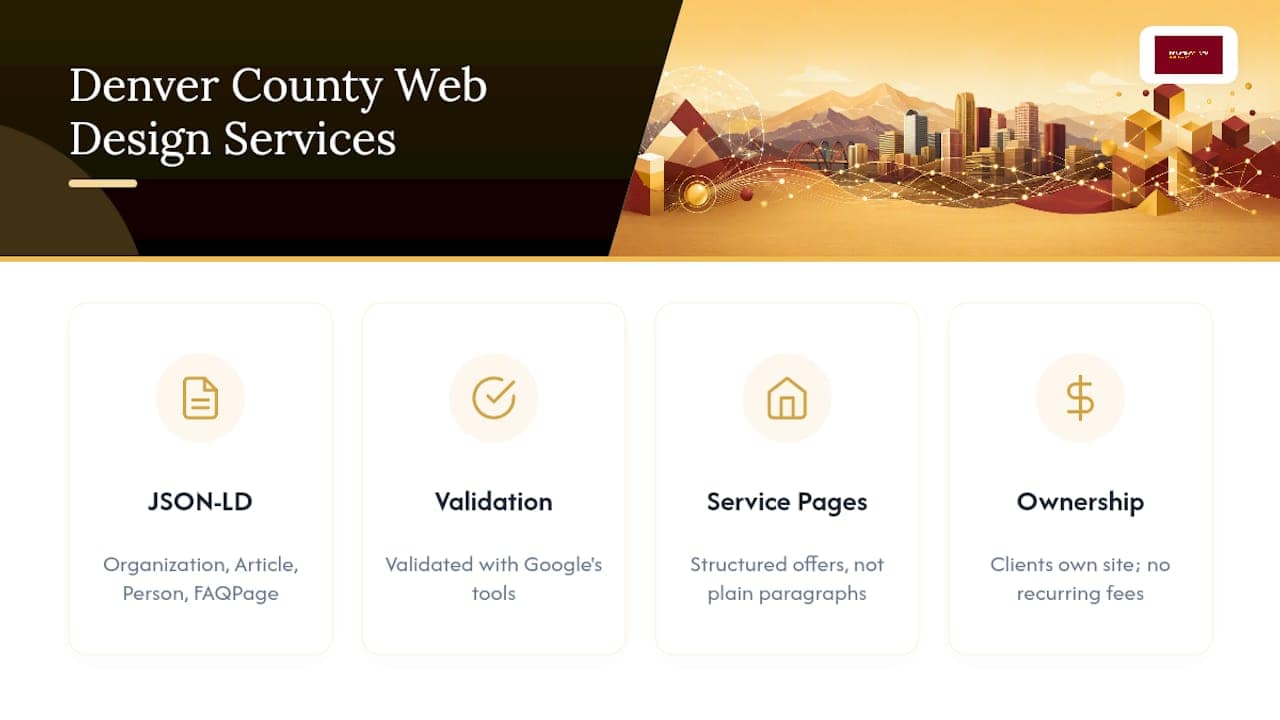
For home service businesses, that means schema audits, full JSON-LD implementation across Organization, Article, Person, and FAQPage types, and validation against Google’s own tools before anything goes live. Service pages get structured offers instead of plain paragraphs, which matters when an AI system is trying to figure out what you actually do and where you do it. Denver County Web Design’s contractor-focused web design work builds this in from day one, and clients own the finished site outright with no recurring fees attached.
If your current site was built without any of this in mind, request a free SEO audit and find out exactly where your schema gaps are costing you visibility.
Where to Verify Your Schema Implementation
Check your work against Schema official vocabulary, Google Search Central’s structured data docs, and validator.schema.org before publishing.
Sources
- How schema markup fits into AI search — without the hype
- Structured data (Google Search Central)
- Schema Markup Validator
- Reinventing search with AI-powered Microsoft Bing and Edge
- Schema and AI citations (analysis)
FAQ
How Should I Structure Information for AI Search?
Use JSON-LD to define entities (Organization, Person, Article) with stable @id values, link related nodes through a single @graph, and keep every fact in your schema visible in the page’s actual content.
What Is an AI Schema?
“AI schema” isn’t an official Schema.org term. It refers to using standard schema.org markup, especially entity-grounding properties like @id and sameAs, in a way that’s optimized for how AI search systems extract and cite content.
What Are the Four Types of Schema?
There’s no fixed “four types” standard, but for AI search visibility, the four highest-priority types are Organization, Article (or BlogPosting), Person, and FAQPage, which together form the trust and citation foundation most sites need.
What Model Does Google Search Use for AI?
Google’s AI Overviews and AI-driven search features run on its Gemini model family, and Google’s own structured data guidance confirms that well-implemented schema helps that system parse and understand page content accurately.
Does Schema Guarantee My Content Gets Cited by AI?
No. Schema increases the probability that an AI system extracts and trusts your content, but citation also depends on topical authority, content quality, and how well your answers match the query.