Budget roughly $50 to $500 a month for a small-business website, $300 to $1,000-plus for ecommerce, and as little as $5 for a personal blog. Enterprise sites can run $25,000 or more. The real work is classifying your site correctly, then picking DIY, managed hosting, or a full-service retainer like the ones Denver County Web Design structures around one-time project fees instead of recurring lock-in.
TL;DR:
- Costs for small-business website maintenance typically range from $50 to $500 per month, depending on site complexity, traffic, and transaction needs.
- Ecommerce sites usually incur higher costs, from $300 to over $1,000 monthly, because of payment gateways, inventory management, and PCI compliance requirements.
- The main expense components include hosting, backups, security monitoring, and developer support, with costs varying based on the level of support and site features.
- DIY maintenance may save money upfront but tends to be more costly in time and effort once the owner’s hourly value is considered.
- Effective budgeting should include a buffer of 20 to 30 percent for unexpected issues, especially if the site handles transactions or stores customer data.
Table of Contents
- How Much Does Website Maintenance Cost by Site Type?
- What Line Items Make Up Website Upkeep Expenses?
- What Do Website Maintenance Pricing Models Actually Include?
- How Do You Build an Annual Website Maintenance Budget?
- How Do You Choose the Right Maintenance Vendor?
- What Do Real Website Maintenance Budgets Look Like?
- Why These Numbers Hold Up
- What the Pricing Guides Don’t Tell You
- Ready for a Website That Doesn’t Bleed You Dry Monthly?
- Sources
- FAQ
How Much Does Website Maintenance Cost by Site Type?
Your maintenance bill depends almost entirely on what your site does, not how it looks. A five-page brochure site and a 500-product online store both “just sit there,” but one needs a payment processor watched around the clock and the other doesn’t.
Here’s how the ranges typically break down, based on benchmarks compiled across multiple 2026 industry guides:
- Personal or blog site: $5 to $25/month ($60 to $300/year). Mostly hosting and domain renewal, with little to no active management.
- Small business site: $50 to $500/month ($600 to $6,000/year). Covers hosting, backups, security monitoring, and occasional content updates.
- Ecommerce store: $300 to $1,000+/month for mid-size shops, climbing to $500 to $5,000+/month for larger stores. Payment gateways, inventory sync, and PCI compliance push costs up fast.
- Corporate or custom-built site: $500 to $2,500/month, driven by custom code that needs a developer familiar with the codebase, not a generic support ticket.
- Enterprise site: $2,500 to $25,000+/month, factoring in multiple integrations, compliance audits, and dedicated technical staff.
Three things move a site from one bucket to the next: traffic volume (more visitors means more server load and more monitoring), whether the site processes transactions, and how much custom code sits under the hood. A WordPress site running five well-supported plugins costs far less to maintain than one with a custom booking system built by a developer who left the project two years ago.
First-year costs also run higher than ongoing years. Initial setup, security hardening, and getting backups and monitoring configured properly is front-loaded work. Year two and beyond, you’re mostly paying for upkeep, not setup.

What Line Items Make Up Website Upkeep Expenses?
A maintenance invoice isn’t one number. It’s a stack of smaller costs that add up differently depending on your platform and traffic.
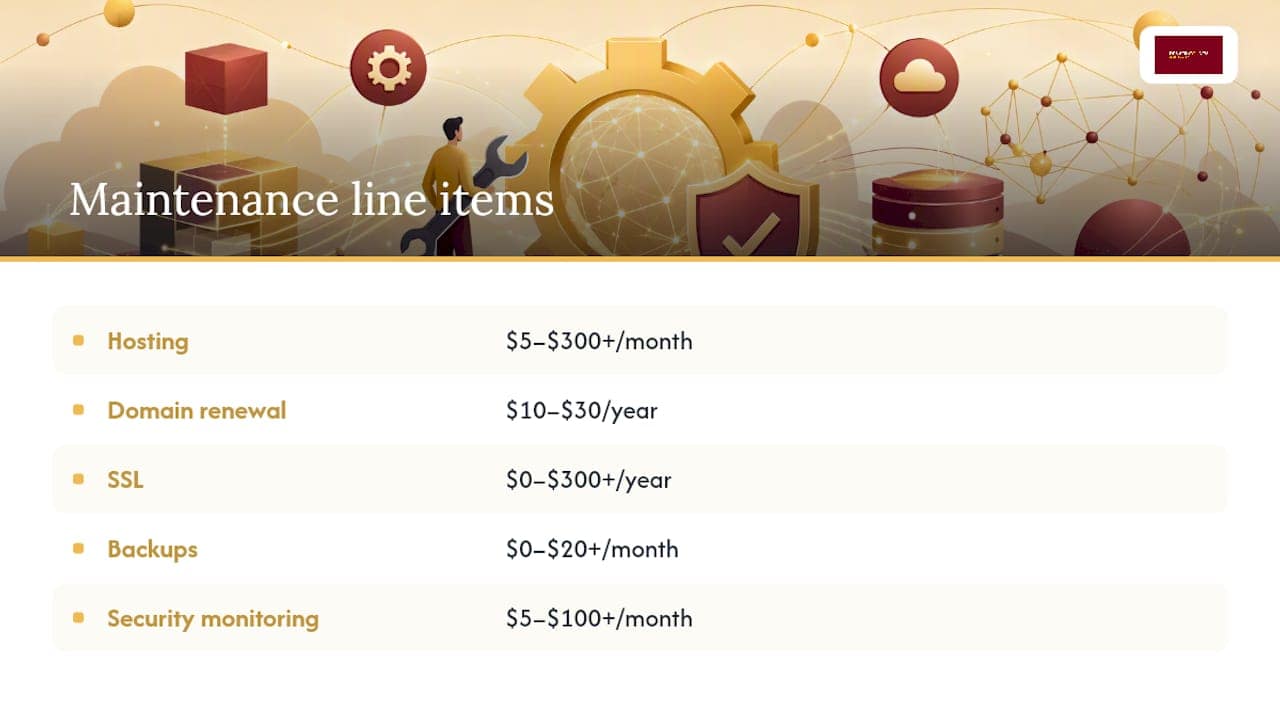
Hosting is usually the biggest recurring line. Shared hosting runs $5 to $25/month, VPS hosting $20 to $100/month, and managed or cloud hosting $50 to $300 or more, depending on traffic and included support. You upgrade hosting tiers when your current plan can’t handle traffic spikes or when uptime starts slipping.
Domain renewal and SSL are the smallest predictable costs. Domain renewal runs $10 to $30 a year. SSL certificates range from free (through Let’s Encrypt or similar automated tools) to $300-plus a year for extended-validation certificates that larger institutions sometimes require.
Backups, security monitoring, and CMS updates form the maintenance core. Automated backups cost $0 to $20-plus a month; security monitoring and malware scanning run $5 to $100-plus a month depending on how aggressive the scanning is. According to industry pricing data, common recurring line items break down as: hosting $5 to $300+, domain $10 to $30/year, SSL $0 to $300+/year, backups $0 to $20+/month, security $5 to $100+/month, and developer support at $50 to $200-plus an hour.
Pro Tip: Ask whether “backups” in your quote includes restore testing. A backup nobody has ever restored is a theory, not a safety net.
Developer time is where budgets get unpredictable. Hourly rates for WordPress developers typically fall between $50 and $200. Retainer clients often pay a flat monthly fee that bundles a set number of hours, which tends to be cheaper than paying hourly every time something breaks.
For stores, add payment gateway fees (usually a percentage per transaction plus a flat fee), PCI compliance costs, and inventory management tool subscriptions. These are on top of the base hosting and security stack, which is why ecommerce sites consistently land in a higher cost bracket than content sites of similar size.
What Do Website Maintenance Pricing Models Actually Include?
Not every “maintenance plan” means the same thing. Three models dominate the market, and confusing one for another is how business owners end up underpaying for coverage they think they have.
- Managed hosting ($25 to $100-plus/month). This is infrastructure, not maintenance. You get server uptime, sometimes automated backups, but rarely content updates, plugin management, or human troubleshooting. Managed hosting typically excludes hands-on support for anything beyond the server layer.
- Maintenance-only care plans ($39 to $359/month). These add plugin and CMS updates, basic security scanning, and a small pool of support hours, but usually exclude major redesigns, new feature builds, or emergency malware cleanup beyond a baseline. Pricing tiers for these plans commonly scale with the number of included hours and response speed.
- Full-service retainers ($435 to $2,190-plus/month). These bundle strategy, content updates, SEO monitoring, and priority developer access. Staging environments and pre-release testing are usually included here, rarely lower down the tier list.
DIY sits outside all three. It costs the least in dollars, roughly nothing beyond hosting, but demands 2 to 8 hours a month of your own time for updates, monitoring, and troubleshooting. That time has a real cost even when no invoice shows up for it. If your hourly value exceeds what a $50/month care plan charges, DIY is usually the more expensive option once you’re honest about the math.
How Do You Build an Annual Website Maintenance Budget?
A workable maintenance budget follows a repeatable four-step method rather than a guess pulled from a competitor’s rate card.
- Classify your site’s complexity and risk. A static portfolio site carries low risk. A store processing daily transactions carries high risk, and the budget should reflect that.
- List your fixed recurring costs. Hosting, domain, SSL, and any subscription tools you already know you’re paying for.
- Estimate retainer or hourly support. Base this on how often you expect updates, content changes, or troubleshooting.
- Add a buffer of 10 to 30% for ad-hoc work. Unplanned incident remediation is the line item almost every owner underestimates.
Sample annual budgets:
- Small business site: $1,200 hosting/security + $2,400 retainer (10 hours/month at $20) + $360 buffer (10%) = $3,960/year
- Ecommerce store: $3,600 hosting/security + $9,600 retainer + $2,640 buffer (20%) = $15,840/year
Lean toward the higher end of that buffer range, 20 to 30%, if your site takes payments, holds customer data, or would cost you real revenue during downtime. A brochure site with no transactions can usually get by on a 10% cushion.
How Do You Choose the Right Maintenance Vendor?
The gap between a good maintenance quote and a bad one usually shows up in what’s not written down. Ask these questions before signing anything:
- What’s the guaranteed response time for a broken site versus a routine update request?
- Do you test backup restores, or just confirm backups ran?
- Is there a staging environment for testing updates before they go live?
- What’s explicitly excluded, redesigns, new features, emergency malware removal?
- Is pricing itemized, or is hosting bundled invisibly into a “maintenance” fee?
Watch for vague language like “unlimited edits” with no definition of what counts as an edit. That phrase almost always has an unwritten ceiling. Insist on a written restore-testing policy. A vendor who backs up your site daily but has never actually restored one hasn’t proven the backup works.
Pro Tip: Calculate what an hour of downtime costs your business in lost leads or sales. If that number exceeds a year of a higher maintenance tier, the upgrade pays for itself the first time something breaks.
What Do Real Website Maintenance Budgets Look Like?
Numbers land differently once they’re attached to a specific kind of site. Here’s how the math plays out across common small-business profiles:
- Brochure site (5 to 10 pages, no transactions): $25/month hosting + $50/month basic care plan = $75/month, $900/year
- Local service business site (contact forms, blog, local SEO): $50/month hosting + $150/month maintenance plan = $200/month, $2,400/year
- Mid-size WooCommerce store (50 to 200 products): $100/month managed hosting + $400/month retainer + payment processing fees = $500+/month, $6,000+/year
- Marketing/lead-gen site (landing pages, ad tracking, CRM integration): $75/month hosting + $300/month retainer = $375/month, $4,500/year
The signal to upgrade tiers is usually traffic growth outpacing your current hosting plan, a second plugin conflict in the same quarter, or adding any feature that touches customer payment or personal data.
Why These Numbers Hold Up
Denver County Web Design builds and supports websites for contractors and home-service businesses across Colorado, plumbers, electricians, landscapers, remodelers, where downtime means missed calls, not just missed page views.
The agency’s model reflects the budgeting logic above: a one-time project fee for the build, full ownership of the finished site with no forced monthly fees, and maintenance retainers offered as an option rather than a requirement. That structure matches what this guide recommends, know your fixed costs, decide what ongoing support you actually need, and avoid paying indefinitely for services bundled into a contract you didn’t ask to negotiate.
What the Pricing Guides Don’t Tell You
Most cost guides hand you a range and stop there, and that’s the part I’d push back on. A $50 to $500 monthly range for small-business sites is technically accurate and practically useless if you don’t know which end you land on. The determining factor isn’t your industry or your site’s age. It’s how much custom code sits between your CMS and your content.
Conventional advice treats maintenance like a subscription decision: pick a tier, pay it, move on. In practice, the businesses that overspend are the ones that never separated hosting cost from labor cost in their own head. They see one invoice and assume it’s all “maintenance,” when half of it is infrastructure they’d pay regardless of who manages the site.
If I had to prioritize one thing from everything above, it’s the buffer. Skip it, and the first plugin conflict or payment gateway hiccup becomes an emergency instead of a line item you already planned for.
— Luis
Ready for a Website That Doesn’t Bleed You Dry Monthly?
Most maintenance conversations start after a business owner realizes they’re paying $200 a month indefinitely for a site they don’t actually own outright. Some web design agencies take a different approach: a custom WordPress build for contractors and home-service businesses, delivered fast, with full ownership and no forced monthly fees baked into the deal.

That distinction matters more than it sounds. When you own your site outright, maintenance becomes a choice, not a condition of keeping your business online. Local SEO, Google Business Profile setup, and Google Ads management may be available as part of some packages, but the foundation stays under client control regardless of retention of additional services. For businesses in the Denver metro area weighing a redesign, the contractor-focused web design service is built specifically around generating booked jobs, not just page views.
If your current site costs more each month than it earns you in leads, request a free site audit and find out exactly where that money is going.
Sources
- How much does it cost to maintain a website in 2026?
- How WordPress maintenance plans actually cost | DreamHost
- Website maintenance cost: Monthly and yearly pricing
FAQ
How Much Should It Cost to Maintain a Website?
Most small-business sites cost $50 to $500 a month to maintain, covering hosting, backups, security monitoring, and periodic updates. Ecommerce sites run higher, typically $300 to $1,000-plus a month, because of payment processing and inventory management needs.
How Much Does It Cost to Hire Someone to Maintain a Website?
Freelance and agency developers typically charge $50 to $200 an hour, while structured maintenance-only care plans run $39 to $359 a month depending on included hours and response times. Full-service retainers with strategy and content support start around $435 a month.
Is $1,500 a Good Price for a Website?
A reasonable starting price for a simple brochure or small business website build is typically in the low thousands, though it usually doesn’t include ongoing maintenance. Many providers structure this as a one-time project fee, with maintenance offered separately as an optional retainer rather than bundled into the build cost.
How Much Should I Pay Someone to Host My Website?
Basic shared hosting runs $5 to $25 a month, VPS hosting $20 to $100 a month, and managed or cloud hosting $50 to $300-plus a month depending on traffic and included support. Hosting is a separate cost from maintenance, so a low hosting bill doesn’t mean your site is fully covered for updates or security.